Luosto and its neighbour Pyhä get mixed up constantly, and the confusion causes real booking mistakes: they are two separate villages, roughly 10km apart by road, sitting on opposite sides of Pyhä-Luosto National Park. Each has its own ski slopes, its own small cluster of hotels and cabins, and its own set of activity operators. A tour or hotel listed simply as “Pyhä-Luosto” does not tell you which village you would actually be based in — always check the specific location before you book anything. This page covers Luosto, the quieter and smaller of the two.
Where Luosto is and how to get there
Luosto sits about 120km from Rovaniemi, which works out to roughly 1h45 by car on a fairly direct road running through or near Sodankylä depending on the route taken. There is no train link, so the practical choices are a rental car, a private transfer booked through your accommodation, or a Matkahuolto bus that typically involves a change. Given the distance and the low frequency of public transport this far north, most visitors either drive themselves or arrange a transfer in advance rather than turning up and hoping to sort out logistics locally.
The village itself is small: one main road, a cluster of hotels and cabin complexes, a handful of restaurants and a ski centre, all within easy walking distance of each other. There is no old town or historic core to see — Luosto exists because of the fell and the national park around it, not because of anything to look at in the village itself.
Luosto village and what it actually offers
Luosto is a fell station in the low-key sense of the word: a base for skiing, hiking and aurora watching rather than a resort with a long list of attractions of its own. The downhill ski area on Luostotunturi has a small number of lifts and runs — nowhere near the scale of Levi, Ylläs, Ruka or Pyhä, and that modesty is exactly what draws some visitors: shorter lift queues, a smaller crowd, and a village you can walk across in ten minutes. Cross-country tracks run from the village into the surrounding forest and fell terrain, maintained through the winter season.
Compared with Pyhä, Luosto tends to feel a notch quieter and slightly more spread out, with accommodation ranging from standard hotel rooms to freestanding cabins in the woods just outside the centre. Neither village is large enough to offer much nightlife; both function as a base for daytime activity and evening aurora watching rather than as destinations to explore for their own sake.
Lampivaara amethyst mine
The best-known reason to visit Luosto specifically is the amethyst mine on Lampivaara fell, a few kilometres from the village centre. In winter, operators run visitors up by snow-track vehicle, a trip of around 20 to 30 minutes each way through forest and open fell; in summer the same route is a signed walking and cycling trail. At the mine you dig for your own stone under guidance and keep what you find, and the surrounding viewpoint gives one of the better outlooks over the national park’s fells.
This page only covers the basics of getting there, because the mine itself — what a visit actually involves, what it costs, how long to allow, what to bring — is covered in full on the Lampivaara amethyst mine page and the matching day trip guide. If the amethyst mine is your main reason for coming to Luosto, read that page before you book anything, since operators and access methods change with the season.
Hiking into the fells
Luosto sits at the edge of Pyhä-Luosto National Park, and several marked trails climb from the village onto the surrounding fells, connecting further into the park toward Pyhä. Trail difficulty ranges from short, well-marked loops near the village to longer routes across open fell terrain that demand proper footwear, layered clothing and, outside summer, daylight planning given how early dusk falls in midwinter.
Rather than duplicate a full trail-by-trail breakdown here, the geology, the marked routes and what the national park protects are covered on the Pyhä-Luosto National Park page — read that before setting out, since it applies to both villages. Nearby, Riisitunturi National Park, known for its snow-laden “ghost trees” (tykky), and the frozen waterfalls of Korouoma canyon are both within a reasonable drive of Luosto and worth combining into a longer stay if hiking and winter landscapes are the priority. Posio, the small town near Korouoma, makes a workable stop on that loop.
Glass igloos and aurora cabins
Luosto has a handful of glass-roofed igloos and cabins built specifically for watching the sky from bed, alongside more conventional cabins with a clear view north. They solve the practical problem of standing outside for hours in the cold, but they come with a real limitation: the glass roof only frames a narrow patch of sky, and nearby site lighting can dull a faint aurora enough that it is easy to miss from indoors. They suit people prioritising comfort and photography set-ups over maximising the chance of a sighting — a distinction worth weighing honestly before paying the premium these rooms usually carry. The trade-offs are covered in more detail in the glass igloo guide.
Northern lights from Luosto
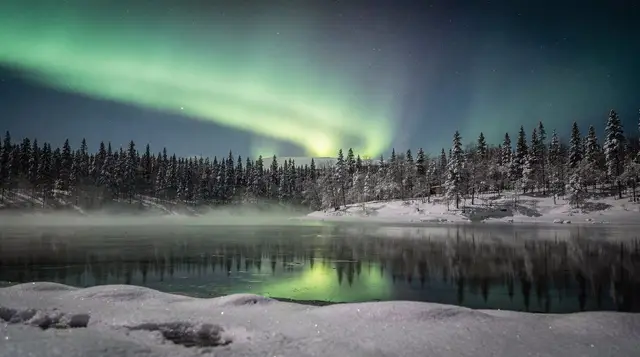
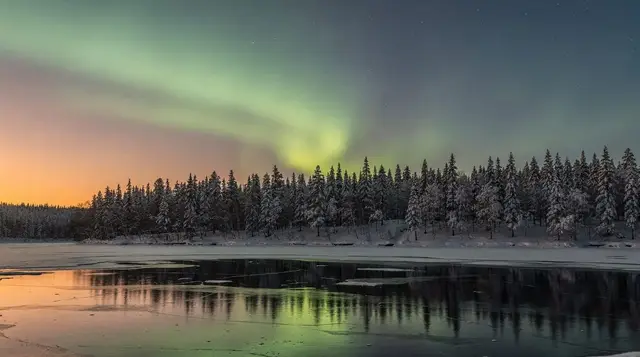
Luosto sits under the same aurora belt as the rest of this part of Lapland, with a season running roughly from late August to early April. Seeing anything on a given night depends on the same two factors everywhere: a clear sky and real darkness, and neither is guaranteed by location alone. Luosto’s low ambient light helps compared with a larger town, but cloud cover — not geography — is what usually decides whether a night produces anything. If you want the general mechanics of forecasting and viewing conditions rather than a Luosto-specific angle, the aurora hunting guide and the month-by-month breakdown both apply here too.
A guided northern lights road trip out of Luosto with photos and snacks included takes the practical route: driving away from local lighting and any cloud toward a clearer patch of sky, which is usually more productive than staying put at the village. For a version that markets itself as guaranteed, an aurora road trip with a guarantee and unlimited kilometres of chasing is worth reading the fine print on: the guarantee covers a refund or a repeat outing if nothing is seen, not the aurora itself.
Other things to do around Luosto
Outside the mine, the trails and the ski slopes, Luosto works as a base for a few other activities. A guided berry-picking outing with a local expert runs in the warmer months, when lingonberries, bilberries and, with luck, cloudberries are in season in the surrounding forest — a low-key way to spend a few hours that also explains Finland’s everyman’s right to forage on unfarmed land.
In winter, a private snowmobile safari to a nearby reindeer farm combines two of the region’s staple activities into one outing, and works well for visitors who only have a day or two in the area and want to cover more than one thing.
Husky sledding is not run directly out of Luosto village; the nearest operator sits over in Pyhätunturi, a short drive away, running trips such as a 5km husky safari including a farm visit. If dog sledding is a priority, it is worth checking pick-up points carefully, since “Pyhä-Luosto” branding on a tour does not tell you which side you would actually be collected from.
How to shape a stay of one or two nights
A short stay in Luosto works best when each day has one main idea rather than a list. Arrive with enough daylight to settle into your cabin or hotel, walk the village once so you know where the ski centre and the restaurants are, and keep the evening free for the sky. The next day can then go to the single thing that brought you: the amethyst mine, a trail onto the fell, or a morning on the slopes. Packing in all three tends to leave you tired and cold rather than satisfied.
If you only have one night, put the aurora first and treat everything else as a bonus. A clear evening is the scarce resource here, so stay flexible: if the forecast looks good, skip the afternoon activity that would leave you exhausted and sleep a little instead. The aurora forecast apps and tools guide explains how to read the conditions, and free northern lights viewing spots is useful for the principle of finding a dark horizon even when you are not on a tour.
With two nights you can afford a slower rhythm. One evening can be spent on a guided outing and the other simply stepping outside from your cabin to look, which is often how the most memorable sightings happen. If you are building a longer trip around several bases, the Rovaniemi 5-day Lapland in depth and northern lights hunting itinerary show how a quiet fell village can fit between busier stops.
Dressing and preparing for the fell
The fells around Luosto are exposed in a way the village is not. A walk that feels easy in the shelter of the trees can turn cold quickly once you climb onto open ground, so dress in layers you can add and remove rather than one heavy coat. The three-layer system explains the logic, and it applies equally to a snow-track ride to the mine and to standing still under the sky at night. Standing still is what makes you cold, not moving, so bring more than you think you need for aurora evenings.
Keep a small daypack with something warm to drink, spare gloves and a charged phone, and tell someone at your accommodation where you are heading if you go out on a trail alone. For anyone new to the Nordic outdoors, everyman’s right is worth reading before you wander into the forest: it explains what you may and may not do on land you do not own, and it is the reason berry picking and walking off the main paths are possible at all.
Eating, resting and slowing down
Because the village is so small, the rhythm of a Luosto day is set by the cabin and the kitchen. Many visitors find this is part of the appeal: after a day outside, there is no pressure to go anywhere. If you are cooking for yourself, the grocery shopping budget tips written for Rovaniemi apply just as well, and the idea of buying supplies in a larger town before you arrive is worth taking seriously. For a taste of local food once you are settled, Lappish cuisine gives the background on what you are likely to see on a menu.
The sauna is the other natural way to end a day here. If you are unsure of the customs, Finnish sauna etiquette covers what to expect so that you can relax rather than worry about doing it wrong.
Choosing Luosto over a bigger base
People usually end up in Luosto because they have decided they do not want a resort. That is a perfectly good reason, but it helps to be honest about what you trade away: fewer restaurants, fewer organised activities on your doorstep, and less choice if the weather turns. If you want more infrastructure, Levi and Ylläs sit on the other side of the spectrum, and the comparison in Rovaniemi versus Levi shows how a town base differs from a fell base. If your priority is culture and a wider choice of things to do in the evening, staying in Rovaniemi and visiting Luosto for a day may serve you better.
Families should think about the same question from the child’s point of view. A quiet village with simple outdoor play suits some children very well and bores others; the family-friendly Lapland itinerary can help you judge whether a small base suits the people travelling with you.
Luosto versus Pyhä at a glance
| Luosto | Pyhä | |
|---|---|---|
| Distance from Rovaniemi | 120km | About 130km |
| Ski area | Small, Luostotunturi | Small, Pyhätunturi |
| Best known for | Amethyst mine, quieter village feel | National park access, fell scenery |
| Village size | Very small | Very small |
| Distance between the two | About 10km by road | About 10km by road |
Both villages share the national park, and a rental car makes it easy to base yourself in one and still visit the other for a day. Without a car, moving between them takes more planning, since public transport between the two is limited.
Where Luosto sits on a wider trip
For most visitors, Luosto is not a stand-alone destination so much as one stop on a longer route through this part of Lapland. It pairs naturally with Sodankylä, roughly on the way back toward Rovaniemi and worth a stop for its 1689 wooden church, or with a longer loop east toward Posio and Korouoma canyon for anyone building a few days around hiking and winter scenery rather than resort activities. Coming from Rovaniemi, allow the better part of a day each way if you are not staying overnight, since the 120km drive is not one to rush, particularly with reindeer on the road and limited daylight for much of the winter.
Practical notes
Luosto has no cash-machine-lined high street or large supermarket — it is a small village built around accommodation and activity operators, and most visitors eat at their hotel or cabin restaurant, or self-cater with supplies brought from a larger town. Prices for food and activities run broadly in line with the rest of rural Finnish Lapland: expect a guided half-day activity to cost in the region of €100 to €200 per person, and a simple restaurant meal €15 to €30. As everywhere in this region, cards are accepted for almost everything, including small purchases, and tipping is not expected.
Winter driving here follows the same rules as the rest of Finland: winter or studded tyres are required through the coldest months, headlights stay on at all times by law, and reindeer cross roads without warning, including at night — slow down rather than swerve or brake hard, and report any collision, which is a legal requirement.