Glass igloos in Lapland: are they worth the money?
Are glass igloos in Lapland worth the price?
They are worth it if what you actually want is warm comfort and an unobstructed view of the sky from bed, not a guarantee of the northern lights. A glass igloo doesn't improve your odds of seeing an aurora over a normal hotel with a clear night sky; it improves your comfort while you wait for one, at a price that usually runs several times a standard room.
What a glass igloo actually is
A glass igloo is a heated room, usually dome-shaped or with a domed section of roof, where the upper panel or the whole ceiling is transparent glass instead of the usual solid roof. You sleep in a normal bed, under a duvet, in a room kept at a comfortable temperature — and you can see the sky directly above you without getting up or getting dressed. That’s the entire pitch, and it’s worth being precise about it before you compare prices, because the marketing photos tend to promise more than the structure does.
Two things get lumped together under “glass igloo” and shouldn’t be. The first is an individual thermal cabin: a small, self-contained unit with its own bathroom, sometimes a kitchenette, sitting apart from its neighbours in the forest. The second is a shared hotel arrangement, where a row or cluster of glass-domed rooms opens off a central lodge, closer together and with less privacy between units.
Kakslauttanen, near Saariselkä, popularised the shared-dome format and is the name most people already have in their head when they picture a glass igloo, but it isn’t the only model, and other properties around Rovaniemi, Levi and Ylläs run their own versions with their own layouts. Don’t assume a feature you read about one property — a private sauna, a specific dome angle, a particular view — applies to another. Check the individual listing.
This page is only about the glass, heated version. Snow hotels and ice hotels are a different concept: structures rebuilt from snow and ice every winter, kept below freezing, where you sleep in a thermal bag on an ice-block bed for one night as a novelty rather than for comfort. If that’s what you’re actually after, the snow and ice hotels guide and the Kemi SnowCastle guide cover that separately — the two get confused constantly, and a traveller who books a snow hotel expecting a warm glass roof, or the reverse, ends up disappointed for a reason that had nothing to do with the northern lights.
The real strengths
The comfort difference between a glass igloo and standing outside on an aurora tour is not subtle. A northern lights minibus tour typically runs four to six hours, mostly outdoors, often from around 8pm to 1am or 2am, in temperatures that can sit anywhere from -10°C to below -25°C in midwinter.
A glass igloo lets you watch the same sky from under a duvet, at room temperature, without a thermal suit, without driving anywhere, and without deciding in advance how long you’re willing to stand around in the cold. For a lot of people — particularly anyone travelling with young children, anyone with mobility limits, or simply anyone who finds four hours in the Arctic dark for a maybe unappealing — that trade is the entire point, and it’s a genuine one.
The unobstructed view matters more than it sounds. A standard hotel room window frames a narrow slice of sky and usually faces a car park, a street light or another building. A glass dome removes the frame and the ceiling both, so if the sky above the property is clear, you see essentially the whole of it, straight up, from a horizontal position that a hotel window simply can’t give you. Combined with dimmed interior lighting and a location chosen to sit away from town, the practical view can be genuinely better than what most in-town accommodation offers, aurora or no aurora.
There’s also a category of demand that has nothing to do with astronomy: the romantic-getaway market. A glass igloo reads, in a single photograph, as an event rather than a room — which is exactly why so many are booked for anniversaries, proposals and honeymoons regardless of the forecast. If that’s the primary reason for the booking, judging the room purely on aurora odds misses what’s actually being bought. It’s fair to want the experience itself, as long as the buyer is clear-eyed that the experience is the room, not a promise about the sky.
a private glass igloo dinner paired with a snowmobile ride packages the warm-comfort side of the experience with an active afternoon or evening outdoors, which suits travellers who want both rather than a static night in.
The real limitations — read this before you book
Condensation is the most common practical complaint, and it’s physics, not a defect. Warm, humid air on the inside of the dome meets cold glass on the outside, and moisture condenses on the inner surface, exactly as it does on a car windscreen. Most properties fit double or triple glazing, some form of low-level heating along the glass edge, or ventilation designed to keep the pane clear, and on an average winter night that’s usually enough.
On the coldest, driest, calmest nights — often the very nights with the clearest skies and the best aurora odds — the temperature differential is largest and a film of condensation or frost can still form on part of the dome, softening or partly blocking the view from directly inside. It isn’t universal and it isn’t every night, but it happens often enough that it shouldn’t come as a surprise.
The second limitation is the one that matters most and gets stated least clearly in marketing copy: a glass igloo does not improve your odds of seeing an aurora. It removes the practical barriers to watching for one — cold, tiredness, the effort of getting dressed and going outside — but the phenomenon itself still depends on geomagnetic activity and, above all, on cloud cover, exactly as it does for someone standing in a field.
On a cloudy night, the dome shows the same grey nothing that a hotel window would. Booking the most expensive room in the region does not buy weather. If the promise attached to a package is “guaranteed northern lights,” read the explainer on what those guarantees actually cover — it’s a refund-or-repeat clause on the tour, never a guarantee of the phenomenon, and the same logic applies here.
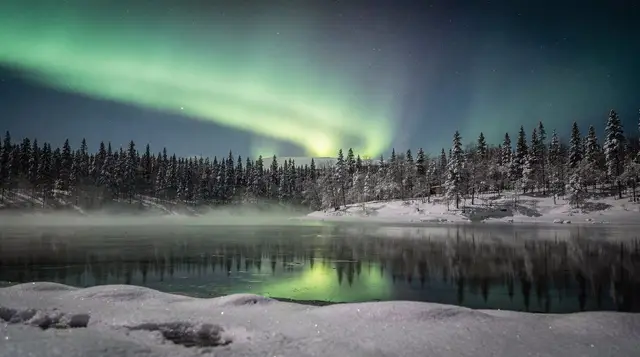
Third, even a fully clear night and a genuinely active aurora often looks less dramatic to the naked eye than the photographs suggest, dome or no dome. Cameras gather light over several seconds and render a saturated green that the eye rarely sees directly; most people watching with their own eyes see a paler, greyish-green band that moves and shifts rather than the vivid curtain in the brochure.
That gap between photograph and eyewitness experience is the single biggest source of disappointment among aurora travellers generally, and a glass igloo doesn’t change it — see the eye vs camera explainer for what to actually expect. If a booking is made purely on the strength of a glass-igloo marketing photo, that photo is doing a lot of the same work a camera sensor does: showing more colour than most guests will see with their own eyes that night.
Fourth: light pollution within the property itself. Shared-dome resorts cluster many units together, often with walkway lighting, other cabins’ interior light spilling out, and sometimes a central lodge nearby. That ambient light doesn’t stop an aurora being visible, but it reduces contrast and can wash out a faint display that would show clearly from a genuinely dark spot. Individual, more isolated thermal cabins tend to do better here, at a price.
Price, set against what it buys
Glass igloos sit at the expensive end of Lapland accommodation, and the gap to a standard hotel room is usually a multiple, not a percentage. Exact nightly rates vary a great deal by property, room category, season and how far ahead you book, so treat the ranges below as a rough sense of scale rather than a quote — check the Rovaniemi trip budget guide for how this fits a wider daily budget, and where to stay in Rovaniemi for how it compares with in-town options.
| Accommodation type | Typical comfort | What drives the price |
|---|---|---|
| Standard hotel room, Rovaniemi centre | Warm, ordinary window | Location, season, hotel standard |
| Individual glass-roof cabin, shared property | Warm, partial sky view, some ambient light | Novelty, view, privacy level |
| Private thermal glass igloo, standalone | Warm, wide sky view, minimal ambient light | Privacy, isolation, often includes dinner |
| Snow or ice hotel room | Near-freezing, thermal sleeping bag | One-night novelty, rebuilt annually |
The honest way to weigh this is to separate two different purchases that get bundled into one price tag: comfort and privacy on one side, and aurora odds on the other. The first is real and reliably delivered — a warm bed under a clear sky, away from most ambient light, is a genuine upgrade over a hotel window regardless of what the sky does that night.
The second is not something any accommodation can sell, glass roof or not; it depends on the same geomagnetic activity and cloud cover as every other viewing method, covered in the month-by-month aurora guide and the aurora forecasting tools guide. If the price is being justified purely by aurora odds, it’s being justified by something the room can’t actually change.
A glass igloo lunch stop built into a full-day Lapland safari is a lower-commitment way to experience the format — a couple of hours inside a dome during daylight, without booking an overnight stay — worth considering for anyone unsure whether the concept is worth a full night’s premium.
Who it actually suits
It suits couples treating the night as an occasion in its own right, not a means to an aurora sighting — the room is the experience. It suits families or groups who want the option of watching from inside without committing to hours outdoors, particularly with small children who can’t be kept out in the cold as long as adults can; see the family activities guide for how that plays against other winter options.
It suits travellers on a short trip who’ve decided that one night of maximum comfort matters more than stretching the budget across several nights elsewhere, and it suits anyone who has already accepted, going in, that the sky might simply not cooperate — which it might not, in any accommodation, on any given night.
It suits less well anyone booking primarily to guarantee a photograph of the aurora from bed, anyone on a tight budget who would rather put the difference toward an extra day or an extra tour, and anyone travelling in June or July expecting a dark sky at all — the midnight sun guide explains why there’s no darkness to see auroras against in that window, though some properties still operate for the novelty of the transparent roof and the surrounding forest rather than for stargazing.
For travellers weighing a glass igloo against active pursuit of the aurora rather than a static wait for it, the two aren’t mutually exclusive on the same trip. An Äkäslompolo reindeer walk that ends with pancakes inside a glass igloo combines a short daytime activity with the format, and staying a night elsewhere — in Levi or Ylläs, both roughly two to two-and-a-half hours from Rovaniemi — spreads the choice between an active tour and a static dome across the same trip rather than forcing one or the other.
The honest verdict
A glass igloo is worth the money if the thing being bought is understood correctly: warm comfort, privacy, and an unobstructed view of whatever sky is actually there, on the night you happen to have. It is not worth the money if it’s bought as an aurora insurance policy, because no accommodation — dome-roofed or otherwise — can deliver a phenomenon that depends on cloud cover and geomagnetic activity outside anyone’s control.
Go in expecting the first and you’re likely to come away satisfied even on a cloudy night, because the room delivers what it actually promises. Go in expecting the second and even a technically successful, aurora-lit night can feel like it undersold itself, because the photograph in the brochure was never really about the room.
Frequently asked questions about glass igloos
Do glass igloos guarantee the northern lights?
No. Nothing does. A glass igloo guarantees you can see the sky from a warm bed if it’s clear; it does not guarantee geomagnetic activity strong enough to produce a visible aurora that night.
Why does the glass dome fog up?
Warm, moist air inside meets cold glass outside, and condensation forms on the inner pane. Most modern igloos use double or triple glazing with heating elements or ventilation to slow this, but it still happens on the coldest, driest nights and can partly block the view.
What’s the difference between a glass igloo and an ice hotel?
A glass igloo is a heated, permanent structure with a transparent dome, kept at a comfortable room temperature year after year. An ice hotel or snow hotel is rebuilt from snow and ice each winter, kept just below freezing, and you sleep in a thermal sleeping bag on an ice bed. They solve different problems and shouldn’t be booked interchangeably.
Are all glass igloos the same?
No. Some are individual thermal cabins with their own bathroom and kitchenette; others are glass-domed rooms inside a shared hotel building, arranged in a row or cluster. Room size, privacy, dome shape and light pollution from neighbouring cabins all vary by property, so check what you’re actually booking.
Is a glass igloo better than an aurora tour for seeing the lights?
They answer different needs. A tour moves you toward clear sky and away from local light and cloud, which usually gives better odds on a given night. A glass igloo keeps you warm and comfortable exactly where you are, which suits people who’d rather not spend four to six hours outdoors after dark. An expedition into the wilderness with a glass igloo lunch stop is one way to combine both approaches on the same day.
How much more does a glass igloo cost than a normal hotel room?
Expect several times the price of a standard Rovaniemi hotel room, particularly in December and around Christmas and New Year. Exact rates vary a lot by property, room type and season, so treat any single figure as a rough guide rather than a quote.
Can you see the aurora from bed even if it’s cloudy?
No. Cloud cover blocks the view regardless of the room you’re in. A glass igloo only helps when the sky above it is clear; on an overcast night the dome shows you the same nothing a hotel window would.
Do glass igloos work in summer, when there’s no darkness?
Some stay open, since the appeal shifts to the midnight sun, the surrounding forest and the novelty of a transparent roof rather than aurora viewing, which needs the dark skies of autumn through early spring.
Ice fishing, ice floating & snow experiences on GetYourGuide
Verified deep-linked GetYourGuide tours. Book through these links and we earn a small commission at no cost to you.
GetYourGuide does not provide a product photo for this activity — the image shows the meeting point, photographed by us.