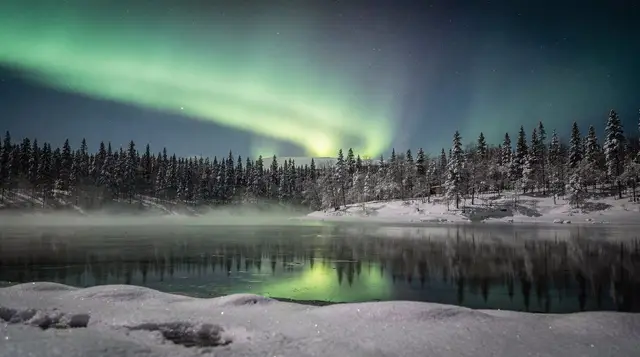
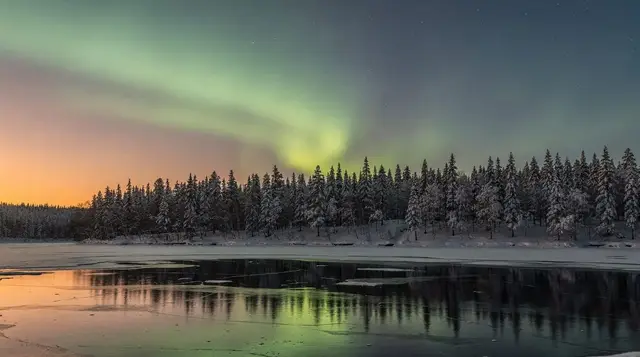
Best time to see the northern lights in Rovaniemi, month by month
What is the best month to see the northern lights in Rovaniemi?
The season runs from late August to early April, because it needs real darkness. September–October and February–March are usually cited as the clearest-sky windows, but no month guarantees a sighting: cloud cover on the night decides more than the calendar does.
Why the calendar matters more than the forecast app
Rovaniemi sits under the auroral oval, so the geomagnetic activity that produces the northern lights is genuinely frequent here through the dark months — locals often quote something like 200 active nights a year. That statistic is real, but it answers the wrong question for most visitors. The question that actually decides your trip is simpler and duller: will the sky over your head be dark enough, and clear enough, on the night you’re there.
This page is about the darkness half of that equation — how it changes from late August to early April, month by month. For the physics of why an aurora happens at all, see how the northern lights actually work. For the cloud-cover half, and what a guided hunt actually involves, see the aurora hunting guide for Rovaniemi.
One thing worth saying plainly before the month-by-month breakdown: no month “produces” more aurorae than another in any meaningful sense. What changes is how many hours of usable darkness each month offers, and, separately and less predictably, how often the sky over Rovaniemi happens to be clear. Treat every claim below as being about darkness and typical weather patterns, not about the phenomenon itself switching on and off.
The season at a glance
| Period | Darkness available | Typical weather note | Season status |
|---|---|---|---|
| Late August | A few hours after 10–11pm | Still mild, ruska colours starting | Season opens |
| September | Proper dark by late evening | Often clear and stable | Strong month |
| October | Dark from early evening | Increasingly cloudy | Reliable but wetter |
| November | Long dark evenings | Frequently overcast | Frustrating for many visitors |
| December | Longest nights, kaamos 2–12 Dec | Statistically the cloudiest month | Peak darkness, peak crowds |
| January | Still very long nights | Cloud cover often persists | Cold, long, mixed skies |
| February | Days visibly lengthening | Skies often clearer than midwinter | Widely favoured |
| March | More daylight, still 12+ dark hours | Often the most stable skies of the year | Widely favoured |
| Early April | Shrinking dark window | Twilight starts eating the night | Season closes |
| June–July | No real darkness | Midnight sun 6 Jun–7 Jul | Not a viewing season |
Late August: the season quietly opens
By the last week or two of August, Rovaniemi’s nights have gone from non-existent to a few genuinely dark hours after 10 or 11pm. Most dedicated aurora tours don’t start running until early September, but a handful of operators and plenty of independent travellers do catch sightings in the final days of August, usually while the ruska autumn colours are still on the trees. It’s a fringe window rather than a headline one: worth knowing about if your trip happens to land here, not worth rearranging a trip around.
September: an underrated month
September is when the season properly starts, and it’s one of the two or three months locals will actually recommend without hedging. Nights are dark enough for a full viewing window well before midnight, temperatures are still mild enough that you’re not fighting the cold on top of everything else, and — this is the part people don’t expect — the weather in early autumn tends to be more settled than in November or December. You get the ruska colours by day and a genuinely dark sky by night. The trade-off is that this is still shoulder season for tour operators, so schedules can be thinner than in peak winter.
October: darker, but the clouds start rolling in
October pushes the dark window earlier still — usable darkness from early evening rather than late night — but this is also where cloud cover starts becoming the dominant variable. Some Octobers are excellent; others are a string of overcast nights. There’s no way to know in advance which kind of October you’ll get, which is exactly why chasing the aurora by car, rather than sitting still, becomes worth understanding: see chasing the lights by car for how that actually works in practice.
November: long nights, short patience
November has plenty of darkness — arguably more useful dark hours per evening than September — but it has a reputation, deserved, as one of the more frustrating months for aurora hunting. Cloud cover tends to be persistent, and the snow hasn’t always properly arrived yet, so the landscape can look flat and grey rather than photogenic even when a display does happen. If your trip is fixed for November, don’t skip the tour, but go in with the expectation that a guide’s job — driving away from cloud, not just away from town lights — matters more here than in almost any other month.
December, and the kaamos in the middle of it
December has the longest nights of the year, which sounds like it should make it the best aurora month. It usually isn’t, and the reason is worth understanding rather than just noting. Roughly from 2 to 12 December, Rovaniemi is in kaamos, the polar night: the sun does not rise above the horizon at all. That doesn’t mean total blackness around the clock — there are typically several hours of blue, dusky half-light around midday — but it does mean darkness is not the limiting factor for aurora viewing during this stretch. Cloud cover is, and December is statistically one of the cloudiest months in Rovaniemi. You have the most dark hours available of any month and, on many nights, a sky too overcast to use any of them.
December is also, obviously, the busiest month in town, driven by Christmas travel rather than by aurora conditions — see Christmas in Rovaniemi and December crowds if that’s part of your planning. None of that changes the sky. A December trip can absolutely deliver a strong display; it can also deliver a week of cloud. Go for Christmas because you want Christmas, not because December is billed as the aurora month — it isn’t, particularly.
a minibus tour that runs most winter evenings out of town, chasing clear patches of sky is the standard way to hedge against a cloudy stretch in your own location: guides watch forecasts and drive to wherever the sky is actually open, sometimes 100–200km from Rovaniemi.
January: cold, dark, and a coin-flip on cloud
January keeps December’s long nights without kaamos itself, and the cold generally deepens — this is when Rovaniemi sees its coldest stretches, sometimes well below -20°C. Darkness is not a limiting factor at any point in January. Cloud cover remains a genuine coin-flip, similar to December, though it tends to improve slightly as the month goes on. A private, flexible tour matters more here than a fixed departure, because the difference between a good and a wasted January night is almost entirely about which direction the guide chooses to drive.
a private aurora tour with your own vehicle and driver gives that flexibility directly, which is worth the premium in a month where the group-bus departure point is fixed hours in advance.
February: where the “best month” reputation starts
February is the first month where you’ll consistently hear Rovaniemi locals and guides use the word “favoured” rather than just “possible.” Daylight is visibly returning — noticeably longer days than December — but there are still comfortably 12 or more dark hours a night, more than enough for a full viewing window. What actually drives February’s reputation is that Rovaniemi’s cloud statistics tend to improve after the turn of the year: more clear or partly clear nights, on average, than the deep midwinter months. It is not a guarantee, and a bad February happens most years somewhere in the season, but if you’re choosing a month with no other constraints, February is a reasonable, evidence-based pick rather than folklore.
March: often the most reliable stretch of the season
March extends February’s advantage. Days are noticeably longer again, snow cover is usually at its best for the season’s other activities, and clear-sky nights tend to be more frequent here than at any other point in the winter. You still get a proper dark window in the evening and overnight, even as sunrise creeps earlier through the month. Many repeat visitors and long-term residents will name March, alongside September, as the month they’d choose if forced to pick just one — again, for the weather pattern, not because the aurora itself is somehow stronger.
an evening aurora hunt from Rovaniemi with a campfire stop while you wait works well in either of these clearer-sky windows, since the format — driving to find open sky, then settling in — depends on cloud gaps existing to find.
Early April: the season closing down
By the first week or two of April, the dark window has shrunk enough that most dedicated tour operators stop running dedicated aurora departures. It’s not a hard cut-off — a strong display is still physically possible on a clear late-March or early-April night — but evening twilight now lasts long enough to eat into prime viewing hours, and by late April, Rovaniemi’s nights are too light to see anything at all. If your trip falls in the first week of April, treat aurora viewing as a bonus rather than the plan, and build the trip around spring activities instead.
Why summer is a hard no, whatever the solar activity is doing
It’s worth stating this directly because it trips people up: from roughly 6 June to 7 July, the sun does not set at all in Rovaniemi, and the weeks either side of that window aren’t much darker. Geomagnetic storms don’t pause for the calendar — the sun can be just as active in July as in December — but an aurora needs a dark sky to be visible against, and Rovaniemi simply doesn’t have one in summer. If you’re travelling between May and August, come for the midnight sun and the outdoor season and leave the aurora hunt for a different trip.
What none of this changes
Whichever month you land in, the same honest caveat applies: nobody can promise you a sighting on a specific night, and any tour marketed as “guaranteed” is guaranteeing a refund or a repeat trip, not a display in the sky — worth reading in full before you book, see guaranteed northern lights tours explained. It’s also worth knowing before you go that what your eyes see is often a faint, moving grey-green band, not the saturated green of a brochure photo — long-exposure cameras render colour the naked eye usually can’t, covered in eye versus camera: what you really see.
If cloud looks likely to sit over Rovaniemi itself on the night you’re there, a guided hunt that can drive toward open sky is generally a better bet than staying put — that’s true in every month above, not just the cloudy ones. For nights when you’d rather not join a bus, there are spots you can reach on foot from town, covered in walking aurora spots near Rovaniemi, and a shortlist of free viewing locations at free northern lights viewing spots.
If you’d rather watch from indoors, a glass igloo trades some flexibility on where you’re looking for warmth, and it’s worth reading what it does and doesn’t guarantee before booking one for this purpose specifically. And whichever month you travel in, a forecasting app is a genuine help for deciding whether to bother going out at all — see aurora forecast apps and tools.
None of that replaces simply building slack into the trip. A single night, in any month on this page, is a gamble. Three or four consecutive dark, clear-adjacent nights in Rovaniemi is how most successful sightings actually happen — not a lucky single evening, but enough tries that the odds catch up with you. For a full-length plan built around exactly that logic, see the northern lights hunting itinerary, and for how the whole year in Finnish Lapland breaks down beyond just the aurora, see Rovaniemi month by month.
Timing your aurora trip: common questions
Which month has the most northern lights in Rovaniemi?
None of them can claim that with a straight face. Geomagnetic activity is fairly constant across the whole dark season; what changes month to month is how many hours of darkness are available and, less predictably, how often the sky stays clear.
Is December a good month for the northern lights?
December has the most darkness of the year, including the kaamos period, but it is also statistically one of the cloudiest months in Rovaniemi. Long nights help; a grey sky cancels them out.
What is kaamos and does it help aurora hunting?
Kaamos is the polar night, when the sun stays below the horizon all day. In Rovaniemi it runs roughly from 2 to 12 December. It gives several hours of blue twilight rather than full blackness, and it doesn’t by itself improve the odds if the sky is overcast.
Why do people say February and March are the best months?
Because Rovaniemi’s cloud statistics tend to improve after the turn of the year, giving more clear nights than December or January. Days are also visibly longer than in December, but there are still 12 or more dark hours a night, which is plenty.
Can you see the northern lights in Rovaniemi in summer?
No. Between roughly 6 June and 7 July the sun does not set at all in Rovaniemi, and even outside that exact window, summer nights are far too light. Solar activity does not stop in summer, but you cannot see an aurora against a bright sky.
When does the northern lights season end in spring?
Most operators stop running dedicated aurora tours in the first week or two of April, once evening twilight starts eating into the dark hours. Late March can still work well; late April generally doesn’t.
Does a full moon ruin the chances of seeing the aurora?
It doesn’t ruin them. A bright moon lightens the background sky and mutes a faint aurora, but a strong display is still visible under a full moon. Cloud cover matters far more than the moon phase.
Is early autumn, like September, worth planning around?
Yes, and it’s often underrated. Nights are properly dark by mid-September, the weather is frequently more stable than in early winter, and it comes with the ruska autumn colours as a bonus rather than a trade-off.
Northern lights tours on GetYourGuide
Verified deep-linked GetYourGuide tours. Book through these links and we earn a small commission at no cost to you.
GetYourGuide does not provide a product photo for this activity — the image shows the meeting point, photographed by us.