Aurora hunting in Rovaniemi: the complete guide
Can you see the northern lights from Rovaniemi?
Yes. Rovaniemi sits under the auroral oval with roughly 200 geomagnetically active nights a year between late August and early April. Nothing is guaranteed on any single night — cloud cover, not solar activity, is usually the deciding factor.
What the northern lights actually are
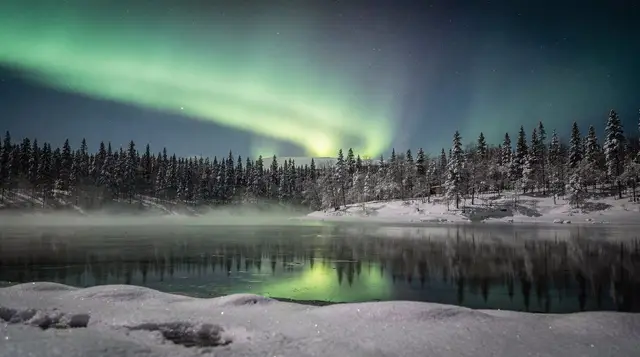
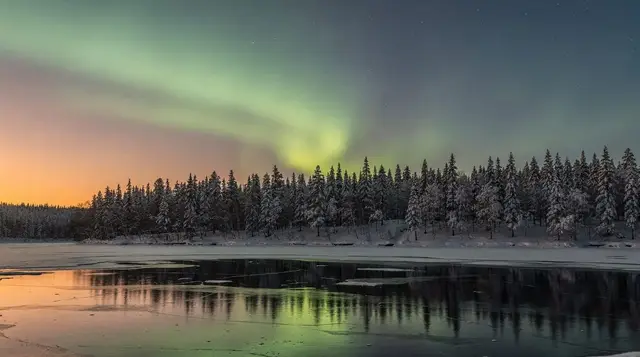
The aurora borealis is sunlight’s cousin, not its opposite: charged particles from the sun hit the earth’s magnetic field and collide with gases high in the atmosphere, and the collisions glow. Green is the most common colour, from oxygen around 100 to 300 km up; pink and purple edges come from nitrogen lower down; a rare, strong storm can push red higher still.
None of that changes what you need on the ground to see it: a dark sky, a clear sky, and some geomagnetic activity happening at the same time. For the mechanics of the KP index, solar wind and why forecasts are only ever short-range, see how the northern lights work — this page stays on the practical side: where, when and how to go looking from Rovaniemi.
Why Rovaniemi is a reasonable base for it
Rovaniemi sits about 8 km south of the Arctic Circle, inside the auroral oval — the band around the pole where activity is statistically most frequent. Operators here commonly cite around 200 geomagnetically active nights a year, and that figure is broadly reasonable for the latitude.
What Rovaniemi does not control is the sky above it: cloud rolling in off the Bothnian coast or the fells can blank out an active night completely, and a hunt built around Rovaniemi is really a hunt for a hole in the clouds, not a hunt for activity itself. The city’s flat surroundings, road network and short flight and train connections make it a workable base for that hunt even when the town’s own streetlights mean you rarely watch from inside it.
The season, honestly
The season runs from late August to early April. Outside that window there isn’t enough darkness for a sky bright enough to hide a faint aurora even during activity. Within the season, three conditions have to line up on the same night: geomagnetic activity, a clear sky, and enough darkness. Only the third is guaranteed by the calendar. The other two are weather, and weather in this part of Finland is genuinely fickle.
| Period | Darkness | Typical cloud | Notes |
|---|---|---|---|
| Late Aug – early Oct | Growing quickly | Moderate, often clearer | Warmer, easier logistics, good early-season odds |
| Oct – Nov | Long nights | Increasingly variable | Snow arrives; roads get harder |
| Dec – Jan (kaamos) | Longest, includes polar night | Cloudiest months of the season | More dark hours don’t offset the extra cloud |
| Feb – Mar | Long, clear more often | Statistically most stable | Widely rated the best viewing window |
| Late Mar – early Apr | Shortening fast | Often clear | Last realistic weeks before the sky stays too bright |
For a fuller month-by-month breakdown with specific pros and cons, see the best time to see the northern lights, month by month. One point worth repeating because it surprises people: December and January, despite the polar night, are the cloudiest months of the season. September, October, February and March consistently outperform them on clear-sky nights.
What decides a given night
Three things, and only three: darkness (the calendar decides this, not you), clear sky (weather forecasts a day or two out are the honest limit of predictability), and geomagnetic activity (the KP index and solar wind data, refreshed every few minutes, tell you roughly how strong a display might be if the sky is clear enough to show it). None of the three substitutes for the others. A KP 6 storm behind total cloud cover shows you nothing. A perfectly clear sky with quiet geomagnetic conditions might show you nothing too, or might show you a faint band low on the northern horizon. The full explanation of what the index measures and how to read it sits in how the northern lights work.
Guided tour or your own car
Most visitors chase the aurora by minibus, driven 100 to 200 km away from Rovaniemi’s own light dome and toward whichever direction the cloud forecast looks clearest that night. A typical tour runs 4 to 6 hours, often 8pm to 1am or 2am, with a campfire stop and a hot drink while the group waits and watches. Driving yourself gives you flexibility to chase a clear patch on short notice, at the cost of navigating unlit rural roads in winter and watching for reindeer on your own. The trade-offs of each approach — cost, flexibility, what a rental car adds and where it falls short — are set out in chasing the lights by car.
Beyond the standard minibus format, several activity-based variants exist:
- Snowmobile-based hunts, covered in snowmobile northern lights tours
- Husky or reindeer sled hunts, covered in husky and reindeer sled aurora tours
- Spots you can walk to from central Rovaniemi on a clear night, covered in walking aurora spots near Rovaniemi
- Watching from a heated glass roof, covered in glass igloo northern lights
A guided minibus hunt with local knowledge of that night’s cloud gaps is the most common starting point, and it’s worth booking one for at least part of a multi-night stay:
a guided aurora-hunting minibus trip with a local guide chasing that night’s clear skyA smaller-group version aimed at travellers who want more input into where the guide drives and why is sold as an insider-style aurora hunt in a smaller group.
”Guaranteed” tours: what the word actually covers
Several operators sell “guaranteed” northern lights tours. Read the small print rather than the headline: what’s guaranteed is a free repeat trip, or occasionally a refund, if the group sees nothing on the booked night. No operator can guarantee that a natural phenomenon will occur and that the sky above a specific patch of Lapland will stay clear for it. Treat “guaranteed” as a booking-risk feature — it protects your money and your time, not the outcome of a single evening. The full mechanics of how these guarantees typically work, and what counts as “seeing” the aurora for the purposes of a refund, are in guaranteed northern lights tours explained.
Free viewing, without booking anything
You don’t have to pay to try. On a genuinely clear, active night, a strong aurora can be visible from dark ground within or just outside Rovaniemi, away from streetlights — the riverbank near the Arktikum, the open ground around Ounasvaara, or a short walk out of the centre. A free viewing attempt won’t get you the 100 to 200 km of cloud-dodging that a guided tour offers, so it works best on nights when the forecast already looks clear over the whole region. A shortlist of specific free spots, and honest notes on what each one actually offers, is in free northern lights viewing spots and walking aurora spots near Rovaniemi.
Glass igloos: comfort, not a guarantee
Glass-roofed cabins, sold as a stay-in-bed way to watch for the aurora, are a genuine comfort upgrade over standing outside at -20°C. They are not a visibility upgrade. Site lighting, roof orientation, tree cover and the simple fact that you’re watching through glass rather than open sky all limit what you’ll actually see compared with standing in an open, dark field. Book one for the stay, not as a substitute for an active night out under open sky. The trade-offs are covered in glass igloo northern lights.
Forecasts and apps
A handful of apps and websites publish short-range KP index forecasts, solar wind data and cloud cover maps, usually reliable a day or two out and much less reliable beyond that. None of them can tell you three days in advance whether Tuesday night will be clear over Rovaniemi. Use them to decide which of your available nights to prioritise once you’re already there, not to plan a trip around a single predicted night before you’ve even booked flights. A rundown of which tools are actually useful, and which numbers on them matter, is in aurora forecast apps and tools.
What you’ll actually see: eye versus camera
This is the single biggest source of disappointment on aurora tours, so it’s worth stating plainly: most of what you see with the naked eye on a typical active night is a pale grey or faint green band, moving slowly, sometimes barely distinguishable from thin cloud until it shifts. A camera on a long exposure gathers far more light than your eye does and renders that same band as a saturated, vivid green — which is what every brochure photo shows.
The photos aren’t staged or dishonest. They simply show something your eyes, on their own, usually don’t. A strong storm is a different experience entirely — visible colour, movement you can follow without a lens — but those nights are the exception, not the baseline. The full comparison, with examples of what a weak, moderate and strong display each actually look like to the eye, is in eye vs camera: what you really see.
Photographing it
If you’re bringing a camera, three things matter more than gear: a tripod, a wide, fast lens, and knowing your settings before you’re standing in the cold trying to find them by torchlight. Photographing the northern lights on a DSLR and camera settings for auroras cover exposure, ISO and focus in detail. If a phone is what you’ve got, modern night modes handle a moderate aurora better than most people expect — see photographing the northern lights on a smartphone. For anyone who wants a guide handling the camera settings while they focus on the sky:
an aurora hunting trip built around photography, with a guide setting up camera shots for youBuilding a hunt around other activities
An aurora hunt doesn’t have to be a stand-alone evening. Many visitors pair daytime activity in the fells or forest with an aurora attempt after dark once genuine darkness returns. A daytime snowmobile run out into open, unlit country doubles as useful reconnaissance for where the sky looks clearest that evening:
a guided snowmobile ride out into open wilderness terrainAnd for the daylight hours in Rovaniemi itself between hunts, a guided walk covering the town’s Alvar Aalto reconstruction and the riverside is a low-key way to fill an afternoon without using up energy you’ll want later that night.
Putting a realistic plan together
Book more than one attempt if the trip allows it. A single night, however good the forecast looks a week out, is close to a coin flip once local cloud is factored in. Three or four nights, ideally spread across the stay rather than back to back, give a genuine chance for cloud cover to break at least once. Mix a guided hunt — for the local knowledge of where the sky is clearing that night — with at least one free attempt from a dark spot near town, and check a short-range forecast each afternoon rather than trusting a forecast made before you left home. None of this converts a maybe into a guarantee. It converts a single roll of the dice into three or four.
Aurora hunting near Rovaniemi at a glance
| Approach | Typical duration | What it adds | What it doesn’t do |
|---|---|---|---|
| Guided minibus hunt | 4–6 hours | Local knowledge of where cloud is clearing | Guarantee a sighting |
| Self-drive | Flexible | Freedom to chase a clear patch fast | Remove winter driving risk |
| Snowmobile hunt | 3–5 hours | Daytime activity plus evening viewing | Suit non-drivers without a licence for solo riding |
| Glass igloo | Overnight | Comfort, no need to stand in the cold | Improve odds of visibility |
| Free viewing near town | As long as you like | Zero cost | Match the cloud-dodging range of a tour |
Northern lights in Rovaniemi: your questions answered
Can I see the northern lights in Rovaniemi in September?
Yes. Late August to early October is one of the more reliable windows: nights are dark enough and the sky is statistically less cloudy than in December. You still need a clear night and some geomagnetic activity.
Is a “guaranteed” northern lights tour actually guaranteed?
No tour can guarantee a natural phenomenon. “Guaranteed” tours promise a free repeat trip or a refund if you see nothing, not that you will see an aurora on the night you book.
What’s the best month to see the aurora in Rovaniemi?
September, October, February and March tend to have clearer, more stable skies than December and January, which are the cloudiest months of the season despite the long darkness.
Do I need to leave the city to see the northern lights?
You improve your odds by getting away from streetlights and cloud pockets, but a strong display is sometimes visible from dark spots inside Rovaniemi itself, such as the riverbank near the Arktikum.
Why does my aurora photo look brighter and greener than what I saw?
A camera sensor on a long exposure gathers more light than the human eye and renders faint grey or pale green movement as saturated green. Brochure photos aren’t fake, but they don’t match what most visitors see with the naked eye.
Does a full moon ruin the northern lights?
No. A full moon brightens the sky and can wash out a weak aurora, but a strong display is still clearly visible. It doesn’t stop a hunt, and moonlight can make the landscape easier to photograph.
What’s the kaamos and does it help aurora viewing?
Kaamos is the polar night, roughly 2 to 12 December in Rovaniemi, when the sun stays below the horizon all day. It gives more dark hours to try, but December is also one of the cloudiest months, so it doesn’t automatically mean better viewing.
How many nights should I plan for to have a realistic chance?
Three to four nights gives cloud cover a real chance to break at least once. A single night is a coin flip regardless of how good the forecast looks.
Northern lights tours on GetYourGuide
Verified deep-linked GetYourGuide tours. Book through these links and we earn a small commission at no cost to you.
GetYourGuide does not provide a product photo for this activity — the image shows the meeting point, photographed by us.