A rebuilt town, not an old one
Rovaniemi is the administrative capital of Finnish Lapland, a town of around 64,000 people sitting at the confluence of the Kemijoki river and the Ounasjoki. It is worth being honest about what that means before you arrive with the wrong picture in mind: this is not a historic Arctic village and it is not a ski resort. It is a small, flat service town with a compact, grid-planned centre you can walk end to end in about fifteen minutes, and its role in your trip is almost entirely as a base — for the Arctic Circle, for aurora hunts, and for huskies, reindeer and snowmobiles.
The reason the centre feels plain rather than picturesque is specific: in October 1944, retreating German forces destroyed more than 90% of Rovaniemi during the Lapland War. The town was rebuilt from the ground up, and the reconstruction plan came from the Finnish architect Alvar Aalto, whose street layout famously forms the shape of a reindeer’s head when seen from above — the stadium and surrounding roads forming the antlers.
It is a genuinely interesting piece of planning history, covered properly in our guide to Rovaniemi’s 1944 reconstruction and in the wider guide to Alvar Aalto’s architecture around town. What it means on the ground is post-war Nordic functionalism, not a historic old town — so don’t come expecting cobbled streets.
Two bridges bookend the town centre’s river views: the Lumberjack’s Candle Bridge, named for its flame-shaped pylon, closes the view south, with the older Ounaskoski bridge nearby. Neither takes long to see, and both are best folded into a walk rather than treated as destinations in themselves.
Where everything actually is
Rovaniemi’s own sights are modest and quick: the Arktikum museum, under its long glass roof reaching towards the Kemijoki, is genuinely the best introduction to Lapland’s history, the 1944 war and Sámi culture, and is worth a full two hours — see our Arktikum visiting guide for the practical detail. Pilke Science Centre shares the building next door and leans towards families with younger children, while Korundi House of Culture, a contemporary art museum in a former bus depot, suits a quieter afternoon.
Across the river, Ounasvaara is the hill everyone in Rovaniemi can see from town — short ski slopes, walking trails and a viewpoint reachable on foot from the centre. It’s a pleasant half-day, but it is not an Arctic fell: at 204m it’s a local hill, not the wilderness scenery you’ll find further north around Pyhä-Luosto or Levi.
The two names most visitors actually come for sit north of town, and this page deliberately doesn’t try to describe them in full — that’s what their own pages are for. Santa Claus Village, about 8km north (bus 8, roughly 25 minutes), straddles the Arctic Circle line itself: entry is free, it’s open year-round, and you pay for activities, the Santa photo and the certificate for crossing the line.
It is a commercial park with shops and cafes, and it’s worth knowing that going in. SantaPark is a separate, paid attraction in a rock cavern about 2km further on, open on a seasonal schedule — read the individual guides before you plan around either one, particularly if you’re travelling with children: see meeting Santa Claus, what it actually costs and the SantaPark guide.
Getting to Rovaniemi, and around once you’re here
Rovaniemi Airport (RVN), about 10km north of the centre, is the busiest airport in Lapland, with Finnair and Norwegian flying from Helsinki in around 1h25, plus seasonal direct flights from several European cities in December. Bus 8 and airport shuttles run into town; full detail is in our airport transfer guide.
The other classic route is the VR night train from Helsinki, around 12 hours, with sleeper cabins, some with their own shower, and — usefully — a car-carrying wagon if you want your own vehicle waiting for you up north. It’s often the most comfortable and, in a shared cabin, the cheapest way to arrive; see the night train guide for booking specifics. Matkahuolto buses connect Rovaniemi to the rest of Lapland, useful for reaching Ranua, Kemi or Saariselkä without a car, though services aren’t frequent.
Within town, bus 8 is the one line every visitor ends up using, running station–centre–Santa Claus Village. A rental car mostly matters for independent day trips: it requires winter or studded tyres by law through the winter months, a parking-post power outlet for the engine heater below about -15°C, headlights on at all times year-round, and real caution around reindeer and elk, which cross roads including at night. Our getting around and winter driving guides cover both options in more depth.
The northern lights, honestly
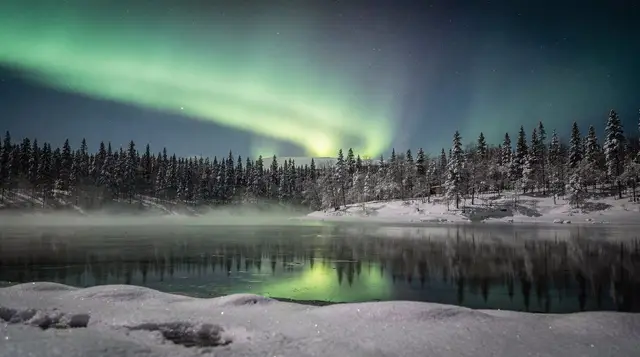
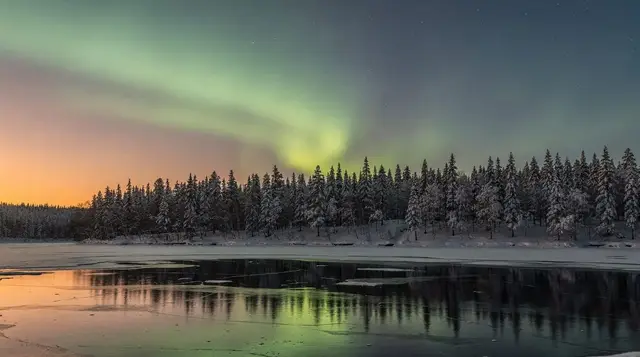
Aurora hunting is the reason most people choose Rovaniemi over anywhere else in Finland, and it deserves a straight answer rather than a brochure one. The town sits under an active auroral zone, and geomagnetic activity is genuinely frequent here — roughly 200 active nights a year is the commonly quoted figure.
But activity alone doesn’t show you anything: you also need a clear sky and real darkness at the same time, and cloud cover over Lapland is the unpredictable part of that equation, not the aurora itself. No tour, hotel or glass igloo can guarantee a sighting. “Guaranteed” aurora tours guarantee a refund or a repeat trip if nothing appears — they do not, and cannot, guarantee the phenomenon. Say that to yourself before you book anything.
It’s also worth knowing what you’ll actually see: to the naked eye, an aurora is often a pale green or grey band moving slowly across the sky, not the saturated green of a long-exposure photograph. That gap between the brochure image and what most people actually witness is the single biggest cause of disappointment among visitors — our eye versus camera guide explains why, and how to adjust your expectations before you go.
A standard aurora tour gets you away from Rovaniemi’s cloud cover and light pollution by minibus, sometimes 100-200km out, usually running four to six hours through the evening with a campfire and a hot drink along the way. September-October and February-March tend to have more stable, clearer skies than December-January, which are statistically the cloudiest months of the season — worth factoring in if your dates are flexible. Full seasonal detail is in best time for northern lights, month by month, and the complete planning guide is at aurora hunting from Rovaniemi.
a minibus aurora hunt out of Rovaniemi’s light pollution is the standard way to try, typically running an evening into the small hours with a fire and hot drinks along the way.
Booking the big activities from Rovaniemi
The activities that draw people north are bookable directly from Rovaniemi, and this page is deliberately not the place for the full detail on any one of them — each has its own guide. In outline: husky sledding comes as either riding as a passenger or driving your own team (usually from age 16-18, with an adult in the sled), and it’s genuinely colder than walking, because you aren’t moving. A short taster run, a couple of kilometres, is a fine introduction; 10-20km starts to feel like a proper trip. If dog welfare matters to you — and it’s worth asking about — good questions for any farm are group sizes, rest schedules, what happens to retired dogs, and whether they operate year-round.
visiting a husky farm to meet the dogs without sledding is a lower-key alternative if you want the animals without the ride.
Reindeer are farmed animals, not wild ones, and reindeer husbandry is a Sámi livelihood managed through herding cooperatives — worth remembering when a sleigh ride is marketed as a novelty. A reindeer sleigh moves slowly, 3-6km/h, and rides are short; some farms hand out a “reindeer driving licence” as a souvenir, not a credential.
a walk among reindeer at a working farm near Rovaniemi is a calmer way to spend time with them than a short sleigh ride.
Snowmobiling requires a full car driving licence to drive yourself (usually 18 and over); without one, you ride as a passenger. Most prices assume two people sharing a machine, and driving solo usually costs a supplement. Alcohol before driving is against the rules, exactly as it would be in a car.
a night snowmobile ride from Rovaniemi combines the drive with a chance at the aurora if the sky cooperates.
For the full picture on any of these — welfare questions, age limits, what a session actually costs — see husky sledding, reindeer sleigh rides and the snowmobile safari guide.
How many days you need, and when to come
Three to five days covers Rovaniemi properly: a day for the town centre and Arktikum, one or two for aurora and husky or reindeer activities, and a day for a trip further out — Ranua’s wildlife park or Kemi’s icebreaker and SnowCastle are the two most popular. If your schedule is tighter, our two-day and three-day itineraries lay out realistic versions of both. The days-needed guide and trip budget guide go further into the trade-offs.
Season matters more here than almost anywhere else in this guide. Late August through early April gives you darkness for the aurora and, from around late October, reliable snow; September-October and February-March tend to bring clearer, less cloudy skies than the December-January peak. December itself is by far the busiest and most expensive period, driven by Christmas travel to Santa Claus Village — see December crowds in Rovaniemi before committing to those dates.
Early June to early July brings the midnight sun and a completely different, ice-free version of the region, covered in Rovaniemi’s summer and midnight sun. Whatever month you choose, book winter activities in warm layers rather than buying gear you won’t use again — most operators lend a thermal suit, boots and mittens as standard, detailed in what to pack.
Frequently asked questions about visiting Rovaniemi
Is Rovaniemi an old town worth wandering around?
No. More than 90% of it was destroyed in October 1944 and rebuilt afterwards, so the centre is a plain, functional grid rather than a historic old town. You can walk the whole centre in about 15 minutes; the real reasons to come are the activities and the surrounding region, not the streets themselves.
Is Rovaniemi actually in the Arctic Circle?
The town itself sits about 8km south of the Arctic Circle line. The line itself is marked at Santa Claus Village, a short bus ride north, where you can stand on it and get a certificate for crossing it.
Will I definitely see the northern lights in Rovaniemi?
No tour or hotel can guarantee that, whatever the marketing says. Rovaniemi sits under an active aurora zone with roughly 200 geomagnetically active nights a year, but you also need clear sky and darkness at the same time, and cloud cover is the unpredictable part. “Guaranteed” tours refund or repeat the trip if nothing appears; they do not guarantee the aurora itself.
How many days should I spend in Rovaniemi?
Most visitors do well with three to five days: one for the town centre and Arktikum, one or two for aurora and husky or reindeer activities, and a day for a trip further out, to Ranua or Kemi for example. Two days is workable if you are only after one or two activities.
How do I get from the airport into Rovaniemi?
Rovaniemi Airport (RVN) is about 10km north of the centre. Bus 8 and airport shuttle services run into town in roughly 20 minutes, and taxis are readily available.
Do I need a rental car in Rovaniemi?
Not necessarily. Bus 8 covers the centre, the airport and Santa Claus Village, and most aurora, husky and snowmobile tours include hotel pickup. A car mainly helps for independent day trips further into Lapland, and requires winter tyres and confidence driving in snow and darkness.
What’s the difference between Santa Claus Village and SantaPark?
Santa Claus Village is a free-to-enter commercial park on the Arctic Circle line, with shops, cafes and paid activities including photos with Santa. SantaPark is a separate, paying attraction in a rock cavern about 2km away, open on a seasonal schedule.
Is Rovaniemi expensive?
Finland is generally expensive, and December pushes accommodation prices up sharply. A half-day guided activity typically runs EUR 100-200 per person; restaurants are few and pricey, so many visitors use supermarkets to control the budget.