A village on a lake, not a resort in the hills
Posio sits around 170km southeast of Rovaniemi, on the shore of Lake Livojärvi, in a stretch of eastern Finnish Lapland that most itineraries skip entirely. It is not a ski resort, not a fell station, and not built for tourism in the way Levi or Pyhä are. It is a working municipality of a few thousand people, with a school, a church, a handful of shops, and a landscape of low wooded hills wrapped around lake water.
What brings visitors here is mostly what lies around it. Posio is the practical base for Riisitunturi National Park, known for the snow-laden trees that form on its ridges in winter, and for Korouoma Canyon, a 30km gorge whose walls carry frozen waterfalls between roughly December and April. Both have their own dedicated pages with trail details, distances and seasonal conditions; this page covers the village itself, how to get there, where to stay, and what kind of trip Posio actually offers once you are not out on those trails.
Getting to Posio from Rovaniemi
The drive from Rovaniemi to Posio covers about 170km and takes around 2 hours 15 minutes on paved roads, running broadly southeast through the Kemijärvi area before turning east. There is no train to Posio and no regular direct bus route from Rovaniemi; the connections that exist run through Matkahuolto with limited frequency, which makes them impractical for anything but a very flexible schedule. In practice, almost everyone reaches Posio either in a rental car or on a guided day tour or multi-day itinerary that includes transport.
Self-driving is straightforward in daylight but demands the same caution as any rural Lapland road: winter tyres are mandatory in the cold months, headlights stay on year-round by law, and reindeer and elk cross without warning, including after dark. See driving in Lapland: reindeer and ice roads before renting. Fuel up before leaving Rovaniemi or Kemijärvi, since options thin out east of there, and check road conditions in advance if you are travelling in the depths of winter, when a fresh snowfall can slow the final stretch into the village.
Lake Livojärvi and the village centre
The village of Posio is built around Lake Livojärvi, and that lake shapes the whole atmosphere of the place. Instead of a fell towering over the settlement, the land here rises gently into a ring of forested hills, and a handful of viewpoints along them give open views back across the water rather than across a mountain valley. It is a quieter, flatter kind of scenery than the fell country further north around Pyhä-Luosto National Park, and it is worth arriving with that expectation rather than picturing dramatic peaks.
The centre itself is small: a main road, a church, a few shops and cafés, a health centre, and services aimed at the surrounding rural municipality as much as at visitors. There is no pedestrian old town to wander and no cluster of tourist shops. What there is, is genuine rural Lapland life, at a scale where you notice individual houses and boats pulled up on the shore rather than a purpose-built resort street. In summer the lake is used for swimming and fishing; in winter it freezes solid and becomes part of the local network of snowmobile and ski routes.
If you have a spare hour, a short walk up to one of the wooded viewpoints above the village gives a decent orientation of the area — Lake Livojärvi below, forest in every direction, and on a clear evening a genuinely dark sky once the last light has gone, which matters more here than the scenery itself.
Where to stay in Posio
Accommodation in Posio is limited and mostly small-scale: a village guesthouse or two, self-catering holiday cottages around the lake shore, and a scattering of farm stays in the surrounding countryside. Closer to Riisitunturi, a small number of cabins put you nearer the national park entrance at the cost of being further from the village’s shops and services. None of this compares in scale to accommodation around Rovaniemi — see where to stay in Rovaniemi for that comparison — and that is by design: Posio is a stopover and a base, not a resort with hundreds of beds.
Because capacity is genuinely small, booking ahead matters more here than in bigger towns, particularly from December through March when demand for anything near Riisitunturi or Korouoma rises sharply. A cottage with its own sauna and lake or forest views is the typical booking; expect fewer amenities than a Rovaniemi hotel and more quiet.
Riisitunturi National Park: what Posio is the gateway to
Riisitunturi National Park lies a short drive from the village and is the reason many visitors come to Posio at all. The park is known above all for the phenomenon of trees bent and coated under heavy snow load in winter, and its trail network, distances, access points and seasonal conditions are covered in full on the Riisitunturi National Park destination page and in the dedicated guide to Riisitunturi’s snow-laden trees. This page will not repeat that trail detail — the two areas have different terrain, different access points and different practical advice, and mixing them causes exactly the kind of confusion this guide is meant to avoid.
What matters here is Posio’s role as the base: it is the nearest village with beds, food and fuel, and most visitors stay in or near Posio the night before or after a Riisitunturi hike or a guided outing such as a 10km husky ride through the park followed by lunch. If you are planning a multi-stop trip that also covers the wider fell region, the Pyhä-Luosto day trip guide is a useful companion for sequencing.
Korouoma Canyon: what Posio is the gateway to
Korouoma is a roughly 30km canyon whose walls host frozen waterfalls in winter and rewarding hiking in the warmer months; the full trail breakdown, distances and difficulty live on the Korouoma Canyon destination page and in the frozen waterfalls of Korouoma guide, with day-trip logistics covered separately in the Korouoma Canyon day trip guide. As with Riisitunturi, this page deliberately stops short of describing the canyon’s trails — that level of detail belongs on Korouoma’s own page, not folded into a village guide where it would get lost or duplicated inconsistently.
From Posio, Korouoma is close enough to visit as a half-day or full-day outing, whether independently or on a guided walk such as a guided hike out to the frozen waterfalls. Posio’s role again is practical rather than scenic: fuel, food, and a bed within a short drive of the canyon entrance, rather than a competing attraction in its own right.
Northern lights from Posio
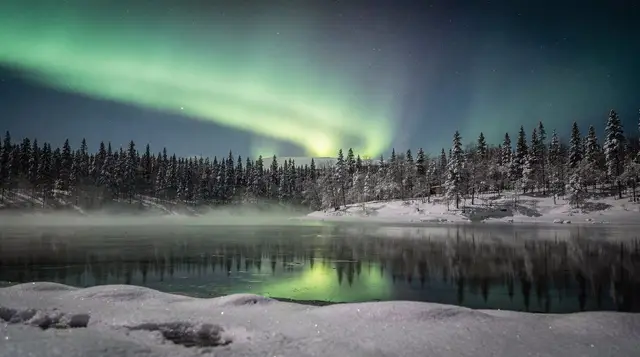
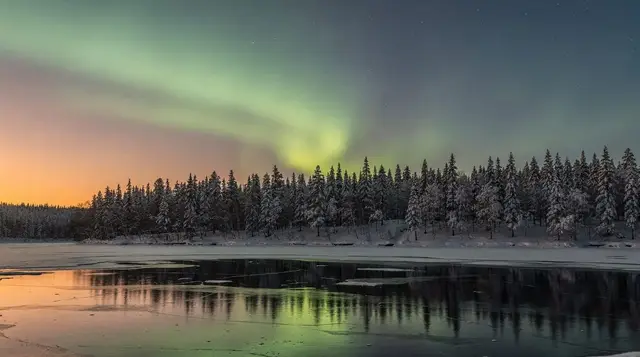
Posio sits well within the aurora belt that covers all of Finnish Lapland, and being a small village rather than a town, it has noticeably less light pollution than central Rovaniemi. That helps on a clear night, since less ambient light makes a faint aurora easier to pick out. It does not change the underlying physics: seeing the northern lights from Posio, exactly as anywhere else, still depends on geomagnetic activity lining up with a clear sky, and no operator can guarantee the phenomenon itself.
See how the northern lights actually work and the best months for northern lights, month by month for the wider picture, and read what your eyes actually see versus a camera before comparing your own experience to a brochure photo.
Because the village is small and surrounded by open lake and forest, a short walk from most accommodation is often enough to get away from the little artificial light there is. Guided options exist too, including a private aurora hunt with a campfire set up away from the village — useful on a night when you would rather not stand around in the cold on your own, or when cloud cover means a guide’s local knowledge of clearer patches is worth paying for. For general background on the wider Rovaniemi aurora scene, the Rovaniemi aurora-hunting guide covers the tour formats and realistic expectations that apply here too.
Eating and everyday practicalities
Posio’s dining options are limited to a small number of restaurants and cafés in the village centre, plus whatever kitchen comes with your cottage or guesthouse — self-catering is common and often the more practical choice given how few restaurants there are. A small grocery store covers basics; stock up in Rovaniemi or Kemijärvi if you have particular needs, since selection in Posio itself is narrow. Cards are accepted everywhere, cash is barely needed, and English is spoken at the businesses that deal with visitors, though less universally than in central Rovaniemi given how few tourists pass through on an average day.
There is no pharmacy of any size and limited medical services beyond the local health centre, so bring what you need for a few days rather than expecting to restock locally. Mobile coverage is generally reliable in the village and along the main roads, but can drop out on quieter forest tracks near Riisitunturi or Korouoma.
Posio at a glance
| Distance from Rovaniemi | 170km, around 2h15 by car |
| Getting there | Self-drive or guided tour; no train, limited bus service |
| Daily budget | €90-180 per person |
| Accommodation | Guesthouses, lakeside cottages, farm stays; book ahead in winter |
| Main draws nearby | Riisitunturi National Park, Korouoma Canyon |
| Best season | Late August to March |
| Recommended stay | 1-2 nights |
When to visit Posio
Late August through March covers the two seasons that draw most visitors: the aurora season begins as the nights darken from late August, and the frozen waterfalls at Korouoma typically form from around December and hold through into April, weather depending. February and March add the snow-laden trees at Riisitunturi to the list, on top of reliably cold, often clearer skies than December brings. This overlaps with the wider pattern across the region — see autumn colours (ruska) in Lapland for the season just before the snow arrives, when the hills around Lake Livojärvi turn before the first proper snowfall.
Summer suits a different trip: long daylight, hiking without snow gear, and the lake itself open for swimming or fishing, in line with Finland’s right to roam, which applies here as everywhere in the countryside. There is no strong reason to visit Posio in isolation outside these windows — the village’s appeal is tied closely to what is happening in the landscape and parks around it, not to standalone village attractions.
Posio frequently asked questions
How far is Posio from Rovaniemi?
Around 170km by road, which takes roughly 2 hours 15 minutes to drive. There is no direct train, and bus connections are infrequent, so most visitors arrive by rental car or as part of a guided tour.
Is Posio a ski resort like Levi or Pyhä?
No. Posio is a working rural village with no downhill ski centre of its own. Its terrain is low wooded hills around Lake Livojärvi, not the fells that Levi, Ylläs or Pyhä are built on.
Can I visit Riisitunturi National Park and Korouoma Canyon from Posio without a car?
It is difficult. Both sites sit outside the village and public transport to their trailheads is minimal, so most visitors either self-drive or book a tour that includes transfers from Posio or Rovaniemi.
What is the best time of year to visit Posio?
Late August to March covers both the aurora season and the frozen waterfalls at Korouoma. February and March add the snow-laden trees at Riisitunturi. Summer suits travellers who want hiking and the lake without snow.
Where should I stay in Posio?
Options are limited to a handful of guesthouses, holiday cottages and farm stays around the village and Lake Livojärvi, plus a small number of cabins closer to Riisitunturi. Book ahead in winter, since capacity is genuinely small.
Are the northern lights better in Posio than in Rovaniemi?
Posio has less light pollution than central Rovaniemi, which helps on clear nights, but the aurora itself depends on geomagnetic activity and cloud cover in exactly the same way it does everywhere else in Lapland.