Seven fells, two villages, no single centre
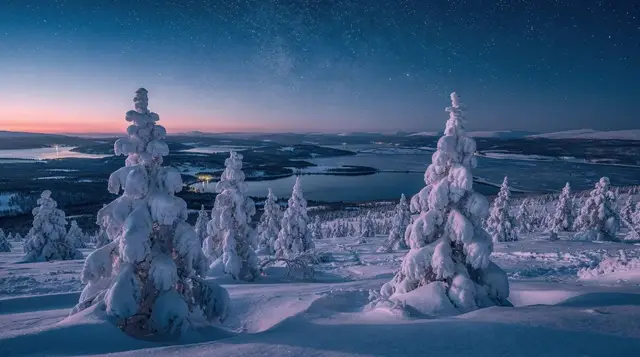
Ylläs is routinely described as Finland’s biggest ski area, and by piste count that holds up — it has more marked downhill runs than any other Finnish resort, spread across the slopes of seven fells within Pallas-Yllästunturi National Park. What it is not is a single village you can point to on a map. Skiers coming from Levi or from the Alps often expect a compact resort centre with one set of lifts radiating out from it, and Ylläs isn’t built that way.
The area is served by two separate villages, several kilometres apart, each with its own lift base, its own shops and restaurants, and its own character. Äkäslompolo, on the eastern side below Kesänki and Äkäsjärvi fells, is the larger and older of the two, with a proper village core, a supermarket, and the wider choice of restaurants.
Ylläsjärvi, on the southern side below the main Ylläs fell itself, is smaller and more spread out, closer to the highest lift stations and to some of the longest cross-country loops. Confusing the two, or assuming either one is “Ylläs” in full, is the easiest planning mistake to make here — decide which side you want before booking, because moving between them daily by car is a 15 to 20 minute drive, not a walk.
Compared with Levi, a two-hour drive further north near Kittilä, Ylläs markets itself on a quieter, more nature-oriented image: fewer bars, a smaller and more dispersed footprint, and a national park on the doorstep rather than a purpose-built resort centre. That reputation is broadly earned. It is not a claim that Ylläs is undeveloped — both villages have hotels, ski rental, restaurants and organised activities — only that the scale and the nightlife sit well below Levi’s.
Getting there from Rovaniemi
Ylläs is about 200 km from Rovaniemi, roughly 2 h 45 by car on Highway 79 north through Kittilä. There is no train to Ylläs itself; the night train from Helsinki terminates in Kolari, about 40 km away, with connecting buses or taxis for the final stretch. Kittilä has a small airport with seasonal direct flights from several European cities in winter, which is often a shorter transfer than routing through Rovaniemi.
Renting a car in Rovaniemi and driving up is the most flexible option, and it lets you combine Ylläs with stops at Muonio or further into western Lapland. Winter tyres are mandatory on this route as everywhere in Finnish Lapland in the cold months, and the same reindeer-on-the-road caution applies — see the driving in Lapland notes before setting off after dark. Shared transfers and buses run from Rovaniemi and Kittilä airports in season if you’d rather not drive; check timetables in advance, since frequencies drop outside the winter peak.
Downhill skiing: more pistes, smaller top-to-bottom drop
Ylläs’s headline claim — most pistes of any Finnish ski area — is a count of marked runs across the whole area, roughly 60 spread over the fells on both the Äkäslompolo and Ylläsjärvi sides, served by around 30 lifts. It is a genuine claim, not marketing rounding, but it needs context: individual runs are short by Alpine standards, and the vertical drop from the highest lift station is a little over 300 m, similar to Levi and to the other Lapland resorts. What you get is more variety of terrain to explore across a day, not longer single descents.
The two sides ski differently. The Äkäslompolo-facing slopes on Kesänki are gentler on average, with a good spread of blue and red runs that suit families and improving skiers. The Ylläsjärvi side, closer to the main Ylläs summit, has the steeper black runs and the area’s best off-piste terrain when snow conditions allow it — guided snowmobile safaris up to the fell top run from this side too, for those who want the view without skiing up to it.
| Ylläs | Levi | |
|---|---|---|
| Marked pistes | ~60, most of any Finnish resort | ~43 |
| Highest vertical drop | ~300 m | ~325 m |
| Cross-country network | One of Finland’s most extensive | Smaller, still substantial |
| Villages | Two (Äkäslompolo, Ylläsjärvi) | One (Sirkka) |
| Nightlife | Limited, low-key | Finland’s liveliest ski resort scene |
See the fuller comparison in the Levi, Ylläs, Ruka and Pyhä downhill guide if you’re choosing between resorts rather than committing to one.
Cross-country skiing: the actual specialty
If downhill piste count is Ylläs’s headline number, cross-country skiing is its real specialty. The area maintains one of the most extensive tracked cross-country networks in Finland — several hundred kilometres of groomed trails connecting the fells, the forests and both villages, including sections that stay lit for skiing after dark in midwinter. Track quality and grooming here are consistently rated among the best in the country, and the terrain — rolling fell shoulders rather than flat forest — gives more variety than most Finnish cross-country venues.
Both classic and skate tracks are maintained on the main network, and rental gear is available in both Äkäslompolo and Ylläsjärvi if you don’t want to bring your own skis and boots. This is worth planning around explicitly: a visitor who books Ylläs expecting Alpine-style downhill and skips the cross-country network is missing what the area is actually known for. Background on technique and what to expect from a first outing is in the cross-country skiing guide, written for Rovaniemi’s network but applicable to the skills needed here.
Northern lights: altitude helps, cloud still decides
Ylläs has a solid reputation as an aurora-watching base, and the reasoning holds up: the fells put you above valley mist and give a wide, unobstructed horizon, and the villages are small enough that light pollution is limited compared with a larger town. Standing on an open fell shoulder at night, away from streetlights, is a genuinely better vantage point than most locations lower down.
None of that changes the basic rule that governs the whole of Lapland: an aurora needs geomagnetic activity, a clear sky and darkness, and altitude only helps with the second and third of those. A guide who takes you up by snowmobile to watch for lights is buying you a better viewpoint, not a guaranteed sighting — treat any “guaranteed” wording from an operator as a promise about a refund or a repeat trip, not about the sky actually cooperating. If the immediate area is clouded over, a longer guided photo tour that chases clear sky further afield can be worth the extra driving.
For those who’d rather combine the wait with a meal instead of standing in the cold, a snowcat-served dinner up on the fell with lights-watching built in is the more comfortable version of the same idea. The general mechanics — season, cloud, what the eye sees versus what a camera captures — are covered in full in the aurora hunting guide, which applies here as much as in Rovaniemi itself.
Where to stay: Äkäslompolo or Ylläsjärvi
Choosing a base in Ylläs means choosing a village, not just a hotel. Äkäslompolo has the larger range of accommodation, from budget cabins to full-service hotels, plus the better supply of restaurants and a proper supermarket for self-catering. It suits visitors who want some evening options beyond the hotel restaurant and who are prioritising downhill skiing on the Kesänki side.
Ylläsjärvi is smaller and quieter, with accommodation skewed toward cabins and chalets rather than hotels, and it sits closer to the higher lift stations and to some of the best cross-country start points. It suits visitors focused on skiing itself over evening amenities, and those who want a shorter walk to the trailheads. Neither village is “downtown Ylläs” — that place doesn’t exist — so match the choice to what you’re actually doing each day rather than to the name on the booking site.
Pallas-Yllästunturi National Park: hiking beyond the ski season
The fells that carry Ylläs’s ski trails sit inside Pallas-Yllästunturi National Park, Finland’s second-oldest national park and one of its most visited. In winter the marked ski trails and the park’s hiking paths overlap; from roughly June to September, once the snow clears, the same fells open up as a genuine hiking destination — rounded, treeless summits, easy sightlines, and a network of marked trails that range from a short afternoon loop out of Äkäslompolo to multi-day routes running the length of the park toward Pallastunturi in the northwest.
September brings the ruska — the turning colours of the birch and the fell vegetation — and it’s one of the better windows to combine hiking with the start of the aurora season, since nights are dark again by early autumn but the trails are still snow-free. Details on colours and timing are in the autumn ruska guide; general trail planning for Lapland’s national parks is in the summer hiking guide. A guided summer day out at a wilderness cabin with local hosts is a reasonable way to get an oriented first look at the park without navigating the trail network alone on your first visit.
Other things to do
Snowmobiling is well represented in Ylläs, ranging from short nature-focused rides to longer safaris up toward the fell tops with wider views over the park. A shorter nature-watching snowmobile tour is a reasonable introduction if you haven’t ridden one before; the longer
safari up to the fell top
covers more ground and more altitude for those with some riding experience already, or riding as a passenger. Reindeer-related activities in the area lean toward culture and craft rather than long sleigh rides — a reindeer antler workshop is a common option for a shorter, indoor-adjacent session, useful on a day when the weather rules out longer outdoor plans. Ice fishing on the frozen lakes near Ylläsjärvi runs on the same low-key, contemplative lines as everywhere else in Lapland: expect quiet more than action.
Practicalities worth planning around: as with Rovaniemi, card payment is standard everywhere and tap water is fine to drink from the tap. Restaurant choice narrows outside the two village centres, so factor a supermarket run into any longer cabin stay, particularly on the Ylläsjärvi side where dining options are thinner. Ylläs sees a real but smaller version of the December price spike than Rovaniemi and Levi; late February through April usually offers steadier snow, longer daylight and calmer pricing than the Christmas and New Year weeks.
If you’re building a longer trip around western Lapland rather than a single stop, the six-day Lapland road trip itinerary works Ylläs in alongside Rovaniemi and Levi; the Rovaniemi versus Levi comparison covers some of the same trade-offs discussed above for readers still deciding between resorts. For getting oriented on Lapland travel generally before you commit to a base, the how to get to Rovaniemi guide covers the wider transport picture that Ylläs connects into.
Questions about visiting Ylläs
Is Ylläs one village or a whole ski area?
Ylläs is a ski area spread across seven fells, not a single village. The two service villages that anchor it are Äkäslompolo, on the eastern side, and Ylläsjärvi, on the southern side — pick one to book, since they sit several kilometres apart with their own lifts and amenities.
How far is Ylläs from Rovaniemi, and how do you get there?
About 200 km, roughly 2 h 45 by car on Highway 79 via Kittilä. There is no direct train; the practical options are a rental car, a shared transfer, or a bus via Kittilä, which has its own small airport with seasonal direct flights.
Is Ylläs better than Levi for skiing?
Ylläs has more pistes in total and by far the larger cross-country network, but Levi has a bigger single downhill area, more nightlife and a livelier commercial centre. Ylläs suits people who want cross-country skiing, quieter evenings and easier access to a national park; Levi suits people who want the biggest downhill runs and the most going on after dark.
Do Äkäslompolo and Ylläsjärvi share the same lifts?
No. Each village has its own lift network on its own side of the fells, and while some pistes connect across the area, the two villages function as separate bases. Book accommodation in the village closest to the slopes or trails you actually plan to use.
Is Ylläs a good place to see the northern lights?
It has a good reputation for it, largely because the fells give altitude above valley haze and cloud, and the surrounding villages are small enough to keep light pollution low. Cloud cover still decides most nights, exactly as it does everywhere else in Lapland — nothing here overrides that.
Can you hike in Ylläs in summer?
Yes. The fells sit inside Pallas-Yllästunturi National Park, and the marked trail network is used for hiking, running and mountain biking from roughly June to September, with the ruska colours peaking in September.
Is Ylläs suitable for families?
Yes, more so than Levi in most visitors’ experience: the pistes are gentler on average, the villages are smaller and quieter, and cross-country skiing works well for kids old enough to manage poles and skis. It has less organised children’s entertainment than Rovaniemi’s Santa Claus Village, so pair the two if that matters to your trip.