Downhill skiing in Lapland: Levi, Ylläs, Ruka and Pyhä compared
Which downhill ski resort near Rovaniemi should I choose?
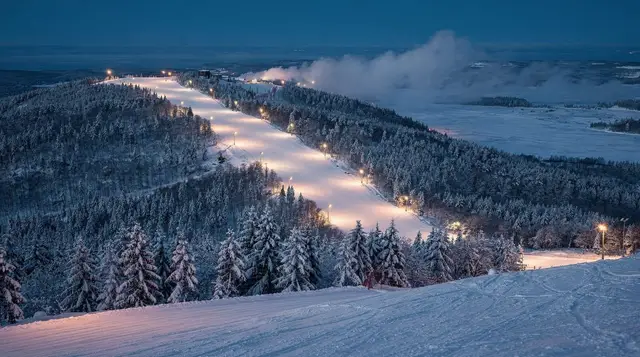
Levi (170 km) is the biggest and busiest, best for nightlife and variety. Ylläs (200 km) has Finland's highest fell and the quietest slopes. Ruka (190 km) gets snow earliest and has the steepest pitches. Pyhä (120 km) is the closest and smallest, good for a short trip or a first go on skis.
Four resorts, one base: what actually changes with distance
Rovaniemi itself has no downhill ski resort. Ounasvaara, the 204 m hill facing the city across the Kemijoki, has a short run or two that is fine to fill a spare afternoon, but nobody plans a ski trip around it. Anyone who wants a proper day on skis is driving out to one of four fells: Levi in Kittilä, Ylläs further north, Ruka near Kuusamo, or Pyhä, paired with its quieter neighbour Luosto.
The four sit at different distances from Rovaniemi, and the drive is the first thing that should decide which one you pick, not the marketing. Pyhä is the closest at roughly 120 km, about 1 hour 45 minutes on a clear road. Levi is 170 km, close to 2 hours 15. Ruka is 190 km, around 2 hours 30. Ylläs is the furthest at 200 km, typically a shade over 2.5 hours. None of these are day trips you do lightly in midwinter darkness with a rental car you have never driven on packed snow before — see driving in Lapland before committing to a self-drive plan.
This page covers downhill skiing only. Cross-country trails around Rovaniemi have their own page, so does snowshoeing, and the Karhunkierros trail that starts near Ruka is a summer hiking route covered separately — it has nothing to do with skiing.
One honest caveat before the resort-by-resort detail: piste counts, number of lifts and lift pass prices change most seasons as resorts add capacity or restructure pricing. Any specific figure printed here risks being wrong by the time you travel, so this guide sticks to what does not change from year to year — distances, terrain character, and what each place is actually like to stay in — and points you to each resort’s own site for the current season’s numbers.
Levi: the biggest and busiest, 170 km from Rovaniemi
Levi, in the village of Sirkka within Kittilä municipality, is Finland’s largest and best-known ski resort, and it feels like it. The village has the widest choice of hotels, restaurants and bars of the four, a compact centre you can walk end to end, and a ski school used to handling large numbers of complete beginners alongside Nordic countries’ more experienced skiers. Levi’s own airport, Kittilä (KTT), sits about 15 minutes from the village, which is why many visitors fly directly here rather than routing through Rovaniemi at all — but coming from Rovaniemi, it is a straightforward 170 km drive, mostly on the E75 and then Route 79.
The fell itself is broad and gently rounded rather than dramatic, with slopes fanning out on several sides so there is usually a sheltered run somewhere whatever the wind is doing. Levi markets itself hard on non-skiing extras — reindeer, husky and snowmobile activities sold directly out of the village, plus a lively après-ski scene that the other three resorts do not really try to match. If you want an evening out after a day on the slopes, Levi is the one that delivers it.
The trade-off is crowding. Levi pulls the largest numbers of any Finnish resort, especially over Christmas, New Year and the Finnish and Swedish school holiday weeks in February and March — queues at the main lifts and a fully booked village are the norm in those windows, not the exception. Outside peak weeks it thins out considerably. For a first taste of Lapland skiing paired with a proper night out, Levi is the easiest single choice; for solitude, it is the weakest of the four.
Levi is also a good base for extending a ski day into other activities. A short backcountry skiing adventure away from the groomed pistes suits anyone who wants to get off the lift-served slopes for a few hours, and a campfire aurora watch once the lifts close is a straightforward way to use the evening rather than just eating and sleeping.
Ylläs: Finland’s highest fell, two villages, 200 km away
Ylläs is the tallest of the four fells used for downhill skiing in Finland, sitting inside the Pallas-Yllästunturi National Park, and it is also the furthest from Rovaniemi at around 200 km — figure just over 2.5 hours depending on conditions. The resort is split across two villages on opposite sides of the fell: Äkäslompolo to the north, generally considered the more scenic and walkable of the two, and Ylläsjärvi to the south, quieter still and closer to the airport road from Kittilä.
Because the fell is genuinely the highest of the four, the top sections give longer, more open descents than Levi’s, and the resort has built a reputation among Finnish skiers as the “proper mountain” of the group, even though by Alpine standards it remains modest. Ylläs also holds the title of Finland’s largest cross-country ski area, which is not the subject of this page but explains why the resort feels quieter on the downhill side — a meaningful share of visitors here are Nordic skiers, not alpine ones, which thins out lift queues compared with Levi.
The two-village layout is worth planning around. Booking a hotel in Äkäslompolo but skiing mostly from lifts nearer Ylläsjärvi (or vice versa) means a short drive or shuttle each day rather than a walk out the door, so check which side of the fell your accommodation actually sits on before assuming everything is within walking distance. For visitors basing themselves in Rovaniemi and treating this as a single long day out, Ylläs’s extra distance over Levi makes it a harder sell unless the appeal of the higher fell and the national park setting specifically draws you.
Ruka: early snow near Kuusamo, 190 km from Rovaniemi
Ruka sits just outside the town of Kuusamo, technically in North Ostrobothnia rather than Lapland proper, but close enough — 190 km, about 2 hours 30 — that it belongs in the same comparison as a major winter destination reachable from Rovaniemi. Ruka’s defining trait among Finnish skiers is timing: its more continental, snowier local climate means it typically opens for the season earlier than Levi, Ylläs or Pyhä, sometimes by several weeks, and the resort leans into this with an autumn opening that draws skiers well before most other Lapland resorts have snow cover worth skiing on.
The terrain at Ruka is generally rated the steepest and most varied of the four, with a compact village centre right at the foot of the slopes — everything from hotel to lift queue is a short walk, which some visitors prefer over Levi’s larger sprawl. Ruka also sits at the gateway to Oulanka National Park, home of the Karhunkierros trail, though that is a summer hiking draw and irrelevant to a winter ski trip.
The 190 km drive from Rovaniemi runs east rather than north, on different roads to the Levi and Ylläs route, so it is worth checking road conditions specifically for that corridor rather than assuming the same forecast applies. Ruka works well as a two-resort combination with a Kuusamo day trip if skiing is only part of what draws you east.
Pyhä: the closest option, paired with Luosto
Pyhä is the nearest of the four to Rovaniemi at roughly 120 km, around 1 hour 45 minutes, which makes it the only one of the group that a determined visitor could realistically treat as a long day trip rather than an overnight stay, though a night there is still the more comfortable plan. Pyhä sits inside the Pyhä-Luosto National Park, paired administratively and touristically with the smaller, quieter village of Luosto a short drive away — the amethyst mine at Lampivaara sits between the two and is a summer and winter attraction of its own, unrelated to skiing.
Pyhä is deliberately the smallest and least developed of the four resorts covered here. The village has a fraction of Levi’s hotel and restaurant count, the slopes are shorter, and there is comparatively little going on after the lifts close. What it offers instead is proximity, lower prices than Levi in most seasons, and a genuinely quiet mountain even during weeks when Levi is packed. It suits a first attempt at downhill skiing without a long drive, a family wanting an uncomplicated day rather than a resort experience, or anyone based in Rovaniemi who simply does not want to commit two nights away to ski.
Comparing the four at a glance
| Resort | Distance from Rovaniemi | Drive time | Character |
|---|---|---|---|
| Pyhä (with Luosto) | ~120 km | ~1h 45 | Smallest, quietest, closest, good for a short trip |
| Levi (Kittilä) | ~170 km | ~2h 15 | Largest, busiest, best nightlife and activity range |
| Ruka (Kuusamo) | ~190 km | ~2h 30 | Earliest snow, steepest terrain, compact village |
| Ylläs (Äkäslompolo / Ylläsjärvi) | ~200 km | ~2h 30+ | Highest fell, two villages, quieter than Levi |
Treat the distances as road-network figures for a car in reasonable winter conditions, not a promise — snowfall, wind and darkness can all add time, and none of these are roads to rush on. See what to pack for cold-weather layering advice that applies equally to a day of skiing as it does to any other outdoor activity here.
Getting there from Rovaniemi
All four resorts are reachable by rental car, and a self-drive trip is the most flexible way to combine skiing with stops elsewhere in Lapland. Winter or studded tyres are compulsory on a rental car through the winter months, and the plug-in points found in most Finnish car parks are there for the engine block heater, not for electric vehicles — plug in below about -15°C. Reindeer and elk cross roads at all hours, including after dark, and a collision must legally be reported regardless of damage.
Bus connections exist to Levi, Ylläs and Ruka via Matkahuolto coach services, but frequencies are low enough that a bus-only ski trip needs planning well in advance and generally suits a longer stay rather than a quick visit. Pyhä has more limited public transport again, which reinforces its role as more of a day-trip or short-stay option for people already in Rovaniemi with a car.
Levi has its own airport at Kittilä (KTT), about 15 minutes from the village, so visitors flying directly into Lapland rather than via Rovaniemi often start there instead. For anyone already based in Rovaniemi for the rest of their trip, though, all four resorts are reached the same way: by road.
What none of these resorts are
It is worth being direct about scale. The highest of the four fells rises a few hundred metres above its base — nothing close to the 1,000 m-plus vertical drops of a major Alpine resort, and none of the runs are long by Alpine standards. A confident skier can realistically cover most of any one of these mountains in a single morning. Anyone arriving with expectations shaped by the Alps, the Rockies or Scandinavia’s own larger southern resorts should recalibrate: the draw here is the Arctic setting, the short winter daylight framing the runs in low golden light, and the realistic chance of finishing a ski day and heading straight out to look for the aurora — not vertical metres.
This page also does not cover cross-country skiing, which has its own dedicated guide and is arguably the more distinctively Finnish of the two disciplines, nor snowshoeing, nor the Karhunkierros hiking trail that happens to start near Ruka but has nothing to do with a winter ski trip.
Choosing based on how many days you have
A single free day from a Rovaniemi base points toward Pyhä, simply because it is the only one of the four where the drive does not eat a disproportionate share of the daylight available for skiing. Two or three days set aside specifically for skiing open up Levi, Ruka or Ylläs as proper overnight stops rather than rushed day trips, and at that point the choice comes down to what kind of trip you want around the skiing itself: Levi for range and nightlife, Ruka for reliable early-season snow and steeper terrain, Ylläs for the highest fell and the quietest slopes of the three larger resorts.
Anyone building a longer Lapland itinerary that already includes Rovaniemi, an aurora tour and one or two other day trips should treat a ski resort visit as a discrete two-day block rather than trying to bolt it onto an already packed single day — see the six-day Lapland road trip itinerary for how that kind of pacing works in practice. If skiing is the main reason for the trip rather than one activity among several, staying at the resort itself for three or four nights, rather than commuting from Rovaniemi, will save more time than any other single decision.
For a first visit where skiing is just one of several things you want to try, a shorter guided outing can be a lower-commitment way in. A guided wilderness outing around Levi or a half-day of beginner-friendly cross-country instruction works as a rest-day alternative to the downhill slopes without requiring a change of location.
Northern lights: skiing and darkness in the same trip
Midwinter daylight in Lapland runs roughly from mid-morning to mid-afternoon, which in practice means a full ski day and a genuinely dark evening on the same date — one of the more natural pairings on a Lapland trip. All four resorts sit far enough from Rovaniemi’s own light pollution to offer a reasonable aurora chance on a clear night, and Levi in particular sells aurora tours directly from the village so there is no need to drive back to Rovaniemi first.
None of this guarantees a sighting: cloud cover decides far more than geomagnetic activity does, on any given night, at any of these four resorts equally. See the main aurora hunting guide for how that actually works before building an evening around it.
Northern lights and downhill skiing: questions answered
Which resort is closest to Rovaniemi?
Pyhä, at around 120 km, roughly 1 hour 45 minutes by road. Levi, Ylläs and Ruka are all further, between 170 and 200 km.
Can I ski at Rovaniemi itself?
Ounasvaara, the hill across the river from the city centre, has a handful of short slopes and is fine for an hour or two, but it is not a downhill ski resort. Anyone who wants a real day of skiing needs to drive to Levi, Ylläs, Ruka or Pyhä.
Which resort has the most reliable snow?
Ruka, near Kuusamo, is consistently the earliest of the four to open each season and often the last to close, thanks to its more continental, snowier microclimate. All four resorts use snowmaking on the lower slopes regardless.
Is Levi or Ylläs better for a first-time skier?
Both run ski schools and beginner areas. Levi’s beginner slopes sit close to the village centre, so lessons, equipment hire and the hotel are all a short walk apart. Ylläs is more spread across two villages, which suits families who prefer a quieter base over convenience.
Do these resorts count as Alpine-scale skiing?
No. The highest of the four fells rises a few hundred metres above the base, not the 1,000-plus metre descents of the Alps. Runs are shorter, and a strong skier can cover the whole mountain in a morning. The appeal is the Arctic setting and the aurora chance after dark, not vertical drop.
Can I combine skiing with a northern lights tour on the same trip?
Yes, and it is the normal way to do it. Ski during daylight hours, which in midwinter run roughly from late morning to mid-afternoon, then join an aurora tour once darkness falls. Levi in particular has campfire and snowmobile aurora tours that start directly from the resort.
How many pistes and what does a lift pass cost?
This changes most seasons as resorts add lifts and adjust terrain, so any fixed number quoted here would likely be wrong by the time you travel. Check each resort’s own website for the current season’s piste count and lift pass pricing before booking.
Which resort is best for a short trip based in Rovaniemi?
Pyhä, since it is the closest and can realistically be done as a long day trip without an overnight stay. Levi, Ylläs and Ruka are better suited to a dedicated one- or two-night stopover, given the drive time each way.
Adventure & outdoor activities on GetYourGuide
Verified deep-linked GetYourGuide tours. Book through these links and we earn a small commission at no cost to you.
GetYourGuide does not provide a product photo for this activity — the image shows the meeting point, photographed by us.