Free ways to see the northern lights around Rovaniemi
Can you see the northern lights near Rovaniemi without paying for a tour?
Yes, if the sky is clear and geomagnetic activity is present. You need darkness, a view unobstructed by trees or buildings, and enough distance from streetlights to let your eyes adjust. A tour buys transport away from cloud and light pollution, not the phenomenon itself.
What a paid tour is actually selling you
A northern lights tour out of Rovaniemi is, in practical terms, a minibus and a driver who knows the current cloud map. You are not paying for the aurora, which nobody can sell, and you are not paying for a location that’s secret. You’re paying for someone else to make the judgement call about which direction has clear sky tonight, drive you there, and keep you warm with a fire and a hot drink while you wait. Read how the northern lights actually work and it becomes obvious why that service has value on a bad-weather night and none at all on a clear one.
If the sky over Rovaniemi itself is clear and dark, you don’t need a driver. You need three things at the same time: clear sky, darkness, and enough distance from artificial light to let your eyes adjust. This guide is about how to find that combination yourself, and about the reasoning you can apply to judge whether wherever you’ve ended up is actually a reasonable spot.
It is deliberately not a list of named locations with opening times, because most of what would go on such a list is private land, riverside paths that get icy and unlit, or spots that are only good depending on which way the town’s glow is drifting that particular night. Anyone publishing a precise address with a promised view hasn’t checked it as carefully as the confidence suggests.
The three ingredients, and which one you can’t control
Geomagnetic activity, the actual solar particles reaching the atmosphere, happens on a large share of nights through the season, and Rovaniemi sits under a band of sky where that activity is common. You cannot influence this and you cannot reliably predict it more than a few hours out; the forecasting tools used by tour operators and enthusiasts alike, covered in more detail in the guide to aurora forecast apps and tools, give you a short-notice probability, not a booking you can rely on days ahead.
Treat any forecast as a rough steer, not a promise, in the same way the operators behind a guaranteed northern lights tour only guarantee a refund or a second attempt, never the sky itself.
Darkness is seasonal and largely fixed: you need genuine night, which rules out the weeks either side of the midnight sun and narrows the realistic season to roughly late August through early April, as covered in the guide to the best months for the northern lights. Within that season, the one variable actually worth checking before you leave the house is cloud cover, not aurora activity. A night with strong geomagnetic activity and total cloud will show you nothing. A night with modest activity and a clear sky can show you a great deal. Check the cloud forecast first.
Distance from light is the one factor you have full control over on any given night, and it’s the one this guide focuses on.
Reading light pollution like a local, not a tourist
Rovaniemi is a small city by most standards, but its centre still throws enough streetlight and building glow to wash out a faint aurora directly overhead. The effect isn’t binary — you don’t step from “no aurora visible” to “aurora clearly visible” at some fixed distance — it’s a gradient. Every metre you put between yourself and a cluster of streetlights improves contrast a little. A car park under sodium lighting is close to useless even under a strong display; a patch of open ground five or ten minutes further out, with buildings and lit windows behind you rather than in your eyeline, is usually enough to turn a washed-out smear into a recognisable band.
The practical test is simple and doesn’t require any special knowledge of Rovaniemi: stand facing away from the brightest light source you can see, let your eyes adjust for a genuine five to ten minutes without checking your phone screen, and look at the northern half of the sky in particular, since that’s where the aurora oval usually sits from this latitude. If you can make out faint stars low on the horizon in that direction, you have a workable sky. If the horizon glows orange or white from town lighting, you’re still too close.
The logic of open water and riverbanks
Rovaniemi sits at the meeting of the Kemijoki and the Ounasjoki, and rivers are worth understanding as a category of spot rather than as a set of named addresses. Two things make a riverbank useful. First, a river corridor is open by definition — no forest canopy, no rooftops — so it gives you an uninterrupted view of a wide slice of sky, which matters because aurora bands move and you don’t want trees cutting off half of what’s happening. Second, rivers in a town like Rovaniemi often run along the edge of the built-up area rather than through its densest, most lit core, so following a riverside path away from the centre tends to put light behind you rather than in front of you.
That logic doesn’t automatically make every metre of the Kemijoki riverbank or the Ounasjoki a good viewing spot. Which bank works on a given night depends on where the town’s lighting actually sits relative to you, whether the path is lit itself, and whether ice and snow have made the ground safe to stand on without slipping toward open water — a real risk this guide won’t pretend away. Walk the route in daylight first if you can, so you know the ground before you’re relying on a torch and your night vision at the same time. The guide to walking aurora spots near Rovaniemi goes into more of this on-foot reasoning if you don’t have a car.
High, open ground: what it buys and what it doesn’t
The other broad category worth understanding is elevation combined with an open outlook. Ounasvaara, the hill across the river from the town centre, is the obvious example close to Rovaniemi: at 204 metres it isn’t a dramatic arctic fell, but it’s enough to lift you above some of the low-lying glow of the streets and give you a wider horizon than you’d get standing in a car park at ground level. A viewpoint reached on foot from town, on a still-populated hillside rather than deep wilderness, is a realistic option for someone without a car, though it’s still worth checking the route and any access conditions rather than assuming a summer path is equally walkable once it’s under snow and ice.
Height on its own isn’t magic. A wooded hillside with trees on the north-facing slope can be worse than flat open ground, because the trees block exactly the direction you need to see. What you’re actually looking for is height combined with a clear, unobstructed line to the north, which is a narrower combination than “somewhere up high” suggests.
Driving further out
If you have a car, the honest advantage over walking or a short taxi ride isn’t a secret viewing spot — it’s the ability to chase clear sky. Cloud cover over Lapland is patchy and can differ meaningfully between two points 20 or 40 kilometres apart on the same night. A cloud radar or satellite image, checked before you leave, will often show a band of clearer sky somewhere within an hour’s drive even when the sky over the town itself is thick with cloud. This is precisely the judgement call a guided minibus tour is making on your behalf; doing it yourself means reading the same maps and being willing to drive toward whichever direction shows a gap.
The guide to chasing the lights by car covers this in more depth, including the practical side that matters as much as the chasing itself: winter roads outside town are unlit, reindeer and elk cross without warning, and the driving conditions covered in the guide to driving in Lapland with reindeer and ice on the roads apply just as much on an aurora chase as on any other winter journey. Pick a pull-off or parking area you can actually see and stop in safely, not a random verge on a dark rural road, and never park somewhere that blocks a road used by others.
What you’ll actually see, and why it’s often less than the photos
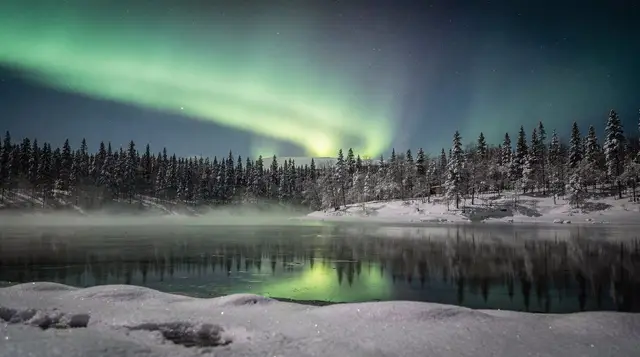
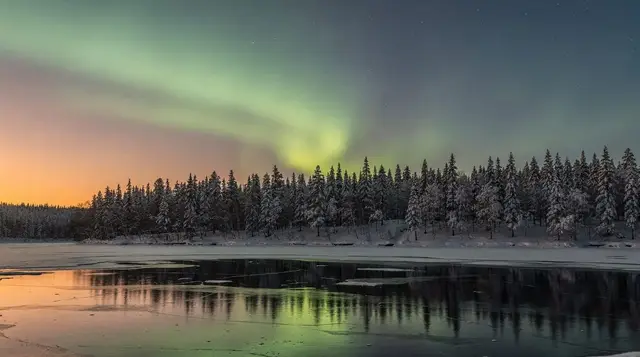
This is the point where most free, self-guided aurora hunting disappoints people, and it has nothing to do with location. A moderate display, to the naked eye, commonly looks like a pale grey or faint greenish band, sometimes barely distinguishable from a thin cloud, that moves and pulses slowly across part of the sky. A camera on a long exposure gathers far more light over several seconds than your eye gathers in an instant, which is why the same display turns a rich, saturated green in a photograph.
Neither version is dishonest; they’re genuinely different things, and understanding that in advance is the single best defence against feeling let down. The guide on what your eyes see versus what a camera sees sets out the physiology behind this in more detail, and if you’re bringing even a basic camera the guide to smartphone night settings for the aurora or, for a proper camera, aurora camera settings will help you capture more than your eyes alone are showing you.
A strong display is a different matter entirely — visibly moving curtains and columns of light, sometimes with colour clearly present to the naked eye — but strong displays are the minority of nights, not the average one.
Weighing your odds honestly
| Factor | What it takes for free | What a tour adds |
|---|---|---|
| Clear sky | Checking a cloud forecast and being willing to wait or move | A driver reading live cloud radar and choosing the best direction |
| Darkness | Getting outside the brightest streets on foot or by short drive | Getting well outside town, sometimes 100 to 200 kilometres |
| Comfort | Your own layers, and patience standing still in the cold | A heated vehicle, a fire, blankets, hot drinks between sightings |
| Local knowledge | Trial, error, and daylight scouting of your own route | Years of watching which spots and directions actually clear first |
| Cost | Nothing beyond transport you already have | Typically in the range of a paid activity, per person |
None of this changes the odds of the aurora appearing at all, which depend entirely on geomagnetic activity you can’t influence either way. It changes how good your view is if it does appear, and how comfortable you are while you wait to find out.
Dressing for standing still
Self-guided aurora watching means standing or sitting largely still outside for an hour or more, at temperatures that in midwinter commonly sit between -10°C and -25°C. This is colder in practice than walking or a husky sled, precisely because you generate no body heat from movement.
The three-layer approach — a wicking base layer, an insulating mid layer, and a windproof, ideally waterproof outer shell — covered fully in the guide to dressing for the cold in three layers, matters more here than for almost any other winter activity in the region. Bring something to sit or stand on that isn’t bare snow, a thermos of something hot, and a torch with a red-light setting if it has one, since white light close to your face ruins the night vision you’ve just spent ten minutes building.
When to stop pretending it’s free
There’s a point at which chasing clear sky yourself stops being a reasonable use of an evening. Persistent cloud through December and January, the two most overcast months of the season, can mean several nights in a row with no realistic gap anywhere within an easy drive. If you don’t have a car, don’t know the roads, or are travelling with people who can’t manage standing outside in deep cold for an uncertain length of time, that’s the point where paying someone else to make the judgement call and provide shelter starts to make sense, not as a guarantee of the aurora but as a guarantee of a warmer, better-informed wait for it.
A minibus hunt that includes a free second attempt if the first comes up empty is built around exactly this trade-off: someone else absorbing the risk of a cloudy first night. If you’d rather combine the wait with an activity, a campfire evening under the sky out toward Levi or a night spent in a traditional lavvu tent up in Utsjoki, well north of Rovaniemi and closer to the aurora oval’s most reliable band, both turn the waiting itself into something worthwhile rather than dead time.
For anyone who wants the operator to formally guarantee a rebooking rather than just offer one informally, a tour with a guaranteed-viewing policy is worth reading the terms of before you book, since what’s guaranteed is always the retry, never the phenomenon.
If you’re planning several nights specifically around aurora hunting rather than a single evening, the dedicated northern lights hunting itinerary lays out how to mix free, self-guided nights with a booked tour as a backstop, and the full aurora hunting guide for Rovaniemi covers the season and the odds in more depth than this page’s narrower focus on free viewing allows.
For accommodation built specifically around watching from indoors, that’s a different subject covered in the separate guide to glass igloos and the northern lights, including the honest limits of what a glass roof over a lit hotel site actually lets you see.
Free aurora viewing around Rovaniemi: your questions
Do I need to leave Rovaniemi to see the aurora for free?
Not always. On a strong, clear night the aurora can appear directly over the town, though streetlights and building glow will wash out anything faint. Moving even a short distance from the brightest lit streets improves what you can see, and moving further still improves it more.
What is the single biggest reason people see nothing?
Cloud cover. Geomagnetic activity happens on most nights of the season, but a cloudy sky hides it completely regardless of how strong the activity is. Checking a cloud forecast matters more than checking an aurora forecast.
Is a riverbank actually a good place to look?
The logic holds: open water and open banks remove trees and buildings from your view of the northern horizon, and rivers often run at the edge of a built-up area rather than through its brightest core. Whether a specific stretch works depends on which side of the river the town’s lighting sits on, which changes site by site.
How late do I need to stay out?
Aurora activity has no fixed schedule and can appear at any point in a dark night, though many sightings cluster loosely around 9pm to 1am. Checking activity levels every 20 to 30 minutes and being ready to wait an hour or more with nothing happening is normal.
Can I see anything with the naked eye, or do I need a camera?
Weaker displays often look like a pale grey or faint greenish band that only becomes clearly green in a photograph, because a camera’s long exposure gathers far more light than the eye. Strong displays are unmistakable without any camera at all.
Does a full moon ruin the viewing?
No. A full moon brightens the sky and can make faint aurora slightly harder to pick out, but it doesn’t block a decent display, and it makes the surrounding snow and landscape easier to see and photograph.
When is self-guided viewing a bad idea?
When the sky is persistently overcast, which is common in December and January, or when getting to open ground safely at night without a car or local knowledge isn’t realistic. In both cases a guided tour is buying transport to clearer sky, not a better show.
Northern lights tours on GetYourGuide
Verified deep-linked GetYourGuide tours. Book through these links and we earn a small commission at no cost to you.
GetYourGuide does not provide a product photo for this activity — the image shows the meeting point, photographed by us.