A 3-day northern lights hunting itinerary from Rovaniemi
This itinerary is not a tour of Rovaniemi with the aurora added on. It is built the other way round: three nights of dark-sky viewing, with the daytime hours deliberately kept light so you are not exhausted for the next one. If you want a fuller look at Rovaniemi itself, the 3-day classic Lapland itinerary or the 5-day Lapland in depth itinerary cover more ground. This one covers less ground and more sky.
Why darkness matters more than sightseeing on this trip
Seeing the northern lights needs three things at once: geomagnetic activity, a clear sky and genuine darkness. Rovaniemi sits under the auroral oval, so activity itself is common — operators here often cite around 200 geomagnetically active nights a year. What decides whether you actually see anything is cloud cover, and that is stubbornly hard to predict more than a day or two out. Our aurora hunting guide and the month-by-month breakdown of best viewing times go into the mechanics; the short version is that September–October and February–March tend to have more stable skies than December–January, which are the cloudiest months of the season.
No tour company can promise you a sighting, whatever the word “guaranteed” on the booking page implies. Read that phrase carefully — our guide to guaranteed northern lights tours explains that it refers to a refund or a repeat trip, not to the phenomenon itself. This itinerary is designed to improve your odds honestly: three separate nights, three separate directions away from Rovaniemi’s own light pollution, rather than one big-ticket night that either delivers or doesn’t.
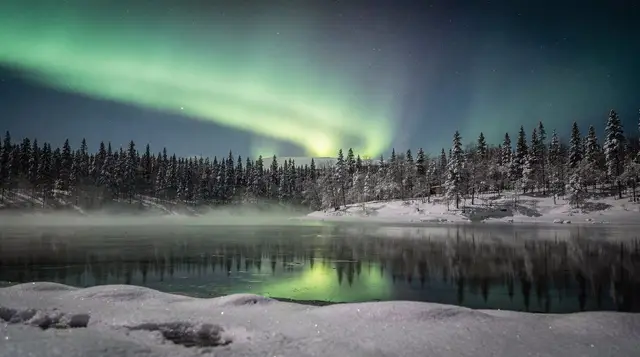
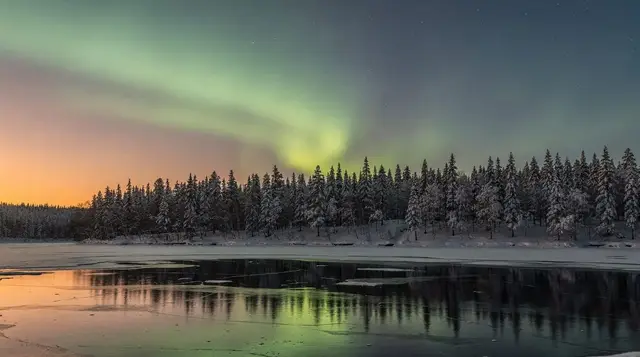
It also helps to reset your expectations of what you’ll actually see. The eye usually picks up a pale grey-green band that moves slowly, not the saturated curtain of colour in a long-exposure photograph. Our piece on what you really see with the eye versus a camera is worth reading before you go, so the first sighting doesn’t feel like a letdown.
Aurora season at a glance
| Period | Sky stability | Notes |
|---|---|---|
| Late August–October | Good | Nights lengthening fast, still mild; overlaps with ruska autumn colour |
| November | Variable | Snow arriving, days shortening |
| 2–12 December (kaamos) | Poor to variable | Polar night: no sunrise, several hours of blue twilight, often cloudy |
| January | Poor | Statistically the cloudiest stretch of winter |
| February–March | Good | Widely rated the most reliable viewing window |
| Early April | Fair | Nights getting shorter again; last realistic month |
Before you set off: three ground rules for this trip
Get away from Rovaniemi’s own lights. Streetlights and shopfronts wash out a faint aurora even on a clear night. Everything on this itinerary is chosen to put you either on the far side of the Kemijoki at Ounasvaara, out at the Arctic Circle Hiking Area, or further out again at Luosto.
Expect a late night, then plan a slow morning after it. A typical hunt runs from around 8pm to somewhere between 1am and 2am. Nothing on the following morning here starts early or asks for much energy — that’s deliberate, not an oversight.
Dress for standing still, not for walking. You’ll be stationary at a fireside or a viewpoint for long stretches. Most operators lend a full thermal suit, boots and mittens as part of the price; check what to pack and the three-layer system for what to bring underneath it.
Day 1: Rovaniemi and the Arctic Circle Hiking Area
Daytime — light and short. Arriving in Rovaniemi is the priority today, not sightseeing. If your flight or the night train from Helsinki gets you in by early afternoon, spend an hour or two at Arktikum for context on the region — the Lapland War, the 1944 reconstruction and Sámi culture are all covered under its long glass roof by the river. Keep it to that one stop; you want to be well rested, not sightseen-out, by evening.
Evening — first hunt, Arctic Circle Hiking Area. The trailheads around Vaattunkiköngäs and the Arctic Circle Hiking Area, north of town, put you well clear of Rovaniemi’s glow while staying a manageable drive away. Most operators run a minibus aurora hunt out to dark countryside north of the city, with a fireside stop and a hot drink while you wait for a gap in the cloud. If you’d rather set your own pace and have a car, a shorter, self-driven version works too — see our note on chasing the lights by car for where locals actually park up.
Don’t expect fireworks on night one. Treat it as a calibration run: you’ll learn what a faint aurora actually looks like to the naked eye, which matters for judging nights two and three.
Day 2: Ounasvaara by day, a longer chase by night
Daytime — deliberately unhurried. After a late finish the night before, Day 2 stays close to town. Ounasvaara, the low hill across the river from central Rovaniemi, is an easy half-day: short trails, a couple of viewpoints over the city and the Jätkänkynttilä bridge, and no early alarm required. It’s 204 metres of hill, not an Arctic fell — plan for a stroll, not an expedition. A slow lunch in town and a look around Korundi or the shops fill the rest of the afternoon comfortably.
Evening — go further, and go by a different method. With one hunt already behind you, Day 2’s outing is worth pushing a little further from Rovaniemi’s light dome and mixing up the format. An ATV-based aurora hunt into darker backcountry covers more ground than a minibus stop and gives you a genuinely different vantage point if the first night’s spot was clouded over. If conditions look unsettled, a shorter option exists too: a short evening drive out to open sky for a couple of hours of watching is a lower-commitment way to try again without staying out until 2am two nights running.
Whichever you choose, check the forecast that afternoon rather than locking in a plan days ahead — our list of aurora forecast apps and tools covers what’s actually reliable versus what just guesses.
Day 3: Luosto and a last, quieter attempt
Daytime — the longer drive of the trip. Luosto is around 120km from Rovaniemi, roughly a 1 hour 45 minute drive, and sits inside the Pyhä-Luosto National Park. Leave mid-morning rather than at dawn — there’s no reason to rush a night-hunting itinerary into an early start. Once there, the fells give you a wide horizon and genuinely dark surroundings once the sun goes down; it’s one of the better base points in the region precisely because it isn’t a town.
Evening — the highest-odds night of the trip, on paper. By this point you’ve seen what a faint aurora looks like and you know your own tolerance for a late finish. Luosto’s distance from any large town is its main advantage: less light pollution to fight against than either of the first two nights.
Some travellers choose to spend this night in a glass-roofed cabin rather than out at a fireside — read whether glass igloos are worth it before booking one, since site lighting and dome orientation can limit what you actually see from bed. A guided option, the aurora tour out from the Luosto area, is the more reliable way to reach a genuinely dark viewpoint if you’re not driving yourself after dark on unfamiliar fell roads.
If the sky stays stubbornly overcast on all three nights — it happens — that’s not a failed trip, just an honest one. Our account of the night we didn’t see the aurora is a useful gut check before you go, and worth reading precisely because it isn’t a success story.
Timing overview
| Day | Daytime pace | Night activity | Typical finish |
|---|---|---|---|
| 1 | Light: arrival, Arktikum | Minibus hunt, Arctic Circle Hiking Area | ~1am |
| 2 | Light: Ounasvaara, town | ATV hunt or short sky-watch drive | ~1–2am |
| 3 | Moderate: drive to Luosto | Guided hunt or glass-roofed cabin | ~midnight–2am |
A note on the kaamos
If your dates fall around 2–12 December, you’re travelling in the kaamos, Rovaniemi’s polar night. The sun doesn’t clear the horizon at all, but the middle of the day still brings several hours of blue twilight rather than total darkness — it surprises most first-time visitors.
It is not, on its own, better for aurora viewing: December and January are statistically the cloudiest months of the whole season, so a kaamos trip can mean long dark days with nothing to see overhead most nights. Our guide to Rovaniemi’s winter and kaamos season and the diary entry on two weeks without a sunrise both cover what that stretch actually feels like to spend time in.
Where this itinerary fits
This is a themed variant, not a full tour. If you’d rather balance aurora nights with husky sledding, reindeer farms and the Santa Claus Village by day, the 3-day classic Lapland itinerary covers that ground; travelling with children changes the calculus on late nights considerably, so the family-friendly Lapland itinerary is a better starting point in that case. What follows here is purpose-built for one goal: giving a clear sky the best possible chance to show you something.
FAQ: hunting the northern lights around Rovaniemi
How many nights should I budget to actually see the northern lights?
Three nights, each in a different direction from Rovaniemi, is a reasonable minimum. It spreads the risk of one cloudy night without turning the trip into a week built entirely around the sky.
Is a northern lights tour ever really guaranteed?
No. “Guaranteed” tours guarantee a refund or a repeat outing if nothing appears, not the aurora itself. Cloud cover, not the tour operator, decides what you see on any given night.
What is the kaamos and does it change the odds?
Kaamos is the polar night, roughly 2 to 12 December in Rovaniemi, when the sun stays below the horizon all day. It brings several hours of blue twilight rather than true darkness, and it does not by itself improve aurora chances, which still depend on clear skies.
Why does this itinerary avoid morning activities the day after a night hunt?
Aurora hunts typically run from around 8pm to 1am or later. Booking a demanding activity for 8am the next morning routinely leaves visitors too tired to enjoy either one, so each night hunt here is followed by a lighter, later-starting day.
Do I need to drive myself, or can I do this without a car?
This itinerary assumes a rental car for flexibility in choosing where to watch from, but every night listed can also be done as a guided minibus tour that collects you from central Rovaniemi.
Why will the aurora in my photos look brighter than what I saw?
A camera sensor on a long exposure gathers far more light than the human eye. Many visitors see a pale grey or faint green band moving overhead, not the saturated green seen in brochure photography, and that gap is the single biggest cause of disappointment.
Does a full moon ruin the chances of seeing the aurora?
No. A full moon does not prevent a display, it simply brightens the background sky, which can mute a faint aurora while a strong one remains clearly visible.
Northern lights tours on GetYourGuide
Verified deep-linked GetYourGuide tours. Book through these links and we earn a small commission at no cost to you.
GetYourGuide does not provide a product photo for this activity — the image shows the meeting point, photographed by us.