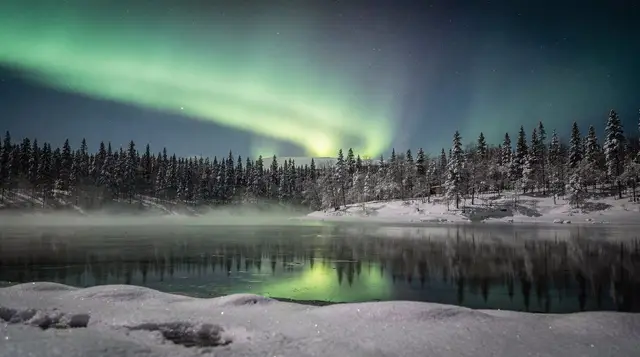
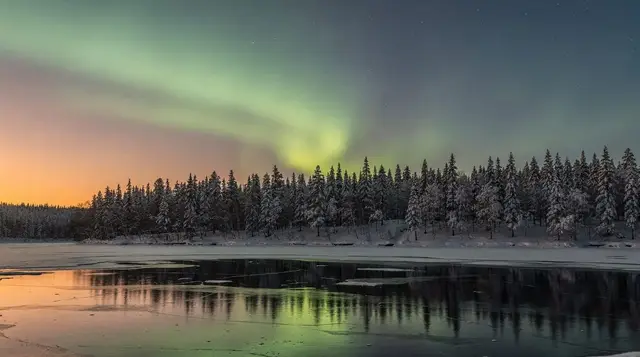
A national park built around one strange winter phenomenon
Riisitunturi National Park sits about 170km south-east of Rovaniemi, in a stretch of eastern Lapland better known for Posio and the frozen waterfalls of Korouoma Canyon nearby. The park itself is small by Finnish standards, around 77 square kilometres, and it doesn’t try to be everything at once. In winter it has one job: growing tykky, the thick crust of wind-driven snow and rime ice that bends spruce trees into rounded white shapes locals call “snow ghosts”. In summer the same fells strip back to open peatland, dark tarns and low, rolling ridgelines that draw a much smaller, quieter crowd of hikers and birdwatchers.
Both versions of the park are genuinely worth seeing. Neither is worth a special trip if the timing is wrong, and that’s the mistake most visitors make with Riisitunturi. The tykky season is short and specific, not a general “Lapland winter” thing, and turning up in December expecting the postcard image is the single most common way to leave disappointed.
Tykky: what it actually is, and when it’s actually there
Tykky forms when moisture-laden air off the surrounding lowlands rises against Riisitunturi’s fells, cools, and deposits layer after layer of soft rime and wet snow onto spruce branches. Over weeks, a single tree can end up carrying several hundred kilograms of frozen build-up, curling under its own weight into the rounded, almost sculptural shapes photographed on Riisitunturi’s marketing material and, honestly, most of Finnish Lapland’s tourism material generally.
The part that matters for planning is timing. Tykky needs a full winter’s worth of accumulated snow and repeated freeze-thaw-freeze cycles to build up to its heaviest, most photogenic state, and that takes most of the season to happen. In December and January the fells are usually still building up their coating: snowy, but not yet the dense white sculpture people expect. The formations are at their thickest and most dramatic from roughly mid-February through March, tapering off as the melt starts, usually by April. Visit in November hoping for tykky and there may be none of it worth photographing at all.
This isn’t a minor caveat. If tykky is the specific reason for the drive, mid-February to March is the window, not “sometime in winter”. Outside that window, Riisitunturi is still a pleasant snowshoe destination with decent views, just not the one from the photographs.
a 10km husky sled ride that runs directly through the park and finishes with a lunch stop is one of the few guided ways to see the tykky forest from a sled rather than on foot, and it’s worth timing against that same February–March window rather than assuming any winter date will do.
The trails: what’s actually walkable, and how long it takes
Riisitunturi’s main draw for hikers is the Riisitunturi summit loop (Riisitunturin kierros), a circular trail of around 9km that climbs the park’s low fells, passes several viewpoints over the peatlands and forest below, and loops back to the starting car park. It isn’t a hard trail by fell-walking standards, the highest point sits at only around 340m, but in winter it’s snowshoe or ski terrain, not a stroll in boots, and the loop through deep snow with photo stops routinely takes four to six hours. In summer, walked in hiking boots on cleared ground, the same loop is closer to three to four hours for most people.
There’s also a shorter option cutting off part of the loop near the main car park, useful if the weather turns or daylight is running out, and a couple of lean-to shelters (laavu) along the route where the trail passes wet ground on duckboards. None of this is technical hiking. What it is, is genuinely quiet: Riisitunturi sees a fraction of the visitor numbers of the bigger parks around Pyhä-Luosto or Urho Kekkonen, and on a weekday it’s realistic to walk the whole loop without meeting more than a handful of other people.
| Trail | Distance | Typical time | Terrain |
|---|---|---|---|
| Riisitunturi summit loop | ~9km | 3–4 hrs (summer), 4–6 hrs (winter, snowshoes) | Fells, boardwalk over peatland, some elevation |
| Shortened loop | ~5–6km | 2–3 hrs | Same terrain, cuts the far viewpoint |
| Access track from car park | ~1km each way | 20–30 min | Flat, cleared in winter |
Snowshoes are close to essential off the packed sections in winter; the fresh, heavy snow that builds the tykky also makes unbroken trail sections very hard going in boots alone. See the general guidance on snowshoeing near Rovaniemi if this would be a first attempt, and the broader hiking trails around Rovaniemi guide for how Riisitunturi compares to the closer options.
Getting there from Rovaniemi
Riisitunturi is roughly 170km from Rovaniemi, about two and a half hours by car on paved roads, routed via Posio, which functions as the natural staging point for the park, fuel, food and the last supermarket before the trailhead. There’s no public bus service to the park itself; getting there without a rental car realistically means a guided day tour or arranging private transport from Posio.
The road in from Posio narrows toward the park and, in winter, is not always the first priority for ploughing after heavy snowfall. Winter tyres are mandatory on Finnish roads in the relevant months regardless, and the same reindeer-on-the-road caution that applies across driving in Lapland applies here too, arguably more so on the quieter rural stretches east of Posio. There’s a car park at the main trailhead with basic facilities; it isn’t staffed, and there’s no visitor centre at the park itself, so any supplies, food or last toilet stop should happen in Posio beforehand.
Because it’s a genuine half-day-plus round trip from Rovaniemi, most visitors either commit to it as the main event of the day or fold it into a longer eastern Lapland loop that also takes in Korouoma Canyon, roughly 30km further on from Posio. Trying to add Riisitunturi as an afterthought to a different day trip usually means arriving with too little daylight left to do the loop properly.
Summer at Riisitunturi: the version most people never see
Strip away the snow and Riisitunturi is a different park. The fells that carry tykky in winter are, in summer, covered in low aapa mires and open peatland, threaded with boardwalks to keep hikers off the fragile wet ground. Small dark tarns sit in the hollows between ridgelines, and the summit loop trades white sculpture for wide views over unbroken forest stretching toward the Russian border, one of the emptier horizons this far south in Lapland.
It’s a legitimate reason to visit outside winter, not a consolation prize. The peatland habitat supports a good range of birdlife, and Riisitunturi is a known spot regionally for species associated with aapa mires and northern boreal forest; birders visiting Finnish Lapland in June often build it into a wider itinerary. Late August into September brings the ruska colour change to the surrounding forest, another quiet, uncrowded way to see the park that has nothing to do with tykky at all. See autumn colours in Lapland for how that season plays out more broadly across the region.
Everyman’s right applies here as everywhere in Finland: walking off the marked trail on public land, picking berries in season and a single night’s wild camping are all allowed without permission, provided nothing is disturbed or damaged. The boardwalks through the wettest peatland sections exist to protect the ground, not to restrict where visitors are allowed to walk, so staying on them is a courtesy to the habitat rather than a rule. The guide to everyman’s right covers what is and isn’t covered by it in more detail.
Combining Riisitunturi with the rest of eastern Lapland
Posio itself, the gateway village, is covered on its own page rather than here, but it’s worth knowing it’s the sensible base for fuel, food and a last supermarket stop before heading into the park. From Posio, Korouoma Canyon is a further short drive and, in winter, has its own set of frozen waterfalls that pair naturally with a Riisitunturi visit on the same eastern loop, though the two together make for a full day rather than a half-day. The Korouoma frozen waterfalls guide covers that side of the trip, and the Korouoma Canyon day trip page has the practical detail for combining both.
Travellers heading further toward Pyhä, Luosto or Sodankylä sometimes route through this corner of Lapland on the way, in which case Riisitunturi works as a stop rather than a dedicated day.
For anyone staying in that direction overnight, aurora tours based further north tend to have a real logistical edge: a northern lights hunt from Sodankylä or, closer to Riisitunturi itself, a private aurora tour from Posio with a campfire stop both make more sense than driving back to Rovaniemi and out again the same night. Neither guarantees a sighting; see the aurora hunting guide for what “guaranteed” tours actually promise, which is a refund or a re-run, not the phenomenon itself.
Closer to Pyhätunturi, husky operators run similar short farm-and-sled combinations to the one inside Riisitunturi itself, including a 5km husky safari with a farm visit and a longer 10km version, worth comparing on price and distance if the plan already includes a stop near Pyhä or Luosto.
Planning a visit: what it actually takes
A half-day is the realistic minimum once the drive from Rovaniemi is factored in: roughly two and a half hours each way leaves a five-hour round trip before any walking happens, so a same-day return from Rovaniemi means an early start and, in winter, finishing the loop before the light fades mid-afternoon. A full day is more comfortable and leaves room for the complete summit loop, a stop in Posio for food, and some slack for weather or slow going in deep snow.
There’s no accommodation inside the park and no restaurant at the trailhead. Posio has a handful of places to eat and a supermarket; beyond that, this is a bring-your-own-food, fill-the-flask kind of visit. Layering matters more here than in town: the exposed fell sections above the treeline catch wind that the sheltered forest lower down doesn’t, and the three-layer approach covered in what to pack applies directly to a winter loop of this length.
| Season | What’s on show | Realistic time needed | Crowds |
|---|---|---|---|
| Mid-Feb to March | Peak tykky, deep snow, snowshoe trail | Half to full day | Low to moderate |
| Dec–Jan | Building snow cover, tykky not yet at its heaviest | Half day | Low |
| June–Aug | Peatland, tarns, birdlife, cleared boardwalk trail | Half to full day | Low |
| Late Aug–Sept | Ruska colour across the forest and mires | Half day | Very low |
Riisitunturi National Park: frequently asked questions
How far is Riisitunturi National Park from Rovaniemi?
About 170km by road, roughly a two-and-a-half-hour drive via Posio. There’s no direct public transport to the park itself, so this is a self-drive or guided-tour destination rather than one reachable by regular bus.
When can I actually see the tykky snow formations?
The trees carry their heaviest, most photogenic coating of frozen snow from roughly mid-February through March. Earlier in winter the build-up is often still thin, and by April it’s usually starting to melt away, so “sometime in winter” isn’t specific enough if tykky is the reason for the trip.
Is the Riisitunturi summit loop hard?
Not technically. It’s about 9km with only modest elevation gain, but in winter it’s a snowshoe trail through deep, often unbroken snow, which makes it slower and more tiring than the distance suggests. Budget four to six hours in winter, three to four in summer.
Do I need snowshoes?
Off the packed sections, yes, effectively. The same heavy snowfall that builds the tykky formations makes the trail very hard going in ordinary boots once away from the trailhead.
Is there anywhere to eat or stay inside the park?
No. There’s a car park with basic facilities at the main trailhead but no visitor centre, café or accommodation inside the park boundary. Posio, the gateway village a short drive away, has food and fuel and functions as the practical base.
Can I combine Riisitunturi with Korouoma Canyon in one day?
Yes, and many visitors do, since both are accessed via Posio. It makes for a full day rather than a half-day once both the drive and both trails are accounted for, so it suits travellers with a full day free rather than a quick stop.
What’s Riisitunturi like in summer if I’m not there for the snow?
A genuinely different park: open peatland, small tarns and wide views over boreal forest, with boardwalk sections protecting the wettest ground. It suits hikers and birdwatchers more than photographers chasing the winter image, and it’s considerably quieter than the winter season.
Is a guided tour necessary, or can I just drive and hike myself?
A guided tour isn’t necessary for the hiking itself, the trail is marked and manageable independently with the right gear, but there’s no public transport option, so a self-drive is the main alternative to a guided tour rather than a genuine choice between two equally easy options.