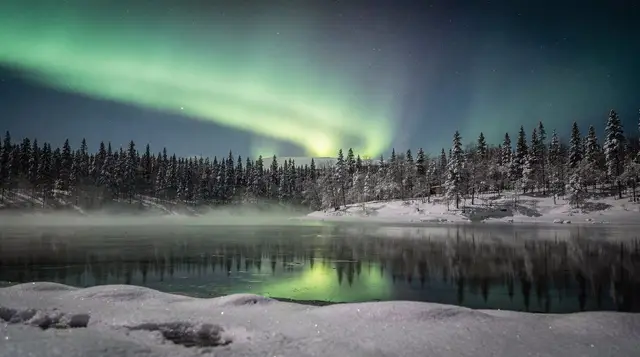
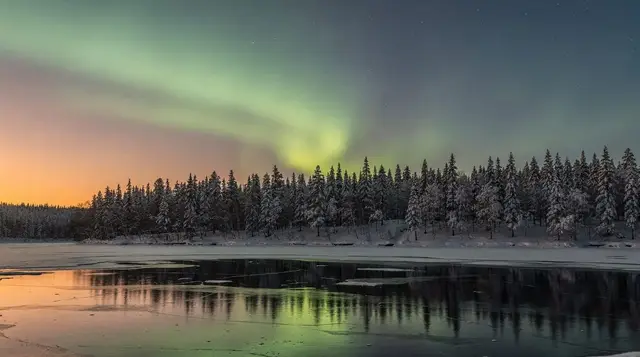
Winter and the kaamos season in Rovaniemi
What is kaamos in Rovaniemi, and is it completely dark?
Kaamos is the polar night, when the sun stays below the horizon in Rovaniemi from roughly 2 to 12 December. It is not 24-hour darkness: the town still gets several hours of blue, dusk-like light around midday, with true dark only for part of the day.
What kaamos actually means
Kaamos is the Finnish word for the polar night: the stretch of winter when the sun does not climb above the horizon at all. In Rovaniemi, that happens for roughly 2 to 12 December, give or take a day depending on the year. It is the single most misunderstood fact about a winter trip here, so it is worth stating plainly: kaamos is not 24 hours of black night.
Even on the shortest, darkest day of the year, the sky over Rovaniemi lightens to a deep, dusk-like blue for several hours around midday. Locals call it the blue light, and it is bright enough to walk around town, take photographs, or watch reindeer graze at the edge of a field without a torch. What disappears is direct sunlight and the sharp shadows that come with it, not visibility itself.
The confusion is understandable. Photos and marketing copy for the region lean hard on words like “polar night” and “no sunrise,” and readers picture something closer to a solar eclipse that lasts a fortnight. The reality is a town running on a long, moody dusk: streetlights stay on most of the day, cafe windows glow from mid-morning, and the snow itself reflects what light there is, so open ground and lakesides often feel brighter than the forest.
Locations further north, such as Utsjoki or Inari, lose the sun for longer stretches than Rovaniemi does, because the length of kaamos grows the further you sit above the Arctic Circle. Rovaniemi, sitting just south of the line itself at the Santa Claus Village marker, gets one of the shorter versions of the phenomenon in Finnish Lapland.
The dates, and why they shift slightly
The 2 to 12 December window is the commonly cited range for Rovaniemi, but the exact start and end depend on latitude and how you define sunrise and sunset for a town that sits close to the threshold. In practice, the run-up to kaamos and the days just after it look and feel almost identical to the polar night itself: the sun clears the horizon for only a few minutes, low and orange, before dipping back down.
Visitors arriving in late November or the first week of January will notice barely any difference from being there during the technical kaamos dates. If you want the exact day-by-day daylight hours for planning a specific date, that level of detail sits in the month-by-month breakdown rather than here — this page is about what the season as a whole feels like on the ground.
Temperatures through the dark months
Cold in Rovaniemi is steady rather than dramatic most days. From December through March, daytime temperatures commonly sit between -10°C and -25°C, and most winters produce at least a handful of days below -30°C, usually in January. It is a dry cold: -20°C in Lapland is generally easier to stand still in than 0°C and drizzling, because there is no dampness working its way through clothing. Wind is what changes the equation.
A still -20°C day feels manageable within minutes of stepping outside; the same temperature with a stiff breeze off open ground cuts through a jacket fast, and exposed skin — cheeks, fingertips, ears — is where frostbite risk actually starts. Anyone heading out on a snowmobile safari or standing still for an aurora hunt will feel the wind-chill difference far more than someone walking briskly through town.
Snow cover: longer than the polar night itself
Snow settles over Rovaniemi from around late October and typically stays on the ground until mid-May, which means the entire kaamos period, and the whole of what most visitors think of as “winter,” falls comfortably inside the snowy season. Depth builds steadily through November and December, and by January and February the snowpack is usually at its deepest, which is also when activities like cross-country skiing and deep-snow husky routes run at their best. Because snow arrives before the polar night and outlasts it by months, there is no real trade-off between visiting during kaamos and getting good snow conditions — the two overlap by design, not coincidence.
Aurora season overlaps the whole of kaamos
The northern lights viewing season in Rovaniemi runs from late August to early April, which means kaamos sits squarely inside it, not as a special extra window but as one part of a much longer season. What kaamos adds is dark hours: with the sun below the horizon for most of the day, there is more of the night available for an aurora to appear in, weather allowing.
The catch, covered in full in the aurora hunting guide and the month-by-month aurora breakdown, is that December and January are also statistically among the cloudier months in Rovaniemi, and cloud cover, not darkness, is what actually decides whether anyone sees anything on a given night. A kaamos trip does not buy a better chance at the aurora than, say, late September or early March — it buys longer nights and a genuinely striking, low-light landscape, which are worth having on their own terms.
a small-group aurora hunt out of Rovaniemi timed around the darkest hours of the day is one straightforward way to use those long kaamos nights, heading out toward open, cloud-free sky away from town lighting. It is worth repeating what every honest operator will tell you: nobody can guarantee a display on a given night, only a genuine attempt and, usually, a refund or a repeat trip if nothing shows.
What the blue light actually looks like
The midday light during kaamos is not grey or flat — it is a saturated, cold blue that settles over snow, buildings and the Kemijoki for a few hours around noon, brightening gradually from around 10am and fading back down by early afternoon. Photographers tend to like it more than they expect to, since it produces a consistent, moody colour cast without the harsh contrast of a low winter sun.
What it is not is enough light to read fine print outdoors or navigate an unlit trail without care; most guided walking routes and the well-used paths through town and around Ounasvaara are lit or well marked, but anything further off the beaten track needs a headlamp regardless of the hour. The same gap between expectation and reality that trips up first-time aurora viewers — see the eye versus camera guide for that — shows up here too: photos taken during kaamos, especially with a phone camera on auto settings, often brighten the blue light into something closer to daytime than what the eye actually saw standing there.
Rovaniemi winter at a glance
| Period | Typical daylight | Typical temperature | Snow on ground |
|---|---|---|---|
| Early winter (late Oct–early Dec) | Shortening days, a few hours of low sun | -5°C to -15°C | Building through the period |
| Kaamos (2–12 Dec) | No sunrise; several hours of blue midday light | -10°C to -20°C | Established, still deepening |
| Midwinter (Jan–Feb) | Sun returns low on the horizon, lengthening daily | -15°C to -25°C, occasional sub -30°C | Deepest of the year |
| Late winter (Mar–Apr) | Long, bright days | -10°C to -20°C, milder by April | Still solid, softening toward May |
This is a snapshot, not a full calendar — for exact daylight hours and conditions in a specific month, the month-by-month guide goes into that detail.
Typical winter activity costs
Prices vary by operator and group size, but these ranges hold across most Rovaniemi-based winter activities booked directly rather than through a hotel package.
| Activity | Typical duration | Typical price per person (EUR) |
|---|---|---|
| Evening aurora hunt by minibus | 4–6 hours | 100–180 |
| Husky sled, short passenger ride | 2–5 km, under an hour on snow | 100–160 |
| Snowmobile safari, two-person machine | Half-day | 130–220 |
| Reindeer sleigh ride | 20–40 minutes | 60–100 |
| Ice fishing on a frozen lake | 2–3 hours | 80–140 |
a full day out on a snowmobile through the forest around Rovaniemi is a longer, more physically involved option than the short safaris in the table above, and it fills a full daylight and blue-light window rather than a couple of hours. For a gentler introduction that pairs two of the region’s signature animals in one outing, a short husky and reindeer sled combination near Rovaniemi works well as a first full day in the cold before committing to anything longer.
December around Christmas: the busiest, most expensive stretch
The two or three weeks either side of Christmas are, by a wide margin, the busiest and most expensive time to visit Rovaniemi. Flights from several European cities add seasonal direct routes for exactly this period, hotel and cabin prices climb well above their winter average, and popular activities — aurora hunts, husky rides, a photo at Santa Claus Village — often need booking weeks in advance rather than on arrival. None of that is a reason to avoid the period if a Christmas atmosphere in Rovaniemi is genuinely the point of the trip; it is a reason to book early and to budget for it honestly.
The Christmas in Rovaniemi and December crowds guides go into what that actually looks like on the ground, from queues at the village to restaurant availability. Travellers who want the same darkness, snow and aurora chances without the peak pricing tend to look at the first half of December, or push into January and February instead, when conditions are just as wintry and often colder, but considerably calmer and cheaper.
A broader sense of how costs shift across the season sits in the trip budget guide and in where to stay, which flags which parts of town and which cabin areas carry the steepest Christmas markup.
Dressing for kaamos
The clothing question for kaamos is no different from any other Rovaniemi winter visit: a moisture-wicking base layer, an insulating mid-layer such as fleece or wool, and a windproof, snow-resistant outer shell, built as a system rather than one heavy coat. Most guided operators lend a thermal overall, insulated boots, mittens and a hat for the duration of an activity, which covers the coldest stretches of any snowmobile, husky or aurora outing without needing to buy specialist gear.
What kaamos adds to the packing list is less about warmth and more about light: a small headlamp is genuinely useful for the darker hours either side of the blue midday window, and reflective strips or a bright layer make a difference for anyone walking along unlit stretches of road, where reindeer and moose also cross. The full breakdown of what to actually pack, layer by layer, is in the three-layer packing guide.
Getting around during the dark hours
Daily life in Rovaniemi does not stop for kaamos. Buses, shops, museums such as Arktikum, and restaurants run on their normal winter hours regardless of when the sun is or isn’t up, and the town’s compact, grid-planned centre — a legacy of the postwar reconstruction — is easy to cross on foot in fifteen minutes even in low light, since the main streets are lit.
Where kaamos genuinely changes the calculation is on the road outside town: reindeer and moose are a year-round hazard, but reduced visibility through the darker hours makes them harder to spot in time, and winter tyres are a legal requirement rather than a suggestion. That subject — road conditions, reindeer, what to actually do in a near-miss — has its own dedicated guide at driving in Lapland, and is worth reading in full before renting a car for a kaamos trip rather than summarised here.
For a change of pace from driving altogether, a guided outing into the winter forest at night by rail-style transport from Rovaniemi covers some of the same dark-hours scenery — quiet, snow-laden trees, open sky away from streetlight — without needing to navigate icy roads directly.
Sauna, slow evenings, and the rhythm of the season
A practical side effect of kaamos worth mentioning: with a shorter working daylight window, evenings in Rovaniemi start early and run long, and the local rhythm leans into it rather than fighting it. A sauna after a day outdoors is not a spa treatment here, it is routine — see sauna etiquette if it is a first visit — and most cabins and hotels built for winter tourism have one attached for exactly this reason.
Evenings free of a booked activity are a normal, even recommended, part of a kaamos itinerary, both because the body needs the recovery time in sustained cold and because an unstructured evening is often when an aurora forecast turns favourable at short notice. Anyone building a trip specifically around the northern lights during this stretch of the calendar will find a ready-made structure in the northern lights hunting itinerary, which spaces activity days against open evenings for exactly that reason.
a winter northern lights outing based further north at Levi is worth considering for travellers combining a Rovaniemi kaamos stay with a few days at a ski resort, since it reaches darker, more open sky than is available directly around town.
Kaamos and Rovaniemi winter: your questions answered
Does the sun rise at all in Rovaniemi during kaamos?
No, not above the horizon, for roughly 2 to 12 December. But the sky still lightens to a blue, twilight glow for several hours around midday, which is enough to see clearly outdoors. Total darkness is limited to the hours either side of that window.
How cold does it get in Rovaniemi in winter?
Daytime temperatures commonly run from -10°C to -25°C between December and March, with occasional dips below -30°C most winters. It is a dry cold, which feels less punishing than damp near-freezing weather, but wind changes that quickly.
Is December the best time to see the northern lights in Rovaniemi?
December has plenty of dark hours but is also one of the cloudier months, which can hide the aurora for days at a stretch. The viewing season runs from late August to early April, and clearer skies are more common in autumn and late winter than in midwinter.
Is Christmas week the most expensive time to visit Rovaniemi?
Yes. The final two weeks of December are the busiest and most expensive stretch of the Rovaniemi year, with accommodation prices well above the winter average and tours booked out weeks ahead. Early winter and late winter offer similar snow and darkness at a lower cost.
Is there snow on the ground for the whole of kaamos?
Yes. Snow cover in Rovaniemi typically runs from late October to mid-May, so the entire kaamos period falls well within the snowy season. Depth builds through December and January and is usually at its deepest in February and March.
Do I need special clothing for kaamos, or is it the same as any winter visit?
The clothing needs are the same as for any Rovaniemi winter trip: a three-layer system of a base layer, an insulating mid-layer, and a windproof outer shell. Most guided activities lend a thermal overall, boots and mittens, so kaamos itself does not require extra gear beyond ordinary winter kit.
Can children handle a trip during the polar night?
Most families manage kaamos fine, since the several hours of blue daylight give a natural rhythm to the day and most indoor and guided activities are timed around it. Short outdoor stretches, warm breaks, and realistic expectations about the low light matter more than the darkness itself.
Seasonal experiences on GetYourGuide
Verified deep-linked GetYourGuide tours. Book through these links and we earn a small commission at no cost to you.
GetYourGuide does not provide a product photo for this activity — the image shows the meeting point, photographed by us.