Kaamos: two weeks without a sunrise
I got to Rovaniemi in early December telling myself I understood what I was walking into. I had read the numbers: no sunrise for about ten days, a blue half-light at midday, then back to normal darkness by evening. What I had not understood, because no guide had put it this plainly, is how strange it is to lose the one part of the day you use to reset.
What the calendar actually says
Kaamos, the true polar night, hits Rovaniemi from roughly 2 to 12 December. For that stretch the sun does not clear the horizon at all. That is the whole fact. It is not two weeks of blackness, and it is not the six-month night that people sometimes imagine when they hear “polar night” applied to somewhere much further north, like Utsjoki or Nuorgam. Rovaniemi sits about 8 km south of the Arctic Circle itself, near where a lot of aurora hunt minibuses turn around to find clearer sky, and that position sets how short the sunless window is here compared with Inari or Ivalo further north, where it runs longer.
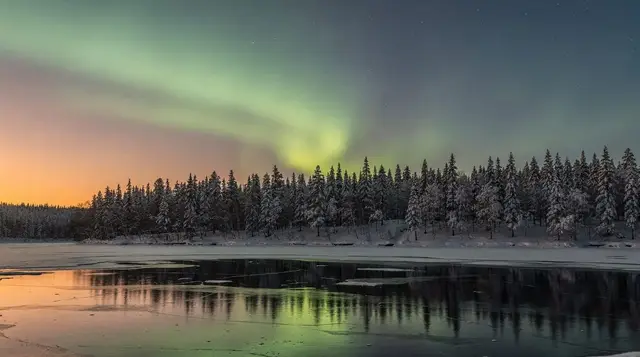
Around midday, for two or three hours, the sky lightens to a flat, saturated blue, the kind of colour you would associate with dusk rather than noon. Photographers chase it deliberately. It sits behind the low buildings of the rovaniemi grid in a way that makes the whole town look slightly unreal for a short while, then it fades back to grey and then to full dark by mid-afternoon. I want to be exact about this because most of what gets written about kaamos either overstates the darkness for drama or undersells it for reassurance. It is a real absence of daytime, softened by a few hours of genuine, if dim, light.
The light itself, and why it gets to you
The blue hours are the part visitors usually enjoy, at least at first. There is no glare, no need to squint, and the snow holds and reflects whatever light there is, which brightens things further than the sky alone would suggest. I found it genuinely beautiful for the first three or four days. Walking along the Kemijoki with that colour overhead felt closer to a long twilight than to night.
What I was not prepared for was the accumulation. By day six or seven, I noticed I had stopped checking the time by the sky, because the sky gave me nothing to check against. Morning, noon and evening all looked roughly the same shade of dark, punctuated by that blue window I had to remember to actually go outside for. A guide I spoke to at Arktikum, which has an exhibit on exactly this rhythm of the Lapland year, put it simply: the problem with kaamos is not the dark, it is the lack of contrast. Your body wants a clear signal that a day has happened, and for those ten days it does not get one unless you go looking for it.
I am not going to dress this up as something mystical. Some days I felt fine, mildly novel even. Other days, by the afternoon, I felt flat and a little foggy in a way that had nothing to do with tiredness. That matches what I heard from people who live here year-round: the mood dip during kaamos is common and usually mild, tied to reduced daylight and a circadian rhythm with nothing regular to anchor to. It is not the same as living through it every winter, and I would not claim otherwise after ten days as a visitor. But even that short a stretch made the effect obvious enough that I stopped being sceptical about it.
What actually helped
Going outside during the blue hours, deliberately, rather than treating them as background. A short walk, even in the cold, made a bigger difference than staying in a warm café watching the light change through a window. A sauna in the evening helped in a way I had not expected from something so ordinary here; it is worth reading up on Finnish sauna etiquette before your first one so you are not guessing at the rules.
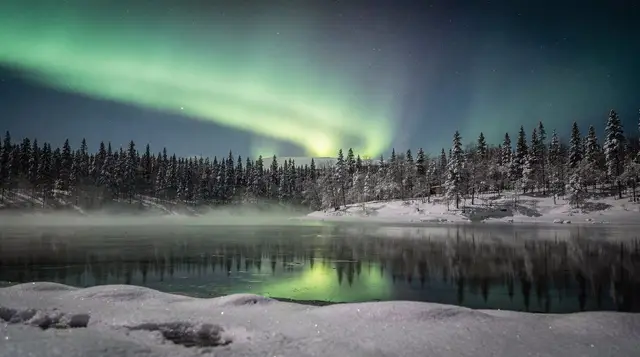
And getting out of town after dark to actually look for the aurora hunting guide style trip gave the darkness a purpose rather than leaving it as something to sit through. On a clear night, a few hours away from the streetlights with a smaller private aurora outing did more for how I felt than any amount of daytime rest.
I should be honest that early December is not the best month for that last part. It falls inside the aurora season by best time for northern lights, month by month, but it is also one of the cloudier stretches of the Lapland winter, so clear skies are not something to count on. Darkness on its own does not show you an aurora; a gap in the cloud does. If you want to understand the gap between what the eye actually sees and what a camera captures, that is covered separately in eye vs camera: what you really see, and it applies just as much during kaamos as any other month.
Kaamos is not the opposite you might assume
It is worth saying clearly: kaamos is not simply “winter” and it is not the same length as the midnight sun on the other side of the year. The sun-never-sets stretch runs from around 6 June to 7 July, roughly five weeks; the sun-never-rises stretch is closer to ten days.
I have written separately about the other extreme, in June, and the two experiences are not mirror images so much as different problems: one is too much light with no cue to sleep, the other is too little light with no cue to wake. If you are curious how the cold itself factors in on top of the dark, forty below: what it actually feels like covers that side of a Rovaniemi winter, and pairs with kaamos more than either alone.
| Period | Dates (approx.) | What happens |
|---|---|---|
| Kaamos, no sunrise | 2–12 Dec | Sun stays below the horizon; a few hours of blue light around midday |
| Deep winter, short days | Dec–Jan | Sun rises briefly and low; most cloudy of the aurora season |
| Best aurora windows | Sep–Oct, Feb–Mar | Longer dark hours with statistically clearer skies |
| Midnight sun | 6 Jun–7 Jul | Sun does not set; opposite problem, too much daylight |
If you are weighing whether to build a trip around kaamos specifically, my honest answer is that it is worth experiencing once, mostly for the blue light, which is unlike anything I have seen elsewhere, but I would not plan a whole itinerary around the sunless dates alone. For a longer, lighter-focused stay, the broader Rovaniemi winter and kaamos season guide and the month-by-month breakdown in Rovaniemi month by month give a fuller picture of how the light shifts either side of those ten days.
And if a heated glass roof to watch the sky from sounds more appealing than standing outside in the cold, it is worth reading whether glass igloos are actually worth it before booking one. I did not see an aurora on the two clear nights I had during kaamos itself; I wrote about that separately in the night I didn’t see the aurora, which is a fairer summary of how these trips can go than most brochures let on. What kaamos gave me instead, reliably, was that blue hour and a much better understanding of what a body actually needs a sunrise for.
Kaamos, questions I got asked
What exactly is kaamos?
Kaamos is the period around the winter solstice when the sun stays below the horizon all day. In Rovaniemi it runs from roughly 2 to 12 December, when the sun does not rise at all, though the sky still lightens to blue for several hours around midday.
When does kaamos happen in Rovaniemi?
The sunless stretch is short, about 2 to 12 December. Rovaniemi has long, dim winter days for weeks either side of that, with the sun only briefly above the horizon, but true kaamos with no sunrise at all is roughly ten days.
Is it completely dark for two weeks?
No. Rovaniemi gets several hours of blue civil twilight around midday even during kaamos, plus reflected light off the snow. It is not black darkness around the clock, but there is no direct sunlight and no proper daytime either.
Does kaamos affect mood?
Many people, locals included, notice lower energy and a flatter mood during the darkest weeks, likely tied to reduced daylight and disrupted circadian rhythm. It is usually mild and temporary, though it is worth taking seriously if you already struggle with seasonal mood changes.
How is kaamos different from the midnight sun?
They are opposite ends of the same tilt. Kaamos is the sunless period around 2 to 12 December; the midnight sun is the sun never setting, which happens in Rovaniemi from around 6 June to 7 July. They are six months apart.
Do locals do anything special to cope?
Getting outside during the blue hours, exercise, saunas, and daylight lamps are the common answers people give. None of it is exotic; it is mostly about not skipping the few hours of usable light in the middle of the day.
Is kaamos a good time to visit for the aurora?
Early December sits inside the northern lights season, but it is also one of the cloudiest stretches of the Lapland winter, so clear-sky odds are worse than in September-October or February-March. Darkness is not the limiting factor; cloud cover is.
Seasonal experiences on GetYourGuide
Verified deep-linked GetYourGuide tours. Book through these links and we earn a small commission at no cost to you.
GetYourGuide does not provide a product photo for this activity — the image shows the meeting point, photographed by us.