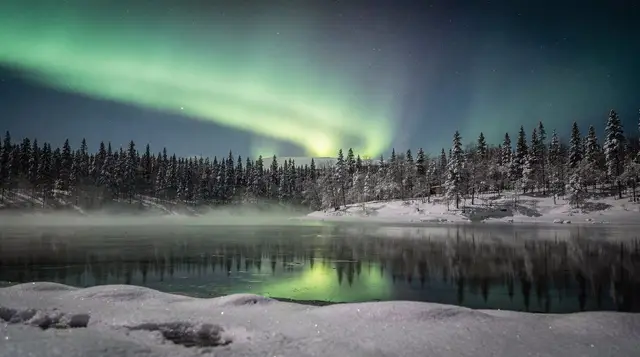
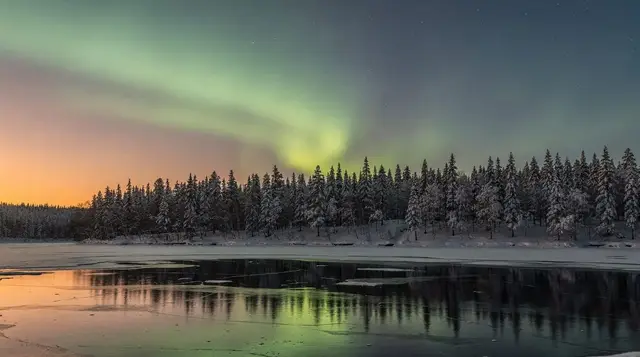
A forest walk that most Santa Claus Village visitors never take
Most people who come out to the Arctic Circle do it in a bus seat: ride out, cross the painted line, photograph the sign, buy a certificate, ride back. A few hundred metres from that car park, though, a marked network of forest trails runs east along the Ounasjoki tributary system to a set of rapids called Vaattunkiköngäs. It’s the easiest piece of genuine Lapland forest to reach from Rovaniemi without a car, and because it sits inside the same bus trip as Santa Claus Village, it’s also one of the most skipped.
This page covers the hiking area on its own terms: the trail, the falls, what the ground is actually like underfoot in each season, and the gear question that trips people up — because “5 km from the village” and “safe without proper boots” are not the same thing once the light drops and the paths ice over.
Getting to the trailhead without a car
Bus 8 from central Rovaniemi to Santa Claus Village takes roughly 25 minutes and runs at intervals of 30 to 60 minutes depending on the season — see getting around Rovaniemi for timetables and fares. From the village bus stop, the signed trailhead for the Arctic Circle hiking area (Napapiirin retkeilyalue) is a 10 to 15 minute walk north-east, well signposted in Finnish and English. There’s no separate ticket for the trail network itself; it’s public land laid out with waymarked routes of different lengths, the shortest loops taking under an hour and the walk out to Vaattunkiköngäs and back taking 2 to 4 hours depending on conditions and pace.
Because the whole outing — bus, village, trail — can be done in a single day with no rental car, it’s the backbone of a car-free Rovaniemi itinerary. If you’re only in the region for a day or two and weighing up how to spend it, this combination is one of the better uses of a single day highlights itinerary: the certificate line for the tourists, the forest for something quieter straight after.
The trail and the falls at Vaattunkiköngäs
The path follows the Vaattunkijoki, a tributary that feeds into the Ounasjoki system, through mixed pine and spruce forest that thins out in patches near the water. It’s flat to gently rolling — nothing that requires fitness, though winter conditions change that calculation considerably (more on that below). Boardwalks cover the boggier stretches in summer; in winter those same stretches are groomed and packed by trail machines, though not always recently.
Vaattunkiköngäs itself is a modest set of rapids rather than a dramatic waterfall — a stretch of the river where the current picks up over rock and gradient. In summer it’s simply fast-moving open water, worth the walk for the sound and the setting rather than any single photogenic drop. In winter it becomes the point of the whole outing: the surrounding river freezes solid while the rapids themselves often stay partially open, throwing up ice formations, frost-rimed rocks and open black water side by side — a contrast that photographs well and that guides sometimes work into wider forest and rapids walks.
There are basic rest points along the way — a campfire site (laavu) with a shelter, where it’s normal to stop, and where visitors following Finland’s right to roam can light a fire in the designated ring if dry wood is available and conditions allow it.
Signage divides the network into a few named loops of different lengths; the walk specifically to Vaattunkiköngäs and back is the longest commonly-used one from the Santa Claus Village side, at around 5 to 6 km round trip. Shorter loops closer to the trailhead suit visitors with less time, small children, or conditions that make the full route inadvisable.
Walking it in winter: ice, dark, and what you actually need
This is the part worth taking seriously, because the setting undersells the risk. The trail starts a 15-minute walk from a major tourist attraction, on marked and partly-groomed paths, which reads as low-stakes. It isn’t automatically. From roughly November to March:
- Ice, not snow, is the hazard. Packed snow compresses into a hard, often glassy surface under foot traffic, especially on the boardwalk sections and any incline. Ordinary winter boots without added grip slip on this. Studded ice grips (crampon-style overshoes, cheap and widely sold in Rovaniemi) make a genuine difference and cost very little to carry.
- Daylight is short and the forest is darker than the open village. Around the winter solstice, useful daylight in Rovaniemi runs only a few hours, and tree cover cuts what light there is further. A route that looks easy at midday can mean walking part of it in near-darkness by mid-afternoon. Carry a torch or headlamp even on a “daytime” walk between late November and January — see winter and kaamos season for what the light actually does across the season.
- Temperature drops faster once you stop moving. Standing still at a viewpoint or the campfire shelter at -15°C or colder cools you quickly even in decent boots. The three-layer system — wicking base, insulating mid, wind- and waterproof outer — matters here exactly as much as it does on a guided tour, because nobody is handing you a thermal suit for a self-guided forest walk.
- The falls themselves are not a place to improvise footing. Ice at the edge of open, fast-moving water is unpredictable in thickness and can be undercut. Admire the rapids from the marked viewpoints and the bank; this isn’t a spot to walk out onto ice near open water, unlike a frozen lake a guide has explicitly checked.
- Phone signal is generally fine but battery drains fast in the cold. Keep a phone insulated (an inner pocket, not an outer one) if you’re relying on it for maps or the return bus time.
None of this makes the walk unsuitable for an ordinary visitor — thousands do it every winter — but “5 km from Santa Claus Village” is doing a lot of reassuring work in most descriptions of this trail, and the conditions deserve the same respect as a more remote route. See hiking the Arctic Circle trails for a fuller rundown of trail conditions by month.
Snowshoeing the same ground
Snow accumulates enough by December, and stays until roughly April, that snowshoes make more sense than boots off the groomed path — deep, unpacked snow in the forest is otherwise slow and tiring to walk through. Self-guided snowshoeing on this network is possible if you rent gear in Rovaniemi and know the route, but most visitors doing it for the first time do better on a guided outing, partly for route-finding once you leave the marked trail and partly because rented gear from a shop rarely fits as well as a guide’s kit.
a reindeer farm visit that pairs a snowshoe walk in the forest with time at the pens is one way to get a guided introduction to snowshoeing without making it the whole day — useful if the trail above is your only planned walk and you’d rather have gear and a guide sorted for you. For background on how snowshoeing here compares with groomed cross-country routes, see snowshoeing near Rovaniemi and cross-country skiing Rovaniemi.
Summer and shoulder-season walking
From roughly June to August the calculation flips: no ice, no darkness (Rovaniemi has midnight sun from 6 June to 7 July), and the main nuisance is mosquitoes near standing water and in still forest air, worse in late June and July. Waterproof boots or good trainers are enough; insect repellent is the one thing worth remembering that winter visitors don’t need to think about. The rapids run full and fast rather than half-frozen, which some visitors find more impressive than the winter version and others find less atmospheric — it’s simply a different walk.
September brings ruska, the turning of the birch and undergrowth to red and gold, and is widely considered the best-looking single month on this trail: cooler, mosquito-free, with colour in the forest and the first frosts starting to rim the rapids by late in the month. It also overlaps with the start of aurora season, which makes an early-evening walk here followed by a look at the sky worthwhile — the trailhead area is close enough to Rovaniemi’s light dome to not be a serious dark-sky spot, but it’s darker than the city centre. For somewhere genuinely dark, see walking aurora spots near Rovaniemi rather than relying on this trail after dusk.
Wildlife, rapids and what to actually expect underfoot
Set expectations honestly: this is accessible forest, not wilderness. You’re likely to see squirrels, birds, and possibly reindeer tracks or a reindeer itself, since animals move freely through the area under Finland’s grazing system — but sightings of anything larger are occasional, not scheduled. The value of the walk is the forest and the rapids themselves, not a wildlife guarantee; anyone wanting a reliable animal encounter is better served by Ranua Wildlife Park or a farm visit than by this trail.
Underfoot, outside the boardwalk sections, the ground is typical boreal forest floor — roots, rock, moss, and in summer occasional soft or boggy patches even where the path looks dry. None of it is technical walking, but trainers with worn soles are a worse idea here than the “easy forest walk” framing suggests, in any season.
Combining it with a Santa Claus Village day
The practical case for this trail is almost always the same: you’re already at Santa Claus Village for the Arctic Circle line, the post office and the shops, and you have an hour or two spare before the bus back. Walking even the shorter loop gives the day some forest and quiet after a genuinely commercial stop — see the Santa Claus Village complete guide and the Arctic Circle line certificate for what the village side of the visit actually involves, since this page deliberately doesn’t repeat that.
If aurora hunting is also on the agenda for the same evening, note that a short short night drive built around sky observation away from town departs later and covers different, darker ground than this trailhead — the two are complementary, not a substitute for one another. Visitors building a full evening around the sky rather than a short outing sometimes prefer an evening combining aurora watching with ice floating in a survival suit, which is a different kind of activity entirely from the forest walk covered here.
Practical planning table
| What | Detail |
|---|---|
| Trailhead access | Bus 8 to Santa Claus Village, then 10–15 min walk on foot |
| Cost | Free to walk; no entry fee for the trail network |
| Shortest loop | Under 1 hour, suitable for young children in good conditions |
| Walk to Vaattunkiköngäs and back | 5–6 km, roughly 2–4 hours at a relaxed pace |
| Terrain | Flat to gently rolling; boardwalks over boggy sections |
| Winter essentials | Ice grips for boots, headlamp, three-layer clothing |
| Summer essentials | Waterproof footwear, insect repellent (June–July) |
| Best single month | September, for colour, cooler air and no insects |
| Facilities | A campfire shelter (laavu) partway along; no shops or toilets on the trail itself |
FAQ about the Arctic Circle hiking area
Is the Arctic Circle hiking area free to visit?
Yes. The trail network is public land with no entrance fee. The only costs are getting there (bus fare) and any optional guided snowshoe or forest tour you choose to book instead of walking independently.
How do I get there without a car?
Take bus 8 from central Rovaniemi towards Santa Claus Village, roughly a 25-minute ride running every 30 to 60 minutes depending on the season. The marked trailhead is a further 10 to 15 minutes on foot from the village bus stop.
Is the trail safe in winter?
It’s walkable by an ordinary visitor, but the paths ice over and daylight is short from November to January. Ice grips for your boots, a headlamp, and proper winter layers are not optional extras here just because the trailhead is close to town — treat it with the same preparation as any other winter walk in Lapland.
What is Vaattunkiköngäs, and is it a waterfall?
It’s a stretch of rapids on the Vaattunkijoki, a tributary that feeds into the Ounasjoki system — fast water over rock rather than a single dramatic drop. In winter the surrounding river freezes while the rapids often stay partly open, which is the main visual draw for a winter visit.
Can I combine this walk with a Santa Claus Village visit on the same day?
Yes, easily — that’s how most visitors do it. The trailhead is a short walk from the village, and even the shorter loops fit into an hour or two before or after seeing the Arctic Circle line and the post office.
Do I need snowshoes, or can I just walk the trail in winter?
The main groomed route to Vaattunkiköngäs is walkable in sturdy winter boots with ice grips. Snowshoes only become useful if you leave the packed path for deeper, ungroomed snow, which most casual visitors don’t need to do.
Are there guided options if I’d rather not walk it alone?
Yes. Guided snowshoe outings that include this kind of forest terrain are available and include gear and a guide, which suits visitors unfamiliar with winter walking conditions or short on time to research the route themselves.
Will I see reindeer or other wildlife on the trail?
Possibly, but it isn’t guaranteed. Reindeer move freely through the wider area and tracks are common; sightings of the animals themselves are occasional rather than reliable. For a guaranteed wildlife encounter, a dedicated park or farm visit is a better bet than this trail.