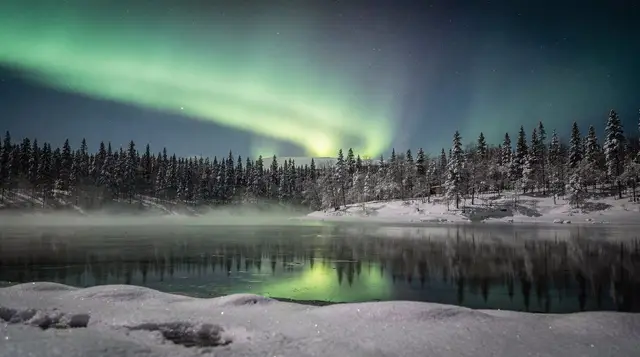
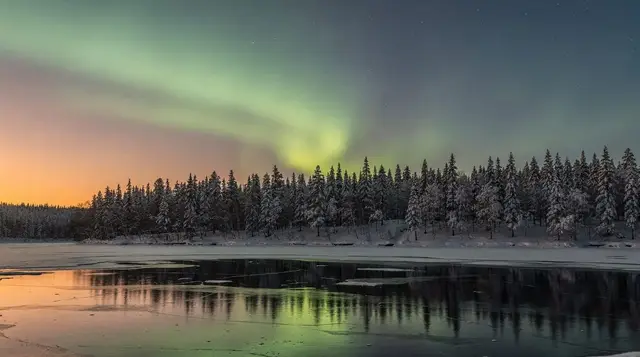
Chasing the northern lights by car from Rovaniemi
Is it worth renting a car to chase the northern lights from Rovaniemi?
Yes, if you're already comfortable with winter driving: a car lets you outrun the city's light dome and local cloud cover on quiet back roads at your own pace. Winter tyres are a legal requirement and black ice is a genuine hazard from roughly November to March, so this suits confident drivers only – anyone without snow or ice experience is better off on a guided minibus tour.
A rental car parked on a dark forest road, engine ticking as it cools, is one of the cheapest ways to chase an aurora from Rovaniemi – and one of the least forgiving if you’ve never driven on ice before. This guide is about the driving itself: why leaving the city matters, what winter roads actually do to a car, and where self-driving stops being a good idea. It doesn’t cover guided snowmobile or dog-sled aurora trips, which have their own pages, and it doesn’t list exact viewing spots either – for those, see the free northern lights viewing spots guide. This one is about the drive.
Why bother leaving Rovaniemi at all
Rovaniemi is a working town of around 64,000 people, and like any town its streetlights, shop signs and traffic throw a dome of light straight up into the sky. That dome doesn’t block an aurora outright, but it washes out anything faint, which is most of what the eye actually sees on an average night – see what your eye sees versus a camera for why that matters. Drive 20 to 30 minutes out of town on a minor road, and the sky darkens noticeably even before you’ve reached anywhere with a name attached to it. The aurora itself doesn’t get any stronger by driving; what changes is your ability to see it, because you’ve removed the artificial light that was competing with it.
The other reason to move is cloud cover, which is local and patchy in a way that light pollution isn’t. A cloud bank can sit over Rovaniemi while the sky is clear 40 kilometres north, or the reverse. A car gives you the option to check the sky in one direction, decide it’s not working, and drive somewhere else – which is exactly what guided aurora tours do in a minibus, just without you at the wheel. For the mechanics of why cloud, darkness and geomagnetic activity all have to line up together, read how the northern lights actually work and the month-by-month breakdown of when to go.
Choosing a direction, not a destination
The instinct on a first night is to look up a single named spot and drive straight there. It’s a reasonable instinct, but it treats the aurora like a fixed attraction rather than a moving, weather-dependent phenomenon. A better habit is to pick a general direction – say, a quiet road running north away from town – and simply drive until the sky opens up and the streetlights are gone, pulling into any safe layby or car park along the way rather than committing to one exact point. Minor roads around Rovaniemi run through forest and past frozen lakes and fields, and a lake shore or a gap in the treeline is often all you need: open sky above, no glow behind you.
This guide deliberately doesn’t list specific pull-offs and viewpoints – that’s covered, with names and directions, on the free northern lights viewing spots page and the walking spots near Rovaniemi guide for anyone without a car at all. What matters for the driving side is simpler: give yourself a route with a few stopping options rather than one single target, because if the sky is clouded over when you arrive, you want somewhere else to try without backtracking all the way into town.
Read the sky before you start the engine
Check a cloud forecast, not just an aurora forecast, before setting out – a clear geomagnetic forecast is worthless under an overcast sky, and Lapland’s cloud cover shifts hour to hour in winter. The aurora forecast apps and tools guide covers which apps are actually useful for this versus which just repeat a generic activity number. A rough rule that saves a lot of pointless driving: if the cloud map shows a clear band 30 to 60 kilometres away in any direction, that’s a realistic target; if it shows cloud everywhere within range, driving further afield on icy roads at midnight rarely pays off, and staying in is the better call.
Winter tyres are not a suggestion
Finnish law requires winter tyres on the road from the start of December to the end of February, and conditions on the ground usually demand them well before and after that window too – in practice, treat November to March as tyre season in Lapland. Every rental company operating out of Rovaniemi Airport or the town centre fits winter tyres as standard for the season, either studded or a heavy-duty friction compound, and this is one area where it’s worth double-checking rather than assuming: walk round the car before driving off and look at the tread.
If you’ve booked outside Finland through a site that doesn’t clearly state winter tyres are included, ask directly. The full detail on studded versus friction tyres, and what a rental actually costs once winter equipment is added, is in the renting a car and winter tyres guide.
| What changes in winter | Typical detail |
|---|---|
| Tyres | Studded or friction winter tyres, compulsory roughly Nov–Mar |
| Engine block heater | Cars often come with a heater cable; plug in below about -15°C where a socket is provided |
| Headlights | On at all times, by law, all year round in Finland |
| Screen wash | Rated for well below -20°C, checked before departure |
| Fuel | Kept above a half tank in remote areas – some stretches have no fuel for 50km+ |
Black ice behaves differently than most visitors expect
The phrase “black ice” tends to conjure a single dramatic patch, but on Lapland’s back roads it’s usually a change in surface that’s invisible until the car is already on it: a stretch of road in shade, a bridge deck, a spot where a side road joins and packed snow has been polished by passing tyres. The give-away is often not visual at all – it’s a very slight looseness in the steering before anything else happens. The response that keeps a car under control is almost the opposite of instinct: ease off the accelerator, don’t brake hard, don’t turn the wheel sharply, and let the speed bleed off gradually. Braking hard or steering sharply on ice is what turns a minor loss of grip into a spin.
Studded tyres help enormously but don’t eliminate the risk, and neither does four-wheel drive – four-wheel drive helps a car accelerate on snow, it does nothing extra for stopping or turning on ice. The two biggest practical safeguards are speed and following distance: driving 10 to 20 km/h below the posted limit on an untreated rural road at night, and leaving several times the gap you would on a dry road at home. For a fuller rundown of ice-specific hazards, including how Finnish drivers themselves adjust for them, see driving in Lapland: reindeer, ice and rural roads.
Reindeer and elk are a nightly hazard, not a novelty
Reindeer in Lapland are free-ranging livestock, owned and marked by Sámi herding cooperatives but not fenced in, and they graze right along road verges through the winter because ploughed roadsides are often the easiest walking. They cross without warning, at any hour, and they’re most active and least visible at dusk, dawn and on clear moonlit nights – the same conditions that are good for aurora-watching. Elk are less common but heavier, and a collision with either is a genuine, not theoretical, cause of accidents in the region; Finnish law requires you to report any collision with an animal, even a minor one, to the emergency number.
The practical response is unglamorous: keep speed down on open rural stretches after dark, scan the verges rather than just the road ahead, and use full beam whenever no oncoming car is in sight – reindeer eyes reflect at a distance the same way a cat’s do, giving a moment’s warning if the lights reach far enough. Don’t swerve hard to avoid an animal that appears suddenly; a controlled brake in a straight line, even if contact is unavoidable, causes far less damage than a swerve that puts the car into a skid or oncoming traffic.
What actually changes about the car at -20°C and below
A car’s behaviour shifts in ways that aren’t obvious from a warm climate. Braking distances lengthen, sometimes considerably, on packed or polished snow, so the following-distance habit above matters even more than the speed limit does. Diesel engines can gel in extreme cold if not rated for it – rental fleets in Lapland use winter-grade fuel, so this isn’t something to manage yourself, but it’s why “why is this engine sluggish to start” is a real, if rare, complaint on the coldest mornings.
Door seals can freeze shut after a car has sat outside; a firm tug rather than repeated slamming usually frees them. Windscreen washer fluid needs a rating well below the ambient temperature or it freezes in the reservoir, which is why rental cars are filled with proper winter-grade fluid rather than the diluted summer version.
None of this is dangerous on its own, but it adds up to a car that needs a slightly more deliberate startup routine than a rental in a milder climate: give the engine and cabin a few minutes to warm before setting off, clear all glass fully rather than a porthole through the frost, and check tyre pressures periodically, since cold air drops pressure noticeably over a few days.
A realistic night out
An aurora drive by car tends to run 2 to 4 hours once you count the time spent finding a clear patch of sky, waiting, and driving home, and it’s almost always a late one – 9pm to midnight is the practical window on a clear night, sometimes later.
Dress as if you’ll be standing still outside for 20 to 40 minutes at a time in temperatures that can sit anywhere from -10°C to below -25°C; see the three-layer packing system for what actually works, because a car’s heater does nothing for you once you’re standing outside it with the engine off to kill the noise and light. Keep your phone warm inside a jacket rather than a bag – batteries drain fast in deep cold – and bring a printed or offline map for any stretch with patchy signal, which describes most of rural Lapland after dark.
Fuel matters more here than it does at home: some rural stretches run 40 to 60 kilometres between filling stations, and running low at night in deep cold, far from town, is not a situation to test. Top up before setting out and again if the tank drops below half on a longer drive, particularly toward Sodankylä or further into Finnish Lapland beyond day-trip range.
When self-driving is the wrong call
None of the above is meant to talk anyone into driving who shouldn’t be. If you’ve never driven on snow or ice before arriving in Rovaniemi, an aurora-hunting car trip is not the moment to learn – the combination of an unfamiliar car, an unfamiliar road network, deep cold and low light is a lot to take on at once, and it’s exactly the scenario Finnish winter driving courses exist to prepare people for over weeks, not one evening. The honest test is simple: if the idea of the car sliding slightly on a bend makes you tense rather than something you’d know how to handle, that’s the answer.
The comparison with a guided option is worth making plainly rather than glossing over:
| Self-drive | Guided minibus tour | |
|---|---|---|
| Control over route and timing | Full | Set by the guide |
| Ice and snow driving required of you | Yes | No |
| Local knowledge of current clear-sky areas | Your own research | The guide’s, updated nightly |
| Typical cost | Rental car + fuel, shared over the trip | Roughly €100–200 per person for the evening |
| Best suited to | Confident winter drivers | Everyone else, including first-timers |
For a fuller version of this comparison, including cost breakdowns, see guided tour versus rental car in Rovaniemi. A guided evening typically means a minibus, a guide checking cloud cover and forecasts in real time, and a stop 100 to 200 kilometres out with a campfire and hot drinks while you wait – the driving and the route decisions are someone else’s job. In Levi, the Levi Northern Lights Campfire evening follows exactly that format: a guided drive out from light pollution to an open site with a fire going while the group waits for a break in the cloud.
Further north and further from any town glow, the Utsjoki Northern Lights Lavvu tour trades distance for genuinely dark skies, with a traditional lavvu tent as shelter between sightings. And for anyone who’d rather be moving than standing still, the Ruka Guided Northern Lights Hike covers similar ground on foot with a guide who knows the local terrain in the dark, which removes both the driving and the navigation from the equation entirely.
Whichever way you choose to do it, remember what a car trip can’t do: it can’t create an aurora that isn’t there, and no operator can promise otherwise – see what “guaranteed” aurora tours actually guarantee before booking anything sold on that word. What a car buys you, when conditions are right, is the freedom to put real distance between yourself and Rovaniemi’s lights and to keep moving until you find a clear patch of sky – provided you’re driving in conditions you already know how to handle.
For the wider seasonal picture of what a Lapland winter actually involves beyond aurora-hunting, see Rovaniemi’s winter and kaamos season, and for a full multi-day plan built around aurora chances, the northern lights hunting itinerary lays out a realistic pace across several nights rather than betting everything on one.
Questions about chasing the aurora by rental car
Do I need a special licence to drive in Finnish Lapland?
No. A full driving licence valid for Finland is enough; there’s no separate winter or Arctic permit. UK, EU and most other national licences are accepted at rental desks, though it’s worth checking Finland’s official entry requirements if your licence is from further afield. Automatic cars are limited in number and sell out first in winter, so book early if you can’t drive a manual.
Are winter tyres compulsory on a rental car?
Yes. Finnish law requires winter tyres from December to the end of February, and in practice they’re needed whenever the road is icy or snow-covered, which in Lapland is roughly November to March. Every reputable rental company in Rovaniemi fits studded or heavy-duty friction winter tyres as standard; if a car is ever offered on summer tyres in winter, refuse it.
How far do I need to drive to get away from Rovaniemi’s light pollution?
Often not far – 20 to 30 kilometres along a quiet minor road already cuts most of the sky glow, because the point is putting distance between yourself and streetlights and traffic, not reaching one exact spot. If you want named, specific viewing points rather than a general direction, see the free northern lights viewing spots guide.
Is it safe to drive at night in temperatures below minus 20 degrees?
It can be, in a properly prepared car – winter tyres, full antifreeze, a charged battery, a scraper and a torch – driven to the conditions rather than to the speed limit. It’s still more demanding than daytime driving in a temperate climate: braking distances lengthen on packed snow, and a windscreen can ice over from breath alone if the heater struggles.
What about reindeer and elk on the road at night?
They’re a real and common hazard, not a folk tale for brochures. Reindeer graze right up to the verge and cross without warning, especially around dusk, dawn and on moonlit nights when they keep moving after dark. Slow down on rural stretches, use full beam whenever there’s no oncoming traffic, and never assume a straight, empty road will stay that way.
Should I book a guided aurora tour instead of driving myself?
If you’ve never driven on snow or ice, yes – that’s the honest answer. A guided minibus tour gets you to a dark sky without you having to learn Arctic road conditions on the fly, and the guide is watching the forecast and the roads for a living. Self-driving pays off mainly for visitors who already drive confidently in snow and want to choose their own route and timing.
Northern lights tours on GetYourGuide
Verified deep-linked GetYourGuide tours. Book through these links and we earn a small commission at no cost to you.
GetYourGuide does not provide a product photo for this activity — the image shows the meeting point, photographed by us.