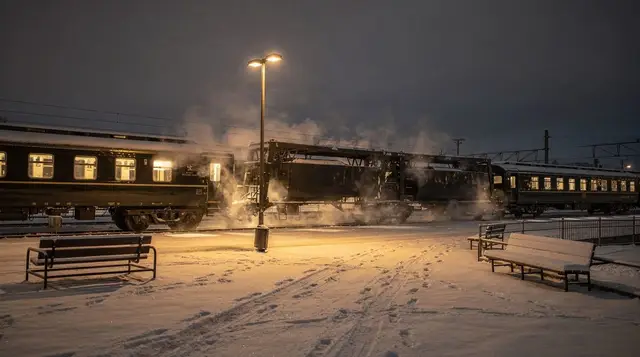
The Helsinki to Rovaniemi night train, cabin by cabin
How long is the night train from Helsinki to Rovaniemi, and is it worth it?
The VR night train covers roughly 830 km between Helsinki and Rovaniemi in about 12 hours, departing in the evening and arriving the next morning. Travelling overnight in a sleeper cabin means you don't lose a daylight day to the journey, though departures, cabin availability and fares vary by season and should be checked directly with VR rather than assumed.
Twelve hours, mostly asleep: how the route works
VR’s night train between Helsinki and Rovaniemi covers the same roughly 830 km you’d otherwise cover by road or air, but it does it while you sleep. The scheduled journey time is around 12 hours: board in the evening, most departures leave Helsinki’s main station somewhere between 18:00 and 20:00, and you wake up already in Lapland, arriving in Rovaniemi typically between 07:00 and 09:00. Those windows move with the timetable and the season, so treat them as a planning range rather than a fixed clock — the current VR timetable is the only source that matters when you’re actually booking.
This page covers the train itself: cabins, the car-carrying wagon, what the night feels like, and where it stops on the way north. It doesn’t compare the train against flying or the long-distance bus in any depth — for that side-by-side, see how to get to Rovaniemi, which weighs all the options together. Once you’re off the train, getting around the city and beyond is covered separately in getting around Rovaniemi.
Why bother with an overnight train at all
The case for the night train isn’t speed — a flight from Helsinki to Rovaniemi Airport takes about 1 hour 25 minutes, a fraction of the train’s 12 hours. The case is what the 12 hours replace. Book a sleeper cabin and you’re paying for transport and a night’s accommodation in one go, and you arrive with a full day ahead of you instead of a travel day burned on getting there.
For a short trip of three or four days, that’s a meaningful fraction of your itinerary back. If your trip is already tight on days, it’s worth reading how many days in Rovaniemi before deciding whether the night train’s day-saving actually changes your plan, or whether flying and taking the saved time as rest is the better trade for you.
There’s also a simple comfort argument that has nothing to do with the clock: a couchette or cabin lets you stretch out, rather than sitting upright for half a day. Combined with the fact that Helsinki’s airport and train station both sit within the same transport network, the night train is a genuinely relaxed way to cover a distance that would otherwise mean a long drive through the dark on unfamiliar winter roads.
Cabin types, from shared bunk to en-suite
VR’s overnight service on this route isn’t a single product — it’s a spread of cabin classes at different price points, and the difference between them is real enough to plan around rather than book on autopilot.
| Cabin type | Beds | Facilities | Best suited to |
|---|---|---|---|
| Shared couchette | Berths in a shared compartment (typically 3) | Bedding provided; washbasin and toilets shared along the carriage | Solo travellers on a tight budget, comfortable sharing |
| Private sleeper cabin | 1–2 berths, door that locks | Private washbasin; toilet and shower shared along the carriage | Couples, solo travellers who want privacy |
| Deluxe cabin | 2 berths | En-suite shower and toilet inside the cabin | Anyone prioritising comfort over cost |
| Car-carrying wagon | — (booked alongside a separate passenger cabin) | Enclosed carriage for one vehicle | Drivers bringing their own car north |
A few things worth knowing before you assume a class is available: the number of cabins per class is limited and fixed by the train’s formation on a given night, deluxe cabins are the first to sell out around Christmas and New Year, and fares climb with both class and how close to departure you book — sometimes sharply in December. None of these figures are fixed enough to quote as a set price here; check VR’s own booking system for your exact dates. For a general sense of what the trip fits into against everything else in a Lapland budget, see Rovaniemi trip budget.
Every cabin above the most basic seating comes with bedding — sheets, a pillow and a blanket — made up for you, so there’s no need to bring your own. What you should bring is anything you’ll want before falling asleep: earplugs if you’re a light sleeper booked into a shared couchette, and a layer warm enough for a cold platform if your connecting transport at either end involves standing outside, since Lapland winter temperatures commonly sit at -10 to -25°C. The three-layer approach covered in what to pack: the three-layer system applies just as much to a station platform as to a husky sled.
The wagon that carries your car
The detail that sets this route apart from most European night trains is the car-carrying wagon: on services that include it, you drive your own vehicle onto a dedicated carriage in Helsinki before boarding your separate passenger cabin, and you collect the car the next morning in Rovaniemi, undamaged by a 12-hour drive and without you having driven a single kilometre of it yourself.
The appeal is fairly direct. It removes the longest and least interesting stretch of winter driving from your trip — the flat, largely featureless run north through the middle of the country — while still leaving you with your own car once you’re in Lapland, useful for reaching places the bus network barely touches, like Ranua Wildlife Park or the fells around Ylläs.
It also sidesteps a rental car booking altogether, along with the requirement for winter tyres covered in renting a car: winter tyres and the driving conditions covered in driving in Lapland: reindeer and ice roads — conditions you’ll still meet once you’re driving locally around Rovaniemi, just not for the long haul north.
Two practical points matter here. First, car space on the wagon is limited and separate from your cabin booking — book both together, and don’t assume a car space is available just because cabins are. Second, not every night train service includes the car wagon; it runs on a subset of departures, so confirm it’s attached to the specific train you’re booking rather than assuming it’s standard.
What the journey actually feels like
Boarding happens the way any overnight train boarding does: find your carriage and berth number on the platform, settle in, and the train pulls out into the evening. There’s usually a restaurant or bistro car serving food and drinks for the first stretch of the journey, worth using before you turn in, since options thin out once most passengers are asleep and the carriage lights are dimmed for the night.
The train does sway, and it does stop — at stations along the route and sometimes for signal or crossing reasons in the middle of nowhere — and neither is a fault, just the reality of overnight rail travel. Most people sleep through the majority of it once they’re tired enough after a travel day, and a private or deluxe cabin with a door that locks tends to make that meaningfully easier than an open shared couchette. If you wake as the train crosses into Lapland proper, the scenery outside shifts from farmland to the flatter, more thinly forested landscape that surrounds Rovaniemi — worth a look if you’re up anyway, though there’s genuinely nothing wrong with sleeping straight through to arrival.
Morning arrival means a functioning washbasin (and, in deluxe cabins, a shower) before you disembark, so you can step off reasonably presentable rather than crumpled from a red-eye flight. That’s part of the case for the night train as much as the saved day is: you arrive rested, not drained.
Stations along the way
The route runs north from Helsinki through Tampere and Oulu, Finland’s main west-coast corridor, before turning inland toward Lapland. Neither city is a realistic stop-off for a Rovaniemi-focused trip unless you’re deliberately breaking the journey, but they’re useful landmarks for tracking progress if you’re awake and watching the platform signs.
Closer to the northern end of the line, some services continue past Rovaniemi to terminate in Kemijärvi, Finland’s northernmost town with that status, on certain days of the week. If Kemijärvi rather than Rovaniemi is actually your destination — perhaps as a base for the eastern fells or Salla — check the specific train’s final stop before booking, since not every departure runs that far.
For anyone arriving in Rovaniemi itself without a car, the no-car Rovaniemi itinerary and the Rovaniemi airport transfer guide — whose transfer logic largely mirrors getting from the train station into town — both cover onward movement once you step off.
a hotel transfer booked in advance from the station is a straightforward way to avoid figuring out local buses on an early, half-awake morning, particularly if you’ve arrived with luggage for a longer stay.
Booking, timing and the caveats worth knowing
Book directly through VR for the most accurate, current fares and cabin availability — third-party comparison sites can lag behind real seat maps. A few points worth carrying into that booking process rather than assuming:
- Frequency is not fixed. The night train does not run identically every single day of the year; services are denser around the Christmas and New Year period and thinner outside it. Confirm your travel date has a departure before building an itinerary around it.
- Fares are not fixed either. Price depends on cabin class, how far ahead you book, and the season — December and early January fares run noticeably higher than the shoulder months, in line with the general seasonal price jump covered in Rovaniemi trip budget. Quote yourself a range, not a number, until you’re looking at a live booking screen.
- Deluxe cabins and car spaces sell out first. If either matters to your trip, book weeks rather than days ahead, especially for travel in December.
- Bedding is included, but bring your own earplugs and eye mask if you’re in a shared couchette and sensitive to noise or light.
If you’d rather not commit to overnight travel at all, the alternative routes and their trade-offs — flying, driving, or the long-distance bus — are laid out properly in how to get to Rovaniemi, which is the better page for weighing this train against everything else rather than assuming it’s the only option.
Arriving in Rovaniemi
Stepping off a 12-hour overnight train with a full day still ahead of you is, in practice, the whole point of taking it. Rovaniemi’s compact, walkable centre — reachable on foot from the station in well under 20 minutes — means you can drop bags at where to stay in Rovaniemi and be doing something the same morning rather than losing it to travel recovery.
A gentle first morning after a night on the rails suits low-effort sightseeing rather than anything physically demanding: the Rovaniemi one-day highlights itinerary and the broader things to do in Rovaniemi city guide both work well as a starting point, and if the town’s unusual post-war layout interests you, a look at Alvar Aalto’s reconstruction plan pairs naturally with an easy walking pace.
a guided walk through Aalto’s reindeer-antler street plan, with transfers included is a low-key way to fill that first morning without needing much stamina, and it’s over well before lunch, leaving the rest of the day free for whatever you actually came north to do — including your first attempt at the aurora that night, since a private aurora tour arranged for your first evening makes good use of the daylight hours you’ve just gained by not having spent them travelling.
For something that folds the train itself into the experience rather than treating it purely as transport, a themed night train excursion through the winter forest is a different product from the Helsinki–Rovaniemi service covered above — worth knowing about separately if the idea of Lapland by rail appeals to you beyond just the transfer north.
FAQ: the Helsinki–Rovaniemi night train
How long does the Helsinki–Rovaniemi night train actually take?
Around 12 hours, door to door on the timetable. Departures are typically in the evening, from around 18:00 to 20:00, with arrival in Rovaniemi the following morning between roughly 07:00 and 09:00. Exact times shift by timetable and season, so check the current schedule before planning connections.
What cabin types are available on the night train?
VR’s overnight service offers shared couchette-style berths, private sleeper cabins for one or two people with their own washbasin, and a smaller number of higher-class cabins with an en-suite shower and toilet. Bedding is provided in every category above the most basic seating.
Can I really take my own car on the train?
Yes, on the services that include a car-carrying wagon, you drive your vehicle onto a dedicated carriage in Helsinki and collect it in Rovaniemi the next morning, while you sleep in a separate passenger cabin. Space is limited and must be booked alongside your own ticket, not assumed as automatically available.
Does the night train run every day of the year?
No. Frequency changes by season, with more departures around the winter holidays and fewer at other times of year, and the car-carrying wagon in particular is not guaranteed on every service. Always check VR’s live timetable for your travel dates rather than relying on a fixed pattern.
Is the night train cheaper than flying?
It depends on how far ahead you book and which cabin class you choose. A shared couchette booked early can undercut a flight, while a private deluxe cabin booked close to departure, especially around Christmas, can cost more than a plane ticket. Treat published fares as a starting range, not a fixed price.
Which stations does the train stop at along the way?
The route runs north through Tampere and Oulu before reaching Lapland, with a handful of further stops before Rovaniemi. On some schedules the service continues beyond Rovaniemi to Kemijärvi, which is worth checking if that town is your actual endpoint.
Is the night train comfortable enough to actually sleep?
Most travellers find the private and deluxe cabins genuinely restful, with a real mattress, sheets and a door that locks, though the train does sway and stop through the night. Shared couchettes are noisier and less private, which matters more for light sleepers than for anyone tired enough after a travel day.
Do I need to book far in advance?
For December and the car-carrying wagon specifically, yes: both sell out weeks ahead in peak season. Outside the Christmas period, booking a couple of weeks out is usually enough, though earlier booking tends to mean lower fares regardless of season.
Transfers & getting around on GetYourGuide
Verified deep-linked GetYourGuide tours. Book through these links and we earn a small commission at no cost to you.
GetYourGuide does not provide a product photo for this activity — the image shows the meeting point, photographed by us.