A lake the size of a small sea, not a village stop
Lake Inari is one of Finland’s largest lakes, and by far the biggest body of water in Finnish Lapland. It spreads across the municipality of Inari, roughly 330 km north of Rovaniemi, and holds more than 3,000 islands — everything from wooded islets to bare skerries.
This page is about the lake itself: what you can do on and around it, in summer and in winter, and what genuinely changes between seasons. The village of Inari and the Siida Sámi museum sit right on its southern shore and deserve their own visit — see the dedicated guides to Siida and to Sámi culture for that side of the trip.
Scale matters here. This is not a lake you walk around or take in from one viewpoint. It is closer to an inland sea, with open water (or open ice) stretching to the horizon in several directions, bays that reach deep into the surrounding forest, and a scattering of islands that makes the shoreline genuinely hard to map in your head on a first visit. That scale is also why the lake works so well for aurora viewing and why it takes real planning, not a casual afternoon, to see properly.
Among the islands, one stands apart. Ukonkivi, a rocky islet not far from Inari village, has long been regarded by the Sámi as a sacred site — a place of offering rather than an ordinary landmark. Some summer cruises pass close to it or stop nearby with a guide who explains its significance. It is worth treating with the same respect you would show any active religious site, not as a scenic backdrop.
Getting there and basing yourself
Lake Inari is too far from Rovaniemi for a comfortable single day trip in either direction — the drive alone runs about 4 hours each way via Ivalo. Most visitors either join a multi-day tour that includes transport, self-drive and stay a night or two, or combine the lake with a stop in Saariselkä, which is closer at around 260 km. See Saariselkä and Inari as a day-trip pairing for how that combination works in practice. Ivalo, Inari village and Saariselkä are the three practical bases, each with its own range of accommodation and activity operators.
Winter driving conditions apply on the route north exactly as they do everywhere in Lapland — winter tyres, headlights on at all times, and a genuine risk of reindeer or elk on the road, especially after dark.
Summer on the water: cruises, fishing and kayaking
Between roughly June and August, once the ice has fully cleared, Lake Inari opens up for boats. Lake cruises are the easiest way to get a sense of the scale of the place and to see islands, including a pass near Ukonkivi, that you cannot reach on foot. A cultural day that pairs a cruise with a stop at Siida is a common and sensible combination — you get the water and the context in one outing, with a lake cruise combined with a Siida museum visit covering both halves.
Fishing on open water is also on offer, targeting the same species — perch and whitefish mainly — that are pulled through the ice in winter, plus lake trout and pike in some areas. Kayaking suits visitors who want to move at their own pace among the islands rather than follow a cruise route; conditions are generally calm close to shore, though the lake can turn choppy in open stretches when the wind picks up, so any self-guided paddling should stay realistic about distance and weather.
Summer here shares the same midnight sun conditions as the rest of the region, so long daylight hours are available for a full day on the water without worrying about losing the light.
Winter on the ice: fishing and snowmobile safaris
Once the lake has frozen solid, usually from January through into March or April, it becomes a working winter landscape rather than an obstacle. Ice fishing on Lake Inari follows the same pattern as ice fishing anywhere in this region: a hole drilled through the ice with an auger, a folding stool, and long stretches where nothing happens.
It is a contemplative activity, not a spectacle, and the fish on offer are the same perch and whitefish as in summer. Several operators pair a few hours on the ice with a warm lunch, including reindeer, back at a lakeside camp — a guided ice-fishing outing on Lake Inari with a reindeer lunch included is one option built around exactly that.
Snowmobiles turn the frozen lake into open road. A safari across Lake Inari’s ice covers ground that would be impossible on foot in the time available, following routes that guides check and mark rather than crossing the lake at will. a snowmobile safari that crosses the frozen lake between Ivalo, Inari and Saariselkä is one way to see a meaningful stretch of it in a single outing.
As with any snowmobile activity in Lapland, driving yourself requires a valid car licence — see snowmobile licence requirements — and most machines are priced for two riders, with a supplement for going solo. Helmets and thermal suits are provided; check the two-person snowmobile pricing before booking if you are travelling alone.
Why the frozen lake is a genuinely good aurora spot
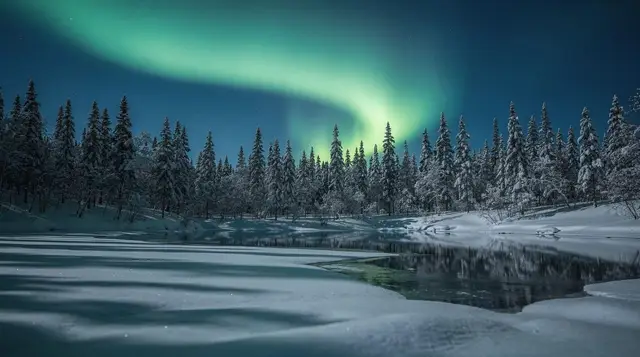
Lake Inari’s winter value goes beyond fishing and snowmobiling. A frozen lake this size is one of the better aurora settings in the region, for a simple reason: there is nothing blocking the sky. Standing on the ice, or on a marked shoreline point, gives an open horizon in several directions at once, which matters far more for aurora viewing than any particular building or monument.
The same rules that apply everywhere in Lapland still apply here — you need a clear sky and darkness as well as geomagnetic activity, and cloud cover, not the lack of activity, is usually what decides whether anything shows on a given night. No operator, on Lake Inari or elsewhere, can promise the display itself; “guaranteed” tours guarantee a rebooking or refund, not the aurora.
Several tours build an evening around exactly this open view, combining a drive out to the lakeshore with a hot drink and, often, dinner while waiting for the sky to clear. a northern lights tour from Saariselkä that ends with dinner on the shore of Lake Inari follows that format. It is also worth knowing before you go that what the eye sees — a pale, moving grey-green band — is usually more muted than the saturated green in tour photography; see what you actually see versus what the camera shows for a realistic idea of what to expect.
Choosing between the lake activities
The activities above do not compete so much as suit different temperaments. Ice fishing is for people who like to sit still, talk quietly and let the landscape do the work. A snowmobile safari is for those who want movement and a sense of distance. An evening aurora outing is for anyone willing to trade sleep for a chance at a clear sky. If you only have time for one, pick the one that matches how you actually like to spend a day outdoors, not the one that sounds most impressive on paper.
In summer the choice is simpler. A cruise gives the broadest first impression of the lake, fishing rewards patience, and kayaking suits confident paddlers who want a slower, quieter view of the shoreline. Because the lake is so large, none of these will show you more than a fraction of it, and that is fine: one good outing is better than a hurried attempt to see everything.
A realistic rhythm for the trip
Because the lake is so far north, it helps to think of it as a destination rather than a detour. Arrive the day before, settle into your base in Ivalo, Inari or Saariselkä, and keep the activity itself for the following day, when you are rested and not racing the clock after a long drive. If you add an evening aurora outing, leave the next morning unscheduled; late nights outside are tiring, and a slow breakfast is part of the experience.
Weather decides a great deal here. Wind, low cloud and sudden changes can reshape a plan, so build in a spare evening if your dates allow. Operators on the lake are used to this and will tell you honestly when conditions are poor, which is another reason to book with a local guide rather than improvise. For a wider sense of how the region fits together, the Lake Inari entry in the destination guide and the Saariselkä versus Rovaniemi comparison are useful companions when deciding where to sleep.
Etiquette and respect on the lake
Lake Inari is not only a scenic backdrop; it is a living landscape for the people who fish, herd and travel here. Keep to marked routes, take your rubbish with you, and follow your guide’s instructions about where to stand and where not to walk. Around Ukonkivi and other places of cultural importance, keep voices low and ask before photographing anything that looks like an offering. The principles of everyman’s right allow generous access to nature in Finland, but they come with a duty of care, and they do not replace local knowledge about ice or water conditions.
Ice that is not uniformly safe
It is worth being blunt about this: Lake Inari’s ice is not one uniform surface you can trust everywhere once winter sets in. Thickness varies by area — currents, inflows and depth all affect how quickly and how evenly ice forms — and it changes through the season as temperatures shift. What is safely thick in February may not have been solid in December, and conditions near shore, near river mouths or under snow cover are not necessarily the same as conditions further out.
This is exactly why every activity above is described as guided: professionals who work the lake through the winter know which routes are currently safe and mark them accordingly. Walking or driving out onto the ice independently, without that local, current knowledge, is not a reasonable risk to take, however solid it looks from the shore.
Two windows when the lake activities simply are not running
Two stretches of the calendar cut winter activities short, and it is easy to plan around them by accident if you are not aware of them.
December is freeze-up — jäätyminen — when the lake is turning to ice but has not yet done so reliably. Ice fishing and snowmobile safaris on the lake typically are not available yet, even though the rest of the region is deep into its winter season by then.
May and June are the thaw, when the same process runs in reverse: the ice breaks up, becomes unsafe to be anywhere near, and the boats are not yet running either, since open water hasn’t fully returned. This is a genuine gap between the winter season and the summer one, not a quiet in-between period with reduced options — for a few weeks, neither the ice activities nor the boat activities are realistically bookable.
| Period | Lake state | What’s running |
|---|---|---|
| Late Aug–Nov | Open water, cooling | Cruises and fishing tail off; boats gradually stop |
| December | Freeze-up (forming, unstable) | Little to nothing on the ice yet |
| Jan–Apr | Fully frozen | Ice fishing, snowmobile safaris, aurora viewing over the ice |
| May–June | Thaw (breaking up) | Ice activities paused; boats not yet running |
| June–Aug | Open water | Cruises, fishing, kayaking |
If your trip falls in one of the two gap windows, plan around the lake rather than on it — a visit to Siida or a stop in Ivalo makes more sense than counting on either boats or ice.
What to wear and what’s provided
Whatever season you visit in, dress for being outside on open water or open ice, where wind has nothing to slow it down. In winter, operators running ice fishing and snowmobile trips lend a thermal suit, boots, mittens and a hat on top of your own clothing — you do not need to buy specialist winter kit for a single outing. Underneath, the usual three-layer approach (a wool base layer, a fleece or wool mid layer, a windproof outer shell) works well, and staying dry matters more than piling on bulk. In summer, the lake’s open water means wind and spray on a boat, so a windproof layer is worth having even on a warm day.
Combining the lake with the rest of the region
Most visitors reach Lake Inari as part of a wider loop through the Saariselkä–Inari area rather than as an isolated stop. Saariselkä sits on the edge of Urho Kekkonen National Park, the glass igloos of Kakslauttanen are on the same road, and Lemmenjoki National Park and the quieter village of Nellim sit further along the lake’s shore for those with more time.
An eastern Lapland itinerary built around Sámi culture is a reasonable way to string these together over several days rather than trying to fit the lake, the village and the museum into one rushed outing. For the wider category of things to do here, the northern lights and ice and snow hubs cover the region beyond this one lake, and the Lake Inari activities page lists everything bookable at this specific spot in one place.
Fishing, ice floating and combined husky or reindeer add-ons round out what operators offer around the lake. If ice fishing feels too static, some trips pair it with an active add-on such as a sleigh ride, and a small number of ice-floating tours run on quieter forest lakes nearby rather than on Inari itself — worth checking the exact location before booking if seeing the lake specifically matters to you. an ice-floating session on a forest lake with a chance of aurora overhead is one such option, distinct from the open expanse of Lake Inari proper.