Finland’s biggest park, and its least accessible
At 2,850 square kilometres, Lemmenjoki National Park is the largest national park in Finland, larger than several of the country’s smaller regions combined. It sits in a wedge of wilderness west of Inari, stretching towards the Norwegian border, and it is almost entirely without roads. One gravel track reaches its southeastern edge at the hamlet of Njurgulahti; everything beyond that point is reached on foot, by boat, or not at all.
This is not the Urho Kekkonen National Park territory that day-trippers from Saariselkä and Kiilopää know, and the two parks should not be confused. UKK sits east of Inari, closer to Saariselkä, with a denser network of marked trails and wilderness huts that make it realistic to sample on a half-day or full-day outing.
Lemmenjoki is a different proposition: fewer marked trails, longer distances between huts, and a river system that is often the only practical way into the park’s interior. If what you want is a manageable afternoon hike, this is the wrong page — read about hiking trails around Rovaniemi or the shorter Lemmenjoki day trip instead, which covers what’s realistically doable without committing to the interior.
What makes Lemmenjoki distinctive, beyond its size, is a working history of gold panning that continues today, and a degree of solitude that is genuinely rare in Finnish Lapland. You can walk for a full day here and not see another hiker.
The gold-panning history
Gold was found in the Lemmenjoki river system in the 1940s, and a small rush followed in the 1950s. Unlike most historical gold rushes, this one never fully ended. A handful of prospectors still pan and dredge for gold in the Morgamoja and Miessijoki tributaries every summer, and their cabins and equipment are a genuine, working part of the landscape rather than a museum piece.
Recreational gold panning is legal for visitors in designated areas of the park, under permit rules set by Metsähallitus (the Finnish state land and forest authority). It is not a casual activity: panning is done in cold running water, technique matters more than luck, and most visitors who try it find a few flecks of colour rather than anything worth much. That is the honest expectation to set. The interest is in the history and the process, not in leaving rich. Anyone serious about trying should check current permit conditions with Metsähallitus before setting out, since rules on where panning is allowed do shift.
The gold-panning museum at Njurgulahti, run by local prospecting families, gives context before you go further into the park: old equipment, photographs, and an explanation of the claims system that still operates on the Morgamoja.
Getting to the trailhead
Njurgulahti is the practical starting point for any serious visit, and it is a long way from anywhere. From Rovaniemi, the drive is roughly 330 km and takes 4.5 to 5 hours, mostly on Road 4 north to Inari and then west on smaller roads. There is no bus service to Njurgulahti itself; Matkahuolto buses reach Inari, but the final stretch requires a car, a taxi arranged in advance, or a lift.
This is why Lemmenjoki does not work as a spontaneous stop on a road trip through the north. Pair it with a night or two in Inari before or after, and treat the drive itself as part of the commitment, not an inconvenience to be minimised.
| From | Distance | Driving time |
|---|---|---|
| Rovaniemi | 330 km | 4.5-5 hours |
| Inari | 60 km | 1-1.5 hours |
| Ivalo | 75 km | 1.5 hours |
| Saariselkä | 100 km | 2 hours |
Into the park: boat, trail, or both
From Njurgulahti, two ways lead into the interior.
The river route follows the Lemmenjoki river by boat, either self-paddled if you have the experience and gear, or on a guided boat trip run by local operators from Njurgulahti in summer. A guided boat tour is by far the easier way to see the gold-panning area at Kultahamina and the lower river valley without committing to a multi-day trek, and it is a realistic option for visitors who want a taste of the park’s character without the logistics of a full trekking trip. It is still not a quick errand: allow the better part of a day.
The trail route climbs out of the river valley onto the fells, following a mix of marked paths and, further in, open, largely trailless terrain typical of Finnish wilderness areas. Trail markers thin out fast once you’re past the first few kilometres, and route-finding across open fell and bog becomes a real skill you need, not a formality. This is the part of Lemmenjoki that separates it from an easy walk: navigation, river crossings, and long stretches without any sign of other people or facilities.
Wilderness huts (autiotupa) are dotted through the park, free to use on a first-come basis, unheated in most cases beyond a wood stove, and intended as emergency and overnight shelter rather than guaranteed accommodation — if one is full when you arrive, you need a tent as backup. Do not plan a route assuming a hut bed will be free.
Who this park is actually for
Be honest with yourself before committing days to Lemmenjoki. This is not a park for a first multi-day hike, and it is not forgiving of bad planning.
- Navigation: sections of the interior have no marked trail. You need to read a map and compass or GPS confidently across open, featureless terrain, in weather that can close in fast.
- River crossings: several routes require fording streams or arranging a boat crossing. Water levels vary with rain and snowmelt.
- Self-sufficiency: there are no shops, no mobile signal in most of the interior, and only occasional wilderness huts. You carry what you need, including a way to purify water and enough food for the full trip plus a buffer.
- Weather: Lapland weather changes quickly even in summer. Rain, wind, and cold snaps are possible in any month, and there’s no shelter beyond what you carry or find in a hut.
- Group and communication: tell someone your planned route and expected return, and carry a means of emergency communication — mobile coverage cannot be relied on once you’re away from Njurgulahti.
If any of that gives you pause, the guided boat trip from Njurgulahti, or a shorter visit that stays near the trailhead, is the sensible way to experience the park without the exposure of a solo interior trek.
When to go
Lemmenjoki’s interior is a summer destination. Snow typically clears from the lower trails by early June and returns by late September or October, and the trekking window in between is short by comparison with more accessible parks.
- Mid-June to early July: long daylight (this far north, near-continuous light), but also peak mosquito season in the bogs and along the river. Pack repellent and a head net; do not underestimate this.
- Mid-July to mid-August: generally the most settled weather, still long days, mosquitoes easing off by late August.
- Late August to mid-September: the ruska colour season turns the fells and birch stands orange and red, days are shorter, nights get properly cold, and midge numbers drop sharply. Many experienced trekkers rate this as the best window despite the shorter daylight.
- Winter: the park is largely inaccessible for casual visitors. Deep snow, no maintained winter trail network comparable to areas around Saariselkä, and serious cold make this a specialist proposition, not a tourist season.
| Period | Conditions | Verdict |
|---|---|---|
| June-early July | Near-continuous daylight, heavy mosquitoes | Doable, pack for insects |
| Mid-July-mid-Aug | Warmest, most settled | Best all-round window |
| Late Aug-mid-Sept | Ruska colours, cold nights, fewer bugs | Favoured by experienced trekkers |
| Winter | Deep snow, minimal access | Not for casual visitors |
What to pack
Beyond the standard three-layer system that applies across Finnish Lapland, a multi-day Lemmenjoki trek needs full backcountry kit: a four-season-capable tent as backup to hut space, a stove and enough fuel, a map and compass (with GPS as backup, not the reverse — batteries fail and coverage is absent), a water filter or purification tablets, insect protection in summer, and several days of food with a margin for delay. This is backcountry self-sufficiency, not a supported trek with resupply points.
Gold panning in practice
If you want to try panning legally, the designated recreational area is along stretches of the Morgamoja and Miessijoki, separate from the working claims held by licensed prospectors. Metsähallitus issues the permits and publishes current boundaries and conditions; check before you go, since claim areas and rules are reviewed periodically. Basic panning gear (a pan, at minimum) is worth bringing or borrowing in Njurgulahti, since there’s nowhere to buy or hire equipment once you’re in the park itself.
Treat the whole exercise as an experience tied to the valley’s history rather than a prospecting trip with real financial upside. The families who work the claims here do so as a serious, ongoing livelihood; visitors panning in the recreational areas are, realistically, playing at a piece of local history rather than competing with them.
Nearby Sámi culture and context
The wider region around Inari and Lemmenjoki is part of the Sámi homeland, and a visit here sits naturally alongside time spent understanding that context rather than only the landscape. The Siida museum in Inari is the reference point for Sámi culture and history in the region, and is worth visiting before or after a Lemmenjoki trip. A guided Lemmenjoki boat tour that includes Sámi culture and a riverside lunch is one practical way to combine the two without a full trekking commitment.
a guided boat trip along the Lemmenjoki river that takes in Sámi culture and a riverside lunch is the most accessible way into the park for visitors who aren’t equipped or experienced enough for a self-supported trek, and it still shows the gold-panning valley and the scale of the wilderness beyond Njurgulahti.
Before or after, spend time at the Siida museum in Inari, which puts the whole region, including the Sámi reindeer-herding livelihood that shapes land use across Lemmenjoki’s surroundings, in proper context.
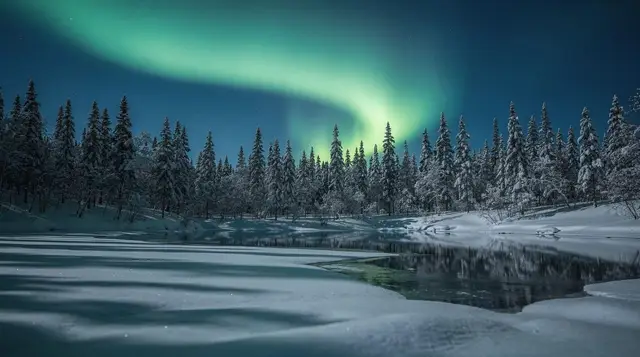
If your Lemmenjoki trip is timed for late summer or early autumn, the nights are dark enough by late August to catch the first aurora activity of the season; consider an aurora-focused evening near Inari either side of your park trip, or a private aurora tour departing Rovaniemi if your route brings you back that way.
Where to stay near the park
Njurgulahti itself has limited accommodation: a handful of small guesthouses, cabins, and a campsite, all best booked ahead in July and August. Inari, an hour or so away, has a wider range of hotels and guesthouses and is the more practical base for the nights either side of a Lemmenjoki trip. There is no accommodation of any kind inside the park beyond the free wilderness huts, which are not bookable and not guaranteed to be free when you arrive.
Combining Lemmenjoki with the rest of the north
Given the drive involved, Lemmenjoki works best as part of a longer loop through the far north rather than a stand-alone target. A natural pairing is Inari and Lake Inari for a day or two, the Siida museum for context, and then Lemmenjoki for the wilderness component, before returning south. Our eastern Lapland Sámi culture itinerary sketches a route that includes all of these without over-scheduling the driving days.
If instead you’re building a trip primarily from Rovaniemi and only have a day or two to spare for this direction, the Lemmenjoki day trip guide sets realistic expectations for what a shorter visit can and cannot cover, and the day-trip-from-Rovaniemi limits page is worth reading before you commit a full day to a place this far out.
Lemmenjoki National Park: your questions answered
Can I do Lemmenjoki as a day trip from Rovaniemi?
No. The drive from Rovaniemi to the Njurgulahti trailhead alone is 4.5-5 hours each way, and the park’s interior, where the gold-panning history and real wilderness character are, needs a boat trip or a substantial walk beyond that. A day trip from Rovaniemi would spend most of its hours driving. A guided boat tour from Njurgulahti is possible as part of a longer stay in the Inari area, but not as a same-day round trip from Rovaniemi.
How is Lemmenjoki different from Urho Kekkonen National Park?
They’re separate parks with separate access. Urho Kekkonen National Park sits closer to Saariselkä and Kiilopää, with more marked trails and a denser hut network that supports shorter outings. Lemmenjoki, west of Inari, is Finland’s largest park by area but has minimal road access, fewer marked trails, and longer distances between facilities. If you want a manageable half-day or full-day hike from Saariselkä, look at Urho Kekkonen rather than Lemmenjoki.
Do I need permits to pan for gold?
Recreational gold panning in Lemmenjoki is only permitted in designated areas set by Metsähallitus, separate from the working claims held by licensed prospectors. Check current permit conditions and area boundaries with Metsähallitus before you go, as rules are reviewed periodically. Basic gear such as a pan is worth bringing, since nothing is available to hire inside the park.
Is Lemmenjoki suitable for a first multi-day hike?
Not really. Sections of the park’s interior have no marked trail, river crossings can be involved, mobile coverage is largely absent, and wilderness huts aren’t guaranteed to have space. It’s better suited to hikers with existing experience of trailless, self-supported trekking. If you want a taste of the park without that commitment, a guided boat trip from Njurgulahti is the realistic alternative.
When is the best time to visit?
Mid-June to mid-September is the practical trekking season. Mid-July to mid-August tends to have the most settled weather; late August to mid-September brings ruska colours, cold nights, and far fewer mosquitoes, which many experienced trekkers prefer despite the shorter daylight. Winter access is minimal and not suitable for casual visitors.
Are there mosquitoes?
Yes, heavily so in June and early July, particularly in the boggy lower valley. A head net and strong repellent are close to essential in that window. Numbers drop noticeably by late August.
Where do I stay near the park?
Njurgulahti has a small number of guesthouses, cabins, and a campsite; book ahead for July and August. Inari, roughly an hour away, has a wider range of accommodation and is a more practical base for the nights before and after a Lemmenjoki trip. Inside the park, only free, unbookable wilderness huts and your own tent are available.
Can I combine Lemmenjoki with the Northern Lights?
If your visit falls from late August onward, nights are dark enough for aurora activity, though as with anywhere in Lapland, clear skies and geomagnetic activity are never guaranteed. Basing yourself in Inari before or after your park trip gives you a realistic chance, and local aurora-focused tours from the Inari area are a straightforward way to try without extra driving.