The single-driver supplement on snowmobile safaris
What is the single-driver supplement on a snowmobile safari?
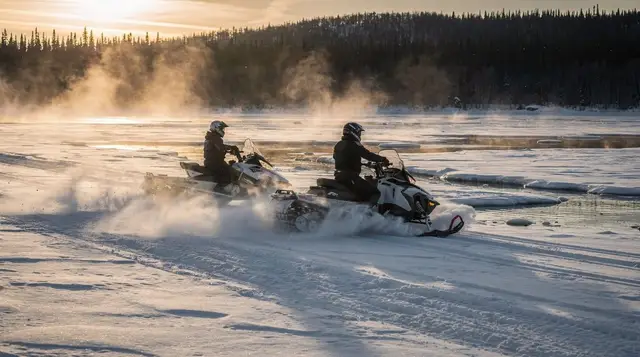
It is the extra fee operators add when one person books a snowmobile built for two, since the machine then earns roughly half its usual revenue per seat. The amount is set by each operator and tends to rise with the length of the safari, and it varies too much between companies to quote a single figure. Paying it does not free you to ride off from the group; you still follow the guide inside the convoy.
Almost every snowmobile safari around Rovaniemi is quoted per person, but the quote assumes two people share one machine, driver and passenger. Ask to drive alone, with the seat behind you empty, and most operators add a line to the invoice: a single-driver supplement. It is one of the most common sources of confusion when travellers compare quotes for a snowmobile safari, because the fee is real, it is rarely explained clearly on booking pages, and it has nothing to do with whether you hold the right licence to drive. This page sets out why the supplement exists, what decides how large it is, and exactly what driving alone does and does not change once you are out in the convoy.
Why a lone rider costs an operator more
Snowmobile safaris are built, priced and staffed around two-up machines. An operator buys or leases a fleet sized for pairs, sends out enough guides and support vehicles to cover a group of a given size, and sets the per-person price so that a full fleet of shared machines covers fuel, insurance, maintenance and staff time with a margin left over.
When one guest books a machine to drive alone, that machine carries one paying customer instead of two, but almost nothing else about running it changes. The fuel burned pulling one rider through the forest is close to the fuel burned pulling two. The guide still has to watch that machine, brief that rider, and account for it in the convoy. The snowmobile itself wears down at roughly the same rate whether the seat behind the driver is occupied or empty.
The result is straightforward: a machine with one rider brings in about half of what it would with two, while costing the operator almost the same to run. The single-driver supplement is how that gap gets closed. It is not a penalty for wanting independence, and it is not a security deposit or an insurance add-on, though some operators bundle those into the same line item. It is simply the operator recovering the revenue lost by not filling the second seat. Framed that way, it is closer to the “single supplement” hotels and package tours charge a solo traveller for a room built for two than to any kind of premium or upgrade fee.
This is also why the supplement disappears the moment you agree to share a machine with another guest. If you are travelling solo and are matched with another single traveller from the same departure, the operator fills both seats again, the economics return to normal, and there is nothing extra to pay. Sharing is covered in more detail in the guide to riding two-up on a shared snowmobile; the point worth making here is that a solo traveller is never forced to pay the supplement. It is a choice, not a requirement of travelling alone.
What actually decides the size of the fee
There is no fixed rate for a single-driver supplement across the industry, and it would be misleading to quote one figure here as if it applied everywhere. Every operator in Lapland sets its own price list, and the amount added for driving alone can differ noticeably between two companies running near-identical routes out of the same town. Rather than a euro figure, which would be out of date within a season anyway, it is more useful to understand the handful of things that push the fee up or down.
| Factor | Typical effect on the supplement |
|---|---|
| Length of the safari | Longer safaris (full-day, evening aurora hunts) usually carry a larger supplement than a short one- or two-hour introduction |
| How the operator prices its fleet | Some companies charge a flat single-driver rate regardless of duration; others scale it with the tour price |
| Season and demand | High-demand weeks around Christmas and New Year sometimes see supplements rise along with every other price on the safari |
| Route and terrain | Backcountry or multi-day routes that need more fuel and support per machine can carry a steeper supplement than a short forest loop |
| Group size and availability | A small departure with few solo travellers to pair up may make the operator more willing to negotiate, or less, depending on how they staff that day |
Because the range is wide, the only reliable way to know what a specific safari will cost you as a solo driver is to check that operator’s own listing or ask directly before booking. Comparing two or three options from the same base, whether that is Levi, Ivalo or Inari, is worth the ten minutes it takes, since the gap between operators can be larger than the gap between a short and a long safari from the same company.
It is also worth checking what the supplement includes. On some listings it only covers the empty seat; on others it is bundled with a private-guide-adjacent experience, extra fuel allowance, or a machine upgrade. None of that is standard across the industry, so read the fine print on the specific tour rather than assuming it matches a safari you booked elsewhere, in Rovaniemi or on a previous trip.
What changes when you drive alone, and what does not
Paying to drive alone buys you two things, and neither of them is independence from the group. The first is control: with nobody on the seat behind you, you set your own throttle, brake earlier or later than a passenger might expect, and do not need to communicate every stop or turn to a second person on the machine. Some riders find this makes the safari feel less like managing a passenger and more like handling the snowmobile itself, particularly on a longer route where fatigue and comfort matter more than on a short taster ride.
The second is a small amount of extra room to manoeuvre within the convoy. A guide leading a line of machines through forest tracks generally lets solo-driven snowmobiles find their own spacing a little more freely than a two-up pair, since there is only one person’s judgement to account for rather than a driver managing a passenger’s weight and balance. That is a modest, practical difference, not a licence to change the plan.
What does not change is the structure of the safari itself. Every machine, solo or shared, follows the lead guide’s route, speed and stops. Nobody peels off to explore a side trail, nobody overtakes to get ahead of the group, and nobody rides after dark without the guide’s lights in view.
This matters especially on an aurora-focused departure, where the whole point of the exercise, covered in the guide to snowmobile safaris timed around the northern lights, is that the group moves together to a viewing spot the guide has judged safe and dark enough, rather than each rider hunting for a clear patch of sky alone. If genuine off-piste freedom is what you are after, that is a different product entirely, usually a much smaller, more expensive private tour, and it is not what the single-driver supplement buys on a standard group safari.
Sharing a machine instead
It is worth repeating plainly, because the assumption trips people up constantly: travelling to Lapland alone does not mean you have to drive alone. Most operators actively offer to pair solo travellers from the same departure so that two people who arrived separately share one machine, one as driver and one as passenger, with roles sometimes swapped partway through the safari. This avoids the supplement altogether and, for many first-timers, is genuinely the more relaxed way to do it, since the passenger gets to look around, take photos and watch the terrain rather than concentrate on the machine.
| Driving solo | Sharing a machine | |
|---|---|---|
| Cost | Base price plus single-driver supplement | Base price only, split or paid individually depending on the tour |
| Who is in control | You, for the whole safari | Alternates, or fixed to whoever books as driver |
| Company on the machine | Nobody | A partner, friend, or a paired guest from the group |
| Best suited to | Riders who want to focus purely on handling the snowmobile | Couples, friends travelling together, or solo travellers happy to be paired up |
Neither option is objectively better; they suit different travellers and different budgets. A solo traveller who wants the safari to be about the machine, not the company, should expect to pay the supplement and can plan for that. A solo traveller who is more interested in the scenery, the aurora, or simply meeting other people on the trip will often prefer to be paired, and should say so when booking rather than assuming a solo seat is the only option offered.
Questions worth asking before you book
Because the supplement is set independently by each operator, a short list of direct questions before you pay is more useful than any general rule of thumb:
- Is the single-driver supplement a flat fee, or does it scale with the length of the safari.
- Does the supplement include anything beyond the empty seat, such as extra fuel allowance or a different machine class.
- If I book solo now, can I switch to sharing later if another rider becomes available on the same departure, and would the supplement be refunded.
- Does the price list separate a driving supplement from a private-tour supplement; some listings bundle the two, which can make a “solo” price look far higher than the standard fee for simply not sharing a seat.
- Is the safari itself priced per person, per machine, or a mix of the two, since that changes how much a single-driver fee actually adds in practice.
These are the same kind of questions worth asking about a chenil before a husky sledding trip, or about which vehicle class fits a route before renting a car for winter driving. Operators expect them, and a clear answer to all five is a reasonable sign the company runs a well-organised safari.
Where this applies across the safaris on offer
The single-driver supplement shows up on almost every guided snowmobile product around Rovaniemi and the wider region, not just on one type of tour. A forest safari out of Levi, for instance the forest snowmobile safari from Levi, typically lists it as a straightforward add-on for anyone who does not want to share.
Evening departures built around the aurora, such as the northern lights snowmobile safari from Levi or the northern lights hunt by snowmobile from Inari, carry the same logic, sometimes with a larger supplement given the longer time on the machine and the extra fuel needed to reach dark, cloud-free ground.
Safaris that combine driving with another activity, including some of the scenery snowmobile safaris out of Ruka, apply it the same way: the fee is about filling the second seat, not about which scenery or activity the tour is built around.
None of these prices belong in a general guide, since operators revise them season to season and route to route. What stays constant is the underlying reason for the charge and the fact that it is optional, tied to your choice to ride alone rather than to any requirement of solo travel.
For planning the rest of a trip built around this kind of activity, it also helps to read up on the wider snowmobile licence and age requirements before assuming you can drive at all, to sketch out a realistic Rovaniemi trip budget that leaves room for supplements like this one, and to check general advice on travelling solo around Rovaniemi if snowmobiling is only one part of a longer solo itinerary.
A four-day winter adventure itinerary is a reasonable place to see how a safari like this fits alongside other activities without over-scheduling the trip, and the general guide to scams and tourist traps around Rovaniemi is worth a read for anyone comparing operators on price alone, since a low headline rate sometimes hides a steep single-driver or single-supplement charge once you get to checkout.
Dress for the cold properly too: the three-layer packing system matters just as much whether you are sharing a machine or driving one alone, since you sit still on a snowmobile far more than you might expect, and driving solo does nothing to keep you warmer.
Common questions about riding solo on a snowmobile safari
Do I have to pay the single-driver supplement if I am travelling solo?
No. A solo traveller can ask to be paired with another guest on the same tour and ride two-up instead, which avoids the supplement entirely. The extra fee only applies if you specifically want your own machine with nobody riding behind you.
Why does riding alone cost more in the first place?
A safari is priced and staffed around machines carrying two people, so an operator who reserves a whole snowmobile for one rider loses roughly half the revenue that seat would have brought in. Fuel, guide time and machine wear stay close to the same either way, so the shortfall is passed on as a supplement.
How much does the supplement usually add to the price?
It depends entirely on the operator and on how long the safari runs, and the figures change often enough that quoting a fixed number here would be out of date within a season. Treat it as one of the questions to ask when comparing quotes, alongside what is included and how long you actually ride.
Does a longer safari mean a bigger supplement?
Generally yes, because a half-day safari and a full-day or evening aurora safari both lose the same proportion of per-seat revenue, but the absolute gap grows with more hours on the machine. Some operators charge a flat single-driver rate regardless of duration, others scale it, so it is worth asking directly rather than assuming.
Can I book solo and switch to sharing later, or the other way round?
Most operators will happily move you from a solo booking to a shared machine if another guest of similar experience is available on the same departure, and the supplement simply drops off the invoice. Going the other way, from shared to solo, usually depends on whether a spare machine is free that day, so it is safer to decide before you book if driving alone matters to you.
Does paying to drive alone let me leave the group or go off-piste?
No. Every machine in a guided safari, solo or shared, stays inside the convoy and follows the lead guide at the group’s pace on the planned route. Driving alone gives you full control of your own throttle and a touch more room to place the machine in the line, not permission to break away or explore off-piste.
Snowmobile safaris on GetYourGuide
Verified deep-linked GetYourGuide tours. Book through these links and we earn a small commission at no cost to you.
GetYourGuide does not provide a product photo for this activity — the image shows the meeting point, photographed by us.