Two-person snowmobile rides: how tandem riding works
Can two people ride the same snowmobile in Rovaniemi?
Yes. One person drives (a valid car driving licence is required) and the second sits behind as a passenger with no licence needed. It usually costs less per person than two separate machines, but operators cap the combined weight and some rougher routes restrict or ban the two-up option.
Sharing one machine instead of booking two
Most snowmobile safaris around Rovaniemi are sold per machine, not per person, and every machine can carry one driver and one passenger. That single detail changes the maths and the experience for anyone travelling as a pair. This page is about that specific setup: one driver with the licence the operator requires, one passenger behind them with no qualification needed at all, both on the same snowmobile for the whole safari.
It is not about the fee some operators charge a solo rider for taking a machine alone — that is covered on the single-driver supplement page — and it is not about who is legally allowed to drive, which has its own licence requirements guide. Here, the question is narrower: what does it actually mean to ride two-up on one snowmobile, what do you gain, and where does it stop being an option.
How the driver-and-passenger setup works
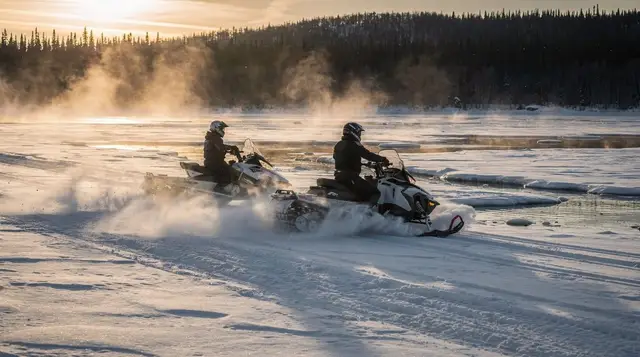
A tandem snowmobile is built with a longer seat than a solo touring sledge, room for two, and a passenger footrest set further back. The driver sits at the front with the throttle, brake and steering under their hands; the passenger sits behind, holds onto a grab handle or the driver’s waist, and leans with the machine on turns the way a passenger on a motorbike would. Briefings at the start of any snowmobile safari cover this for both people, even though only the driver is operating the controls: how to sit, how to signal if something is wrong, and how to get on and off safely with the engine running nearby.
The requirement that matters is on the driver’s side only. Operators around Rovaniemi require a valid car driving licence, generally from age 18, to take the controls of a snowmobile — full detail on that sits on the dedicated licence page rather than here. The passenger seat carries no such requirement. A partner, a friend, a teenager, or in some family products a child riding with a parent, can sit behind without holding any licence, taking any test, or having ridden before. That asymmetry is the whole point of the format: it lets two people experience a snowmobile safari together even when only one of them can legally drive it.
Why couples and pairs choose to ride together
Three practical reasons come up again and again when people choose the tandem option over two separate machines.
The price per person is usually lower. A snowmobile safari is priced per machine, and a machine with two riders costs the same or only slightly more than the same machine with one. Split that price across two people and the cost per head comes down compared with each person renting and paying for their own snowmobile.
This is worth being precise about, because it is easy to overstate: the total price of the safari for two people riding together is not necessarily lower than one machine, and it is certainly not lower than what a solo rider on a single machine pays alone. What drops is the amount each person contributes, not the bottom line on the invoice. A group booking two machines for two solo riders pays for two full-price snowmobiles; a group booking one machine for two people pays for one, split two ways.
Both people can share the driving on a longer route. On safaris that run for several hours rather than a short taster loop, some operators allow a stop partway through to swap who is driving, provided both people hold the licence the operator requires. That means neither person is stuck driving — or stuck as a passenger — for the entire route, and both get a turn managing the machine through the forest trail, over frozen marshland, or along a river route depending on where the northern lights snowmobile safari or forest route is based. Not every operator offers a swap stop as standard, so it is worth asking directly when booking if alternating matters to you.
The passenger can actually look around. Driving a snowmobile takes concentration: reading the trail, managing speed on turns, watching for other machines in the group. A passenger has none of that to manage. For a route built around scenery — birch forest under snow load, a frozen river crossing, or a stretch timed for the aurora hunting guide after dark — that means the person in the back seat is freer to take in the landscape, watch the sky, or hold a phone or camera rather than having both hands committed to the controls. This is a genuine trade-off rather than a pure downside for the passenger: less control, but more attention available for everything else.
Where the tandem option runs into limits
Two riders on one machine change how it handles, and operators build real limits around that rather than treating it as a formality.
Combined weight is capped. A snowmobile is rated for a maximum load, and with two adults on board that limit gets reached faster than with one. Operators commonly work with a combined driver-plus-passenger ceiling somewhere in the region of 150 to 200 kilograms, though the exact number depends on the specific machine and the company running the safari — it is not a figure fixed across the whole industry. If either rider is toward the upper end of that range, or the pair together clearly is, it is worth asking the operator directly at booking rather than finding out at the meeting point. This is also handled case by case: some companies will simply advise a different machine or configuration rather than refuse the booking outright.
Some routes restrict or exclude two-up riding. A loaded machine with two people sits and turns differently from one carrying a single rider, and on terrain with tighter bends, steeper descents, or rougher forest track, that difference matters for control. Operators running routes through more demanding terrain — certain forest sections, some fell approaches, or river-ice crossings with a steeper bank — may restrict the tandem option on those specific legs, or not offer it for that product at all.
This is decided by each operator for each route, not a blanket rule that applies everywhere, so the honest answer to “can we ride together on this particular safari” is to check the specific product page or ask before booking rather than assuming every route allows it.
Neither of these limits is presented to scare anyone off tandem riding — it is the normal, sensible way operators manage a real safety margin on machines that are genuinely faster and heavier than they look standing still.
Comparing the tandem option against riding solo
| One machine, two riders (tandem) | Two machines, two solo riders | |
|---|---|---|
| Price per machine | Standard rate, sometimes a small passenger add-on | Standard rate charged twice |
| Price per person | Lower, since one machine’s cost is split two ways | Full price each |
| Who can drive | Only the licensed driver, for that leg | Both people drive their own machine throughout |
| Passenger requirements | None | Not applicable — everyone drives |
| Typical weight limit | Combined rider weight capped by the operator | Individual rider weight capped, usually a higher ceiling per person |
| Best suited to | Couples or pairs where one person wants to focus on scenery, or where only one holds a licence | Two confident, licensed drivers who both want full control throughout |
This table is a general comparison, not a quote: actual prices, weight limits and route availability come from the specific operator and safari you book, and should be confirmed directly with them.
Booking a tandem ride
A short taster ride suits a first attempt at riding together, and the Family Sledge Snowmobile Ride style of shorter, gentler product is a reasonable starting point before committing to a longer route.
a shorter, gentler snowmobile ride suited to a first tandem outing keeps the pace low and the loop short, which is a sensible way to check how riding together actually feels before booking anything longer.
For a full afternoon or evening route through forest trail, options built around a proper safari length work better once you know the format suits you.
a forest safari near Levi run at a steadier, longer pace is the kind of route where a swap stop for alternating drivers is worth asking about directly.
For anyone combining the tandem format with the region’s main draw after dark, an evening route built around the sky is the natural pairing.
an evening snowmobile route timed for dark skies away from town puts the passenger’s free attention to good use, since watching the sky while someone else drives is exactly the situation where riding two-up earns its keep.
Further north, near Inari and Ivalo, similar tandem-friendly safaris run against darker, quieter skies, generally with a longer drive to reach and a higher price to match the more remote setting.
What to bring and what is provided
As with any snowmobile safari, thermal suit, boots, gloves and a helmet are supplied by the operator on almost every route around Rovaniemi and Levi or Kittilä — full detail on layering underneath that kit sits on the three-layer packing guide. Riding as a passenger does not mean dressing more lightly: sitting still behind a driver in open, moving air at Lapland winter temperatures is, if anything, colder than driving, since the passenger is not making the small physical adjustments that keep a driver’s blood moving. Dress for the temperature on the day, not for the fact that someone else is doing the steering.
Bring your driving licence if you are the one who might drive — even on a route billed as tandem-only for that day, some operators check for it as standard practice, and it is needed at the counter for any swap-driver stop later in the route.
Getting there and what it costs alongside the ride
Most snowmobile operators either meet guests at a pickup point in central Rovaniemi or run from a base near Levi, Kittilä, or further north near Inari, depending on the specific safari and season. Transfers are commonly included or offered as an add-on rather than something you need to arrange separately — check the specific listing rather than assuming either way.
On cost more broadly, a snowmobile safari sits toward the higher end of Rovaniemi’s activity pricing, and the trip budget guide gives a wider sense of where that fits against husky rides, aurora tours and everything else on a typical Lapland itinerary. If you are weighing up how many activities to fit into a short stay, the how many days in Rovaniemi guide is a useful starting point before booking.
If you are driving yourself to reach a snowmobile base outside Rovaniemi, winter road conditions and the reindeer that wander onto them are worth reading up on beforehand — see the driving in Lapland guide for what that actually involves on ice-covered rural roads.
The honest summary
Riding two-up on one snowmobile is a genuinely practical option for a couple or a pair travelling together: it lowers what each person pays compared with two separate machines, it lets you split the driving on longer routes where a swap stop is offered, and it frees the person not driving to actually look at where they are. It is not, and should not be sold as, a way to get the whole safari cheaper in absolute terms — the total invoice for one machine with two riders is close to what one person pays alone, just shared.
And it is not available without limit: combined weight caps and route-by-route restrictions on rougher terrain are real, operator-set boundaries, not fine print designed to catch you out. Ask about both — the weight limit and whether your specific route allows tandem riding — at the point of booking, and you will know exactly what you are getting before you are standing at the meeting point in a borrowed thermal suit.
Two-person snowmobile rides: frequently asked questions
Does the passenger need any licence or experience?
No. Only the driver needs a valid car driving licence, generally from age 18. The passenger sits behind, holds on, and needs no qualification at all.
Is riding two-up actually cheaper?
The price per snowmobile stays the same or rises slightly for two riders, but split between two people it comes out lower per head than each person booking a separate machine. The total safari price is not lower, only the price per person is.
Is there a weight limit for two riders on one snowmobile?
Most operators cap the combined driver-plus-passenger weight, commonly somewhere around 150 to 200 kilograms, though the exact figure varies by machine and company. Ask when booking if either of you is close to that range.
Can we swap who drives partway through the safari?
On longer safaris, yes, many operators allow a stop to switch drivers as long as both people hold a valid car driving licence. Ask at booking, since not every route builds in a swap stop.
Are some routes not available for two-up riding?
Yes. Routes with tighter turns, steeper descents, or rougher forest trail can restrict or refuse the two-up option because a loaded machine handles differently. This is decided case by case by the operator, not a fixed rule.
What does the passenger actually get to do?
Mostly look around and take photos. Riding behind means both hands are free some of the time, and the passenger is not managing the throttle, so it suits people who want the scenery over the driving itself.
Does two-up cost less than the single-driver supplement?
That comparison depends on the operator’s specific pricing, since the single-driver supplement is a separate charge covered on its own page. As a rule, riding with a passenger from the start is usually the more economical route for two people travelling together.
Snowmobile safaris on GetYourGuide
Verified deep-linked GetYourGuide tours. Book through these links and we earn a small commission at no cost to you.
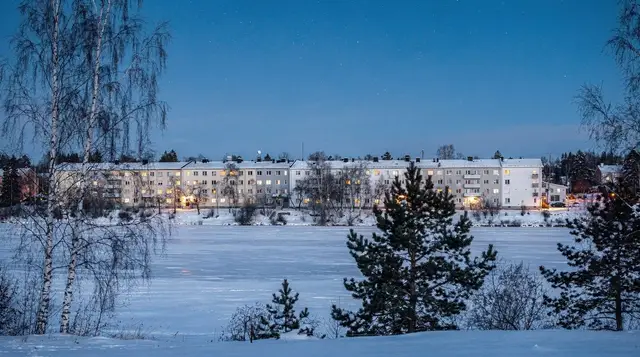
GetYourGuide does not provide a product photo for this activity — the image shows the meeting point, photographed by us.