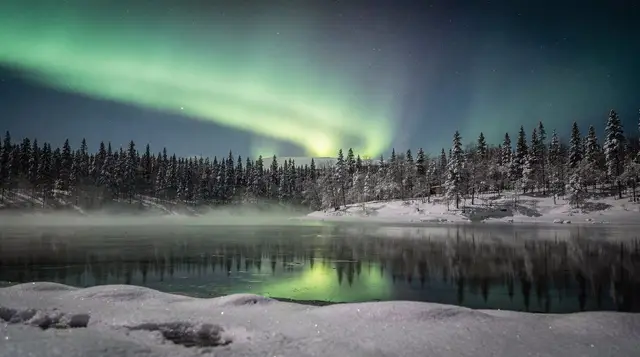
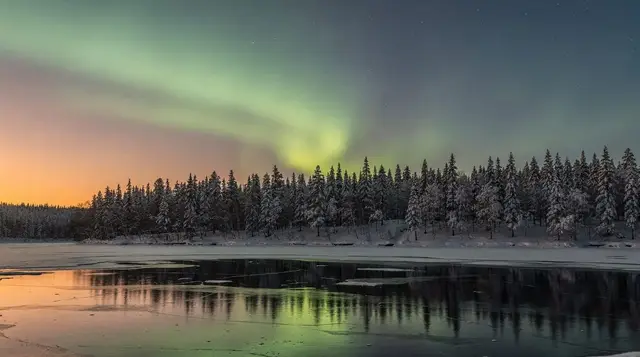
A region the size of a small country, run from one small city
Say “Lapland” to most people and they picture one place: reindeer, snow, maybe a red-suited figure at a village gate. In practice, Finnish Lapland is a region of about 100,000 km² — larger than Portugal, and by some distance the biggest and emptiest region in Finland — with a population under 180,000 spread across an area where some municipalities are bigger than small European countries.
Rovaniemi, with around 64,000 residents, is by far its largest town and its practical front door: the airport with the most connections in Lapland, the endpoint of the night train from Helsinki, and the junction where the main roads north actually meet. But Rovaniemi is not Lapland in miniature. It’s a service town you can walk across in fifteen minutes, and most of what fills a Lapland brochure — the fell landscapes, the ski resorts, the deep-Sámi north — sits well outside it.
This page is a map, not a manual. It won’t tell you how to book a husky sled or what an aurora tour actually involves — those are separate guides, linked from here and worth reading before you commit money to either. What it will do is lay out where things are relative to Rovaniemi, roughly what each place is for, and how long it realistically takes to get there, so you can decide which corners of this region are worth your limited days rather than guessing from a map that flattens winter road conditions into straight lines.
Why the map lies about distance
Every distance quoted on this page and across this site is road distance from central Rovaniemi, and every one of them takes longer in practice than the number implies. Winter Lapland driving is slower than the same kilometres anywhere further south: roads are snow-packed rather than bare for months at a stretch, daylight is short or absent for large parts of the year, and reindeer and elk cross roads — including at night — often enough that slowing down near tree lines is a real precaution, not overcaution.
A 150 km drive that a satnav estimates at under two hours can comfortably take two and a half in January. Treat every duration below as a floor, not a promise, and see driving in Lapland before you rent a car for winter roads you haven’t driven before.
It’s also worth being blunt about what is not reachable from Rovaniemi as a day trip, however tempting the map makes it look. Helsinki is 830 km away — a flight or an overnight train, not a drive. Tromsø in Norway is roughly 600 km, the North Cape around 800 km, and Abisko in Swedish Lapland about 500 km: all are trips in their own right, needing a base further north than Rovaniemi. If your itinerary has “quick trip to Norway” pencilled in alongside Rovaniemi, it’s worth reading what genuinely isn’t a day trip from here before you build a schedule around it.
Reading the seasons across the region
The region shares a broad climate but each part experiences it slightly differently. As a baseline: winter temperatures across inland Lapland run roughly -10 to -25°C from December to March, with cold snaps below -30°C most years, while summer sits a comfortable 15–25°C. Snow typically lies on the ground from late October to mid-May, longer at altitude and further north.
| Season | When | What it’s good for |
|---|---|---|
| Winter | December–March | Snow activities, deepest cold, shortest days |
| Kaamos (polar night) | Roughly 2–12 December in Rovaniemi | No sunrise, but several hours of blue twilight |
| Late winter / spring | March–April | Long daylight, snow still solid — often the best combination |
| Midnight sun | 6 June–7 July in Rovaniemi | 24-hour daylight, warmest weather, no darkness for the aurora |
| Ruska (autumn colour) | Late August–early October | Birch and tundra colour, and the return of dark nights |
Two things shift by latitude. Further north — Inari, Utsjoki — winter arrives earlier and the polar night runs longer than Rovaniemi’s ten days. And the aurora season itself runs from roughly late August to early April everywhere in the region: it needs geomagnetic activity, a clear sky and darkness together, and no location or operator can promise it on a given night, however far you’ve driven to get there. For the mechanics of that, see how the northern lights actually work and the best time, month by month.
The satellite destinations, briefly
None of the places below get the detail they deserve on this page on purpose — each has its own guide, linked below, and this is a map, not the territory. What follows is distance, in one line each, and a fair sense of what you’d go for.
Ranua, 80 km south, about an hour’s drive, is built around one thing: the northernmost wildlife park of its kind, home to brown bears, wolverines, lynx and Finland’s only captive polar bears, walked at a slow pace on a roughly 3 km outdoor loop.
Kemi, 115 km southwest, around ninety minutes, sits on the Gulf of Bothnia and offers something nowhere else in the region does: a retired icebreaker that cracks sea ice and lets passengers float in survival suits in the open channel, plus a snow castle rebuilt every winter with its own hotel and ice restaurant. Both are strictly seasonal, roughly late December to early April, and both need booking ahead.
Pyhä-Luosto, 120 km northeast, around an hour forty-five, is a national park straddling two fells, with an amethyst mine at Lampivaara where visitors dig and keep a stone — open in both summer and winter.
Sodankylä, 130 km north, is a working street-village rather than a resort, notable for a 1689 wooden church, one of Finland’s oldest, and a geophysical observatory.
Kemijärvi, 85 km east, is Finland’s northernmost town to hold that formal status, set on a lake, and a night-train terminus on some routes.
Levi, 170 km north in Kittilä, roughly two and a quarter hours, is Finland’s largest and most developed ski resort, with its own small airport and the broadest range of packaged activities in the region.
Ylläs, 200 km north, split between the villages of Äkäslompolo and Ylläsjärvi inside Pallas-Yllästunturi National Park, carries Finland’s largest cross-country ski trail network.
Ruka and Kuusamo, around 190 km east and technically in North Ostrobothnia rather than Lapland proper, form a major winter destination anchored by Oulanka National Park and the 80 km Karhunkierros trail — Finland’s best-known long-distance hike.
Korouoma canyon, near Posio at about 140 km, is a 30 km gorge whose walls carry frozen waterfalls dozens of metres tall in winter, reached by a moderate 5–7 km round-trip hike.
Riisitunturi, 170 km, is the national park of “ghost trees” — spruce bowed under snow-crusted rime known locally as tykky — reached by roughly an hour’s climb, weather permitting.
Saariselkä, 260 km north, around three hours, borders Urho Kekkonen National Park, Finland’s second largest, and sits on the route to the glass-igloo hotels near Kakslauttanen.
Inari, 330 km north, roughly four hours, is the cultural capital of the Finnish Sámi, home to the Siida museum and the Sámi Parliament, and sits on a lake scattered with more than 3,000 islands.
What this region is not
It’s worth saying plainly what doesn’t belong on this list, because Lapland brochures blur it constantly. This is not a place where you’ll find an “old town” — Rovaniemi was over 90% destroyed in 1944 and rebuilt from scratch, and most of the region’s towns are functional rather than picturesque.
It’s not a place where Sámi culture is best experienced through a staged “Lapp village” or a souvenir-shop costume — the real reference point is the Siida museum in Inari, and it’s worth knowing the difference before you pay for the wrong version. And despite what “guaranteed northern lights” packages imply, nowhere in this region — however far north, however clear the marketing photos — can promise you’ll actually see one. What operators guarantee is a refund or a repeat attempt, not the sky.
None of that is a reason to stay in Rovaniemi. It’s a reason to pick your satellite destinations for what they actually offer rather than for a brochure’s version of Lapland, and to budget the driving time honestly. A short aurora hunt into the dark countryside around Rovaniemi, for instance, is worth doing regardless of where else you go: an adults-only aurora hunt out into the Finnish wilderness covers exactly that — minibus out past the light pollution, a fire, and hours under a genuinely dark sky.
Building a route that isn’t just Rovaniemi
Two patterns work better than most improvised ones. The first is a single satellite added to a Rovaniemi base: three or four nights in Rovaniemi, then two or three more in Levi, Saariselkä or Inari, without trying to see everything on this page. The second is a loop — Rovaniemi to Kemi to Levi or Ylläs and back, or Rovaniemi to Pyhä-Luosto to Sodankylä to Inari — which needs a car and at least seven days to avoid feeling like a series of drives punctuated by short stops.
Ranua fits neatly into either as a half-day add-on given its short distance, and pairs well with an animal-focused morning before an afternoon further out: a husky safari at Ranua is a reasonable way to combine the wildlife park with a first taste of dog sledding without a long separate drive.
Further into the region, ice fishing is offered widely enough that it’s worth treating as a regional activity rather than a Rovaniemi-only one — a small-group ice fishing trip out on the Finnish Lapland ice works whether you book it near Rovaniemi or further north. And if Inari makes it onto your route, reindeer are part of the local economy in a way that’s worth seeing rather than just reading about: a reindeer feeding visit in Inari sits easily alongside a couple of hours at the Siida museum.
Whichever shape you choose, the honest planning question is not “what can I fit in” but “what am I prepared to spend a day driving for.” Ranua and Kemi reward a single extra day each. Levi and Ylläs reward two or three nights, given the drive to reach them. Saariselkä and Inari reward the most time and the longest drive, because they’re the places where Lapland stops looking like a day trip from a city and starts looking like the empty, genuinely remote region it actually is.
Frequently asked questions about Finnish Lapland as a region
Is Rovaniemi the same place as Finnish Lapland?
No. Rovaniemi is Lapland’s administrative capital and main transport hub, but the region stretches roughly 500 km further north to Utsjoki and Nuorgam. Most of what people picture when they say “Lapland” — ski resorts, national parks, the far-north Sámi heartland — lies well outside Rovaniemi itself.
How far apart are the main Lapland destinations?
It varies widely. Ranua and Kemi are around 80–115 km from Rovaniemi, Levi and Ylläs 170–200 km, and Saariselkä and Inari 260–330 km. None of this is a short hop, and the distances only grow if you’re linking two satellite towns to each other rather than routing everything through Rovaniemi.
Can I do day trips to places like Levi or Saariselkä from Rovaniemi?
Levi is a stretch as a day trip and Saariselkä is not realistic as one — the driving alone eats 5–6 hours round trip before you’ve done anything. Ranua, Kemi and Pyhä-Luosto work as long but genuine day trips; anything past about 150 km is better treated as an overnight stop.
Is Sámi the correct word, or should I say Lapp?
Say Sámi. The Sámi are the indigenous people of this region and of northern Scandinavia and Russia — the European Union’s only indigenous people — and the term “Lapp” is rejected by the communities it refers to. “Lapland” remains the correct name for the geographic region.
When is the best time to see the northern lights across the region?
Late August to early April, with September–October and February–March generally giving clearer, less cloudy skies than the darker but often overcast December–January stretch. No tour or location can guarantee a sighting — activity, clear skies and darkness all have to align on the same night.
Do I need a car to see more than Rovaniemi?
Not strictly — Matkahuolto buses reach most towns and many operators run transfers from Rovaniemi — but frequencies are low and a car gives you control over timing, especially for aurora chasing. If you do rent, winter tyres are mandatory and driving conditions are slower than the map suggests.
How many days should I plan for Finnish Lapland beyond the city?
Five to ten days is realistic for two or three satellite destinations without feeling rushed. A single extra stop — Levi, or Pyhä-Luosto, or the Kemi coast — fits into a long weekend added to a Rovaniemi base; reaching Inari or Saariselkä properly wants at least two nights there.
Are the distances shown on a map accurate for winter driving time?
The kilometres are accurate; the time is not. Snow-packed roads, shorter daylight, reduced visibility and the real chance of a reindeer or elk on the road all slow winter driving well below what a map’s estimated time suggests, particularly on the smaller roads north of Sodankylä.