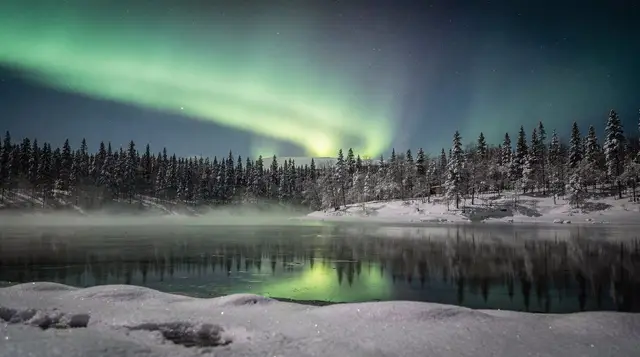
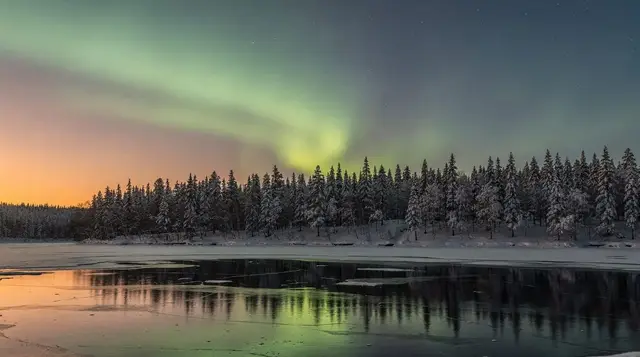
How the northern lights actually work
Why do the northern lights appear, and what do you actually need to see them?
The aurora is caused by solar wind particles colliding with gases in Earth's upper atmosphere, a process that intensifies with geomagnetic activity measured by the KP index. In Rovaniemi you also need two things a KP number can't give you: a clear sky and real darkness, which is why the display is invisible during the midnight sun period from 6 June to 7 July.
Most explanations of the aurora borealis either skip straight to “it’s magnetic” or drown you in space-weather jargon. Neither one tells you why you might stand outside Rovaniemi for three hours and see nothing, or why a friend two nights later saw a full green arc from a car park. The mechanism is simple enough to hold in your head, and once you understand it, the forecasts and the disappointment both make a lot more sense.
What’s actually happening 150 km above your head
The sun constantly throws out a stream of charged particles, mostly electrons and protons, called the solar wind. It isn’t steady: sunspots, solar flares and coronal mass ejections (CMEs) send out denser, faster bursts. When one of these bursts reaches Earth, usually one to three days after leaving the sun, it slams into the planet’s magnetic field.
That field doesn’t let the particles through everywhere. It funnels them down along magnetic field lines towards two rings around the magnetic poles, called the auroral ovals. As the particles funnel in, they collide with oxygen and nitrogen atoms in the upper atmosphere, typically 100 to 300 km up. Those collisions excite the atoms, which release the extra energy as light when they settle back down. Oxygen gives the familiar green, and at higher altitudes a rarer red; nitrogen contributes blues and purples, usually at the lower edge of a display. That’s the whole mechanism: solar wind, magnetic funnelling, atmospheric collision, light.
Rovaniemi sits at roughly 66.5°N, about 8 km south of the Arctic Circle, which puts it directly under the northern auroral oval for a large part of the year. That’s a genuine geographic advantage over destinations further south: the oval doesn’t need to expand very far for Rovaniemi to be underneath it, which is why the region is one of the more reliable places on Earth to try. It doesn’t mean the sky owes you anything on a given night.
The KP index: what the number is actually telling you
The KP index is the number quoted in every aurora forecast, on a scale of 0 to 9. It measures global geomagnetic activity, recalculated from magnetometer stations around the world roughly every three hours, and it describes how disturbed Earth’s magnetic field is as a whole.
| KP index | Geomagnetic activity | What it tends to mean for Rovaniemi |
|---|---|---|
| 0–2 | Quiet | The oval sits close to the pole; a display is still possible under a clear sky here, but often fainter and lower on the northern horizon |
| 3–4 | Unsettled to active | The oval widens to comfortably cover Rovaniemi; this is the range behind most ordinary clear-night sightings |
| 5–6 | Minor to moderate storm | Wider and brighter, sometimes directly overhead; still invisible under full cloud |
| 7–9 | Strong to severe storm | Rare, can push visible aurora well south of Lapland; the nights people remember |
Two things matter about this table. First, Rovaniemi’s location means you don’t need a dramatic number: a KP of 2 to 4 on a genuinely clear night is a perfectly normal, unremarkable aurora night here, not a near-miss. Second, and this is the trap worth remembering: KP is a global average of magnetic disturbance, not a local visibility forecast for one town. A KP of 6 tells you the whole planet’s field is disturbed; it says nothing about whether there’s a cloud sitting over the Ounasjoki right now.
The two local conditions no KP number can give you
Even a strong geomagnetic storm is invisible without two things happening at ground level, at the same time, where you’re standing.
A clear sky. The aurora happens roughly 100 to 300 km above the ground, well above any weather. Cloud, not distance, is what blocks it — a solid overcast layer hides a KP 7 storm as completely as it hides a KP 1 flicker. This is the single most common reason people leave Rovaniemi having “not seen the aurora” despite a promising forecast: the geomagnetic activity was real, and the cloud cover made it irrelevant. It’s also why most guided tours don’t stay in town; they drive, sometimes 100 to 200 km, specifically to get under a gap in the cloud.
Real darkness. The atmosphere has to be dark enough for the eye to pick out the light against the sky. This rules the display out completely during Rovaniemi’s midnight sun, from around 6 June to 7 July, when the sun never sets and the sky never gets dark. It’s also why the aurora “season” here is usually given as late August to early April: outside that window, there simply isn’t enough darkness, regardless of what the sun is doing. Twilight matters too — very early or very late in the season, a bright twilight glow near the horizon can wash out a faint display even after the sun itself is down.
Put together, the condition for seeing the aurora from Rovaniemi is: geomagnetic activity happening (which is common — activity here is frequently cited around 200 nights a year with some level of it) AND a clear sky AND enough darkness, all three at once, in the direction you happen to be looking. Drop any one of the three and there’s nothing to see, no matter how good the other two look.
The trap: a high KP under cloud is worth nothing
It’s worth stating this plainly because it’s the single most common reason for disappointment. A forecast app showing KP 5 or KP 6 feels like a promise. It isn’t one. If there’s an unbroken cloud layer over Rovaniemi that night, the geomagnetic storm is happening exactly as forecast, somewhere above the clouds, and you will see none of it. Meanwhile a modest KP 2 night with a genuinely clear sky can deliver a clear band of moving light that a cloudy KP 6 night never will.
This is also why local operators put more weight on cloud forecasts than on space-weather numbers when deciding where to drive. A minibus aurora tour is, in practice, a cloud-avoidance exercise with an aurora as the reward if it works: guides watch cloud radar and satellite imagery and choose a direction based on where the sky looks like it will stay open, not based on chasing a KP number. That’s covered in more detail in the guide to hunting the aurora from Rovaniemi and in the piece on reading a car around cloud gaps.
None of this means the KP index is useless — a KP forecast of 0 to 1 for the whole night, combined with a clear sky, tells you honestly that any display is likely to be faint and low on the horizon rather than a bright overhead arc. It’s one input, not a verdict, and pairing it with a cloud forecast is what actually predicts a night. The specific tools for doing that, and a proper month-by-month breakdown of when the odds are best, are covered separately in the forecasting apps and tools guide and the month-by-month northern lights guide — this page sticks to why the mechanism works the way it does.
Why what you see rarely matches the brochure photo
The mechanism also explains the gap between eye and camera, which is the other big source of disappointment. The human eye, especially at night, is not very good at detecting colour in low light — the light-sensitive rod cells that dominate night vision see mostly in shades of grey and pale green. A camera sensor on a multi-second exposure gathers far more photons than the eye ever collects in a single glance, and renders them as the saturated green everyone recognises from Instagram.
Both are honest: the eye usually sees a moving grey or pale green band, sometimes with a faint pink fringe on a strong night, while the same moment through a camera comes out vivid green. Neither is wrong, and neither is a scam — it’s simply how the two systems work. It’s covered in full in eye versus camera: what you actually see.
Where the mechanism plays out around Rovaniemi
Because cloud gaps and dark horizons are the deciding factors, not a fixed location, most serious aurora-watching from Rovaniemi involves moving away from the town’s own light pollution and towards whichever direction has open sky that night. Guided minibus trips do this by design; a few spots closer to town, covered in the walking aurora spots near Rovaniemi guide and the free viewing spots guide, work when the sky above town itself happens to be clear.
a minibus aurora hunt out of Rovaniemi that includes a short workshop on how the display forms is built around exactly this cloud-chasing logic rather than a fixed viewpoint. Further north in Levi or Utsjoki, darker skies and lower light pollution improve the odds further: an evening campfire watch from Levi and a night in a traditional lavvu at Utsjoki, near the Norwegian border both trade travel time for darker, often clearer conditions.
For a quieter option that doesn’t depend on a display appearing at all, an evening snowshoe walk under the winter sky in Levi is worth doing on its own terms, aurora or not.
Tours marketed as “guaranteed” deserve the same scepticism the mechanism suggests: they guarantee a refund or a repeat attempt, never the phenomenon itself, because no operator controls solar wind, cloud cover or darkness. That distinction is unpacked fully in the guide to how guaranteed tours actually work. If a clear sky simply doesn’t cooperate, a heated glass igloo at least lets you keep watching in comfort until it might.
The short version to carry with you
Solar wind hits Earth’s magnetic field and gets funnelled into the atmosphere near the poles, where it collides with gas atoms and produces light — that part happens on a schedule set by the sun, roughly measured by the KP index. Whether you see it from Rovaniemi depends on two things the KP index cannot tell you: a clear sky and enough darkness, at the same time, above your head. A high KP under cloud shows you nothing; a low KP under a clear, dark sky can show you plenty. Chase the clear patch, not the number, and treat everything else — cameras, apps, calendars — as detail layered on top of that one mechanism.
Northern lights physics: your questions answered
What actually causes the northern lights?
Charged particles thrown out by the sun in the solar wind travel to Earth and are funnelled by the planet’s magnetic field towards the polar regions, where they collide with oxygen and nitrogen atoms high in the atmosphere. Those collisions release energy as light, mostly green from oxygen around 100 to 300 km up, with red and purple appearing higher and rarer.
What is the KP index, and how high does it need to be in Rovaniemi?
The KP index is a 0 to 9 scale of global geomagnetic activity, recalculated every three hours from magnetometer stations worldwide. Rovaniemi sits under the auroral oval, so a KP of 2 to 4 is often enough for a visible display here on a clear night, well below what a location further south would need.
If the KP index is high, will I definitely see the aurora?
No. KP measures how disturbed Earth’s magnetic field is worldwide, not whether the sky above Rovaniemi is clear. A KP of 6 under total cloud cover produces nothing visible, while a quiet KP of 2 under a clear, dark sky can still deliver a display.
Does a full moon ruin the chances of seeing the aurora?
No, moonlight does not stop the aurora happening or being visible; it brightens the background sky and can wash out the faintest displays, and it also usefully lights up the snow and landscape for photos. Cloud cover, not moon phase, is the factor that actually decides most nights.
Why can’t I see the northern lights in June or July?
Rovaniemi has continuous midnight sun from around 6 June to 7 July, meaning the sky never gets dark enough for the aurora to be visible even during strong geomagnetic activity. The lights are there in the same way they are all year, but darkness is a hard requirement and summer nights don’t provide it.
Why do my photos of the aurora look brighter and more colourful than what I saw?
A camera sensor on a long exposure, often several seconds, collects far more light than the human eye can gather in an instant, so it renders a saturated green that the eye usually sees as a paler grey-green or white band. Both are real; they’re just different ways of recording the same light.
Is the aurora guaranteed if I book a “guaranteed northern lights” tour?
No tour operator can guarantee a natural phenomenon. “Guaranteed” tours guarantee a free repeat trip or a refund if nothing is seen, not that you will see the aurora on the night you book.
Northern lights tours on GetYourGuide
Verified deep-linked GetYourGuide tours. Book through these links and we earn a small commission at no cost to you.
GetYourGuide does not provide a product photo for this activity — the image shows the meeting point, photographed by us.