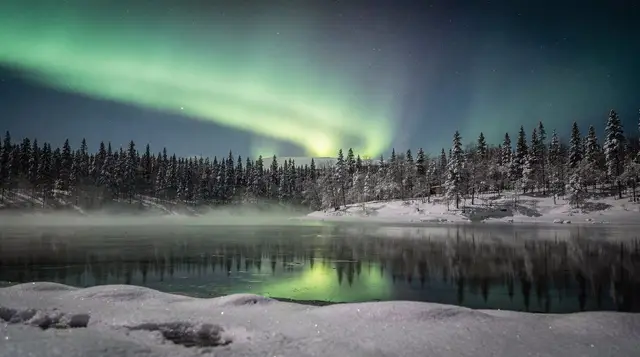
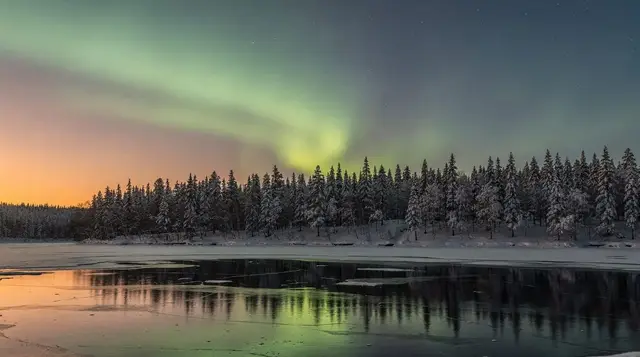
Chasing the northern lights on foot in Rovaniemi
Can you see the northern lights on foot from Rovaniemi, without a car?
Yes, but only partially. The Ounasvaara viewpoint and the Kemijoki and Ounasjoki riverbanks give a darker sky within walking distance of the centre, while the town centre itself is too lit to show a faint aurora clearly. Anything genuinely dark still requires a bus, a tour or a car.
If you are staying in Rovaniemi without a rental car and without a booked tour, you can still go and look for the northern lights on foot. What you cannot do is see them the way the brochures show them from the middle of town. This guide is about the handful of places within a walk of the centre where the sky is dark enough to give a display a fair chance, what you lose compared with driving out of town, and why the market square and the riverside promenade right by the hotels are the wrong place to stand and wait.
Why the centre disappoints and where walking starts to work
Rovaniemi’s centre is a small, flat grid of streetlights, shop signage and hotel facades, rebuilt after 1944 on Alvar Aalto’s plan. None of that was designed with stargazing in mind, and it shows: the sky directly above the pedestrian streets glows an orange-grey even on a clear night, and only a bright, fast-moving aurora punches through it convincingly. A faint band low on the horizon, which is what most displays actually look like, gets lost against the streetlights before it ever registers.
Walking works because Rovaniemi is small enough that you do not need to go far to put a river, a hill or a stretch of trees between yourself and the worst of that glow. Fifteen to forty minutes on foot from most central hotels gets you to somewhere noticeably darker. It will not get you to somewhere genuinely dark — that is still the job of a car or a minibus tour — but it is enough to turn a hopeless view into a workable one, at no cost beyond the walk itself.
Ounasvaara: the closest real dark sky
Ounasvaara is the wooded hill facing the centre across the Kemijoki, reached by crossing the Jätkänkynttilä bridge and climbing the path or road on the far side. It is not an Arctic fell — at 204 metres it is a modest hill with short ski slopes, jumps and a network of trails — but it puts a river and a rise of forest between you and the town, which matters more than altitude for this purpose.
Allow roughly 30 to 45 minutes on foot each way from the centre, more if the paths are icy, which they usually are from November onward. Once you are past the immediate glow of the ski slope floodlights, which run through the season, the viewpoint areas on the upper paths give a genuinely darker sky over the northern and eastern horizon than anything back in town. It is still not silent, black darkness — you can see the loom of Rovaniemi behind you the whole time — but it is the best you will get without transport.
Bring a torch for the descent. The trails are usable but not always lit end to end, and losing the path on packed snow in the dark is a real way to turn an aurora walk into a twisted ankle.
The Kemijoki and Ounasjoki riverbanks
Rovaniemi sits at the confluence of two rivers, the Kemijoki and the Ounasjoki, and both have riverside paths that pull you away from the densest part of the centre within a few minutes. The stretch of the Ounasjoki bank west of the centre, away from the main bridges, and the Kemijoki bank south past the church, both open up a wider, lower sky than any street in the grid.
The advantage of the river paths over Ounasvaara is that they are flat, quick and require no climb — useful on a night when you want to duck outside for ten minutes, check the sky, and go back in rather than committing to an hour-long round trip. The disadvantage is that you are still close to town: streetlights line most of the paths, and the far bank often has its own lighting. Treat the riverbanks as a first check, not a destination — if something is clearly happening, that is the moment to decide whether it is worth the longer walk to Ounasvaara or a darker spot instead.
Jätkänkynttilä bridge and the riverside path south
The Jätkänkynttilä bridge, with its flame-shaped pylon, and the older Ounaskoski bridge close the view south of the centre, and the open water and ice below them give an unobstructed horizon in that direction even from the bridge approaches. It is not a dark spot — the bridge itself is lit, and traffic passes — but the sightline south and east over the river is wide and unbroken by buildings, which is worth more on a night with a low, faint band than a darker but boxed-in side street would be.
Treat a few minutes on the bridge approach as a sky check on your way to or from somewhere else, rather than a place to stand and wait. It is convenient, it is free, and it tells you quickly whether the sky is worth pursuing further that night.
Stretching the walk: the Arctic Circle hiking area edge
The Arctic Circle hiking area, near Santa Claus Village, sits about 8km north of the centre. On foot that is over an hour each way in winter conditions, which puts it beyond a casual evening walk for most visitors — this is a genuine stretch, not a quick detour, and it is honest to say so before you set out expecting something closer.
For anyone who is a committed walker and wants the darkest sky reachable without a car or a tour, the edges of the hiking area, once you are away from the village’s own lighting, are darker again than Ounasvaara. Crossing the Arctic Circle line itself does nothing for the aurora — it is a latitude marker, not a viewing condition — so there is no reason to make that specific point your target. The value here is distance from town, not the line.
What light pollution actually does to the aurora
An aurora is not an all-or-nothing event: it ranges from a faint, slow-moving grey-green smudge low on the horizon to a bright, fast, structured display overhead. Streetlight glow raises the brightness of the sky itself, and a faint aurora against a bright sky background loses contrast the same way a dim projector image washes out in a lit room. The display does not stop happening over the town centre — it is simply harder to distinguish from the ambient glow.
This is why the same night can look like nothing from a hotel window and look like a clear, moving band from Ounasvaara twenty minutes later: the geomagnetic activity and the cloud cover are identical, only the local light has changed. It also explains most disappointment with photos taken from the centre and compared against brochure images shot from genuinely dark countryside — see what your eyes actually see versus what a camera records for more on that gap, which exists everywhere but is worse under streetlight.
Reading the sky before you head out
Three things have to line up: geomagnetic activity, a clear sky, and darkness. You cannot control the first two, but you do not have to guess at them either — check an aurora forecast app or the cloud cover forecast before committing to a walk, and read up on how the lights actually work if the numbers on those apps mean nothing to you yet. A high activity forecast under total cloud cover is a wasted walk; a modest forecast under a clear sky is worth the trip to the river at least.
Season matters as much as the forecast on any single night. The aurora season runs roughly late August to early April, and Rovaniemi sits under the auroral oval with frequent activity through that window — cloud cover, not activity, is usually what decides a given night. December and January tend to be the cloudiest months; September–October and February–March are statistically better bets for clear skies, for what that is worth to a short visit where you cannot choose your dates around statistics.
Dressing for standing still, not walking
Walking to Ounasvaara or the riverbank keeps you warm; standing at the top waiting for something to happen does not. This is the same problem as any aurora activity that involves stopping and staring at the sky rather than moving, and it catches people out on a “quick walk” more than on a booked tour, because there is no guide reminding you to keep moving or head back. Layer properly — a wool base layer, a fleece or insulating mid layer, a windproof outer shell — following the three-layer system, and bring a hat and mittens even for what looks like a short outing. Cotton is the wrong choice for any of this: it holds moisture and stops insulating once you sweat on the climb up.
Check the season and expect real cold from December through March; see the winter and kaamos season guide for what temperatures and daylight actually look like month by month before you plan an evening outdoors.
When a walk isn’t enough
Walking has a hard ceiling: you can put a river or a low hill between yourself and Rovaniemi’s lights, but you cannot outrun the weather. If the sky over town is clouded, it is very often clouded over Ounasvaara too — cloud systems do not respect a twenty-minute walk. On a night like that, the only way to find clear sky is to cover real distance, which means a car or a guided minibus tour that can drive 100 to 200km if that’s what it takes to get under open sky.
a guided minibus aurora hunt is built for exactly that problem: it goes looking for a gap in the clouds rather than waiting under whatever sky happens to be over your hotel. For a smaller group and your own pace, a private aurora tour does the same driving with more flexibility on timing and stops.
If the walk to Ounasvaara has left you wanting the view with a fire and a hot drink rather than standing in the wind, an aurora BBQ evening at chosen viewing spots covers the same ground with a camp set up for you. And if you would rather cover the darkness on a machine than in a minibus, a full-day snowmobile adventure gets you further from any town’s glow than any walk can, though it is a daytime booking rather than a dedicated night hunt.
None of these guarantee a sighting — nothing does, whatever the marketing says; see what “guaranteed” tours actually promise before you book one expecting certainty. What they buy is distance from exactly the light pollution problem this guide is about, on a night when a walk to the river or Ounasvaara has already told you the town’s own sky is not going to cooperate.
If a car-free trip is the whole plan, not just this one evening, the no-car Rovaniemi itinerary lays out how to structure a longer stay around what’s walkable and what needs a bus or a booked transfer.
Walking aurora spots near Rovaniemi: FAQ
Can I see the northern lights from Rovaniemi city centre?
Only a strong, bright display cuts through the streetlights and shopfronts around the centre. A faint or moderate aurora, which is the most common kind, is usually washed out there. Walk to the river or across to Ounasvaara before you judge whether anything is happening.
Which walking spot near Rovaniemi is darkest?
The Ounasvaara viewpoint, once you are past the ski slope lighting, and the quieter stretches of the Ounasjoki riverbank away from the bridges give the best contrast you can reach without transport. Neither is truly dark by countryside standards, but both are noticeably better than the market square.
How far is Ounasvaara from the centre on foot?
Allow around 30 to 45 minutes each way from the centre, crossing the Jätkänkynttilä bridge and climbing the lower slopes. It is a walk, not a stroll, on packed snow and ice in winter, so budget more time than the distance alone suggests.
Do I need to cross the Arctic Circle to see the aurora?
No. The Arctic Circle line itself has no effect on whether an aurora appears; it is a latitude marker, not a viewing condition. Darkness and clear sky matter, and both exist well south of the line, including at the edges of Rovaniemi.
What’s the best time of night to walk out and look?
Aurora activity has no fixed schedule, but many displays cluster loosely around 10pm to 1am. Step outside every hour or two through the evening rather than committing to a single walk, since a clear patch of sky can open and close within twenty minutes.
Is it safe to walk to these spots alone at night in winter?
Rovaniemi is a low-crime town and the riverside paths and Ounasvaara trail are lit or well-used, so walking alone is a normal thing to do. The real risks are the cold and the ice underfoot, not other people: proper boots and layers matter more than company.
Should I book a tour instead of walking out myself?
A tour earns its price by driving you past the clouds and the streetlights that a walk from town cannot escape. If a clear night coincides with your stay and you are happy with a partial, occasionally washed-out view, walking costs nothing and can still work.
Northern lights tours on GetYourGuide
Verified deep-linked GetYourGuide tours. Book through these links and we earn a small commission at no cost to you.
GetYourGuide does not provide a product photo for this activity — the image shows the meeting point, photographed by us.