A line with no fence, no wall and no temperature change
The Arctic Circle is not a place so much as a fact about the sky. It marks the southernmost latitude — currently close to 66°33′ north, and drifting very slowly north each year because of the tilt of the Earth’s axis — at which the sun can stay above the horizon for a full 24 hours at the summer solstice, and below it for a full 24 hours at the winter solstice. Nothing about the ground changes at that latitude. The forest, the road surface, the air temperature: identical a metre either side of the line. What changes is the sun’s behaviour on two specific days of the year, and that’s genuinely worth understanding before you go and stand on a painted stripe for a photo.
Near Rovaniemi, the line crosses about 8 km north of the city centre, on the grounds of Santa Claus Village. That detail surprises a lot of visitors, because Rovaniemi is so strongly marketed as an Arctic Circle destination that people assume the whole city sits inside it. It doesn’t.
Rovaniemi’s centre, the Arktikum museum, the hotels along the Kemijoki river — all of it is a short distance south of the Arctic Circle, not north of it. If you want to have actually crossed the line, you need to travel those 8 km north, by bus 8, taxi or hire car, or as part of an activity that happens to pass that way.
This page is about the line itself — its geography, its marker, the certificate you can buy, and the two extremes of daylight, midnight sun and kaamos, that make the Arctic Circle mean something beyond a line on a map. For the shops, the Santa photo queue and the wider village experience, the complete Santa Claus Village guide covers that in full; it isn’t repeated here.
The painted line and the signposts
At Santa Claus Village, the Arctic Circle is marked by a line painted across the ground, flanked by a cluster of signposts pointing toward cities around the world with the distance to each. It’s a simple, deliberately photogenic setup: stand with one foot either side of the line and you’ve technically had one foot in the Arctic and one foot outside it, which is exactly the picture almost every visitor takes. The marker moves very slightly over the years as the Earth’s axial tilt shifts, so the painted line is a practical approximation rather than a laser-precise boundary — nobody visiting for the photo needs to worry about being a few metres out.
There’s no fee to walk up to the line, stand on it, or photograph it yourself. The costs at Santa Claus Village are for the extras built around that free moment: the professional photo with a printed backdrop, the crossing certificate, and the Santa Claus Village post office’s Arctic Circle postmark stamped onto a postcard or letter. None of those are required to say you’ve crossed the Arctic Circle — they’re souvenirs of having done it.
The crossing certificate, honestly assessed
The Arctic Circle crossing certificate is a printed card, available for a fee at Santa Claus Village, recording the date you crossed the line. It carries no legal or official weight — it isn’t issued by any government body, and nobody will ever ask to see it. It exists purely as a keepsake, in the same category as the Santa Claus Village post office stamp or a photo with Santa Claus himself, which has its own separate cost worth checking before you queue.
Whether it’s worth buying comes down to what you actually want. If a physical certificate matters to you as a memento, or you’re travelling with children who’ll enjoy having something to show at school, it does what it says. If you’d rather keep the money, the free photo at the painted line does exactly the same job for the price of nobody’s time but your own. For the full mechanics — where to buy it, what it costs, what it looks like — the dedicated Arctic Circle line certificate guide goes further than this page needs to.
Why the line matters: the sun, not the ground
The reason the Arctic Circle is drawn where it is comes down to one astronomical fact: north of that latitude, there’s at least one day a year when the sun never sets, and at least one day when it never rises. South of it, including Rovaniemi’s own centre, the sun rises and sets every single day of the year, even if some of those winter days offer only a few hours of low, grey light. That’s the entire logic of the boundary, and it’s worth carrying with you before you photograph the line, because the two headline phenomena tourists come to Lapland for — midnight sun and the polar night — are both explained by it.
Midnight sun: 6 June to 7 July
At Rovaniemi’s latitude, the sun stays above the horizon around the clock from roughly 6 June to 7 July. It doesn’t blaze overhead at midnight the way it does at noon — it swings low toward the northern horizon, casting a long, warm, sideways light, then climbs back up rather than setting. Locals and regular visitors describe the odd sensation of checking a watch at what feels like late afternoon and finding it’s actually 11pm.
For visitors timing a trip around this, the summer midnight sun and shoulder seasons guide covers what else is open and worth doing during those weeks, since most of the husky and snowmobile activity that fills the rest of the year is off the table in June.
Kaamos: the polar night of 2–12 December
The reverse phenomenon, kaamos, is much more specific to Rovaniemi than most visitors expect. True polar night — when the sun stays below the horizon for the entire day — only lasts from around 2 to 12 December here. It is not, as many people assume, the whole of the Finnish winter, and it does not mean total darkness.
During those days the sun sits just below the horizon, and the sky still fills with several hours of a deep, saturated blue twilight around the middle of the day, often photographed as the “blue hour” stretched out to two or three hours rather than the usual few minutes. It’s a strange, calm light, not the pitch black that the word “polar night” suggests to people who haven’t experienced it. The winter and kaamos season guide covers what daily life and daylight actually look like across the whole winter, kaamos included.
Outside that roughly ten-day window — which covers the rest of December, all of January and February, and into March — the sun in Rovaniemi does rise and set every day, just briefly and low on the horizon in the darkest weeks. A late-December visitor gets a few hours of pale daylight around midday, not none at all. That distinction matters: it’s the difference between planning a trip around genuine 24-hour darkness, which only really applies a short drive further north at places like Utsjoki or Nuorgam, and planning around Rovaniemi’s own, much shorter, kaamos window.
The months in between
Between those two extremes, daylight in Rovaniemi shifts fast. By late April the days are already long; by late August they’re visibly shortening again, and by the ruska weeks of September the balance of daylight and darkness starts favouring dark evenings that make aurora hunting possible again after the bright summer months. Anyone building a trip around a specific light condition — long days for hiking, dark skies for aurora hunting, or the shoulder weeks that offer a bit of both — will get more out of the month-by-month breakdown than out of a single date on this page.
What the line has to do with the northern lights
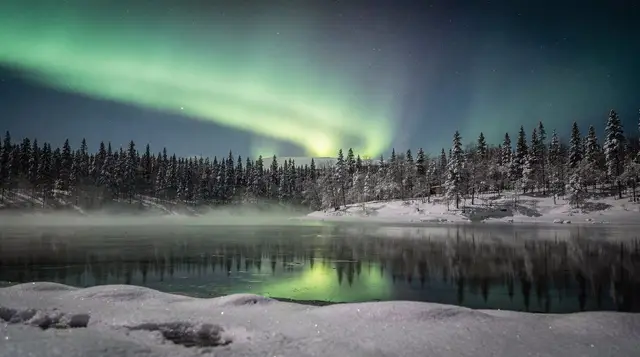
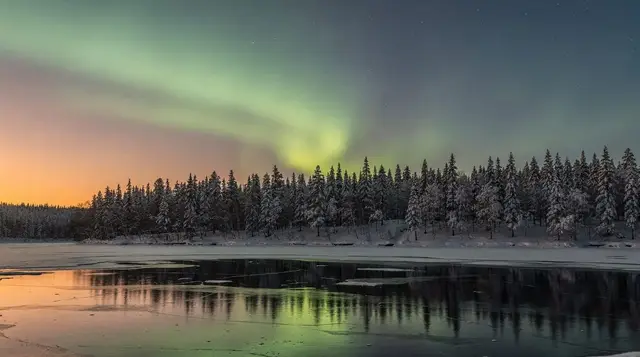
The Arctic Circle’s latitude also happens to sit under the auroral oval, the band around the pole where northern lights activity is most frequent, which is why Rovaniemi markets itself as an aurora destination in the first place rather than purely on account of the line.
Standing at the painted marker itself doesn’t improve your odds of seeing an aurora over standing anywhere else nearby with a dark, clear view north — light pollution and cloud cover matter far more than the few kilometres either side of 66°33′. What the Arctic Circle crossing does add is context: once you understand that the line marks where the midnight sun and kaamos begin, an aurora tour setting off after dark from a spot just north of it makes a lot more geographic sense.
Trips that combine the theme directly include an aurora-hunting evening with a campfire barbecue at dark viewing spots outside the city, a guided ski trek under the northern lights away from town lights, and, for those staying further north around Levi, a private aurora hunt out into the Levi wilderness. None of them guarantee a sighting — nothing does — but they’re built around exactly the darkness and cloud-avoidance logic the line’s astronomy explains.
Getting to the line
The most straightforward way to reach the Arctic Circle marker is bus 8, which runs from the city centre to Santa Claus Village in around 25 minutes and drops you a short walk from the line itself. Drivers can reach it in roughly 15 minutes along the same road north out of the centre; there’s paid parking at the village.
Travellers arriving by air land at Rovaniemi Airport, which is actually closer to the line than the city centre is — worth knowing if you’re short on time between flights, though most people still base themselves in town. The airport transfer guide and the broader how to get to Rovaniemi guide cover the wider logistics of arriving in the region.
Because the line sits inside Santa Claus Village’s grounds, most visitors combine the crossing with at least a walk through the village itself, even if they’ve read the full village guide and know it’s a commercial park rather than a historic site.
It fits naturally into a short first day; the one-day highlights itinerary and the two-day city and Arctic Circle itinerary both build the crossing in alongside the city-centre sights like Arktikum and the Jätkänkynttilä bridge. Families visiting over the festive season, when the village is busiest, may also want the Christmas in Rovaniemi guide for what December crowds and opening patterns actually look like.
What the line isn’t
It’s worth being blunt about what standing on the Arctic Circle line does and doesn’t give you. It doesn’t change the temperature — a day at -15°C on the south side of the line feels identical to -15°C on the north side, a few metres away. It isn’t a national border, and there’s no passport check, no gate, and nothing preventing anyone from walking across it at any hour. It doesn’t guarantee you’ll see the midnight sun or the northern lights just because you’ve crossed it — those depend on the calendar date and the weather, not on which side of the painted stripe you’re standing.
And it isn’t unique to Rovaniemi: the same latitude line runs right around the globe, through northern Sweden, Norway, Russia, Alaska and Canada. What makes this particular crossing point worth a detour is that it’s easy to reach, clearly marked, and sits right beside a village built around the idea of Santa Claus’s home — not that the geography here is special compared with anywhere else on the same parallel.
None of that makes it a waste of time. It’s a genuinely interesting fact made physical and photographable, and pairing the free five-minute version — walk up, straddle the line, take the photo — with a short read on what the sun actually does here in June and in December turns a souvenir snapshot into something you understand rather than just something you did.
Practical notes for the visit
A visit to the line itself rarely needs more than 30 to 60 minutes, though most people stretch that into half a day once the village’s shops, cafés and the post office are added in. There’s no separate admission fee for the crossing, so the only costs to budget for are optional: the professional photo, the certificate, a postmarked card at the post office, and food or drinks in the village.
Wrap up properly for the season regardless of how quick the stop feels — temperatures at this latitude follow the same swings as the rest of Rovaniemi, and standing around for photos in a Lapland winter is colder than it looks in the pictures. For what to actually wear, the three-layer packing guide covers it in more depth than a single paragraph here could.
Visit in early June and you’ll be crossing the line under a sun that has no intention of setting that night. Visit in the first two weeks of December and you’ll cross it under a sky that never quite reaches full daylight but never goes fully black at midday either. Visit any other week of the year, and the line is exactly what it is the rest of the time: a painted stripe marking a fact about the sky, free to stand on, and a five-minute detour that’s easy to justify on the way to or from Santa Claus Village itself.