Driving your own dog sled vs riding as a passenger
What's the difference between driving and riding a husky sled?
Driving means standing on the runners of your own sled, braking with a foot pedal and steering by voice command, after a compulsory briefing of 10 to 15 minutes. Riding means sitting wrapped in blankets while a musher or guide drives. Driving is generally reserved for fit adults on easier terrain; riding suits families with young children and anyone with limited mobility.
Two very different jobs on the same sled
Every husky sled booking near Rovaniemi asks, in one form or another, the same question: do you want to drive, or do you want to be driven? The two options share a trail, a team of dogs and a lot of the same marketing photography, but they are genuinely different experiences, and mixing them up is the single most common source of disappointment reported after a sledding trip. This page is only about that choice — who stands on the runners and who sits in the sled. It does not cover how long a run should last (see our dog sledding tour duration guide) or how well a particular kennel treats its animals (see husky welfare questions to ask).
What driving actually involves
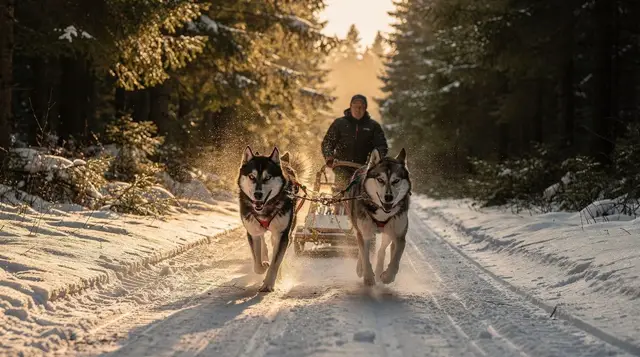
Driving your own dog sled means standing upright on two runners at the back of the sled, holding the handlebar, with one foot resting on a metal brake between the runners. You are not sitting down at any point while you drive. The dogs pull; you control speed with the brake, lean into corners to keep the sled upright, and use a short set of voice commands — typically something like “go” to start and a firm, repeated word to slow the team, since huskies are trained to respond to tone and consistency more than to any specific vocabulary. There is no steering wheel and nothing to turn: the sled follows the team, and your job is mostly about speed control and balance, not navigation.
Before any of that, every kennel around Rovaniemi that offers a self-driven option runs a compulsory briefing, generally 10 to 15 minutes, on foot, before the dogs are even harnessed. It covers standing position, how hard to press the brake, what to do if the sled tips on a bend, and how to keep your weight centred going downhill. This briefing is not a formality to sit through — guides are watching how comfortable people look on their feet, and they can, and do, move someone from the driving role to the passenger seat if the briefing makes it clear that person is not going to manage the runners safely.
The same applies to snow conditions: if the trail is icy, rutted or otherwise judged unsafe for guests to drive themselves that day, a kennel can restrict driving and run passenger-only sleds instead. Any operator who tells you no skill or attention is needed to drive is skipping a step that most reputable kennels build into the day deliberately.
Driving suits fit adults more than anyone else. It asks for reasonable balance, the strength to hold a brake pedal down firmly and consistently, and enough general coordination to lean with the sled on a curve rather than fight it. Kennels generally set a minimum age somewhere between 15 and 18 to drive alone, though this varies by operator, and most expect an adult to ride along in the sled if a minor is driving. Routes offered for self-driving also tend to run on less technically demanding terrain — wider forest tracks and gentler curves — rather than the tightest or steepest sections a kennel’s dogs might use, because a guest at the brake needs margin for error that an experienced musher does not.
Reaching a kennel on time for the briefing
A self-driven sled run starts on foot, with a briefing that generally lasts 10 to 15 minutes before any dog is harnessed. Arriving late or flustered means starting that session already rushed, which is a poor state for a day spent balancing on runners.
Ask the kennel exactly where the meeting point is and whether pick-up from Rovaniemi is included in the price for the driving option or only for the passenger one. If it is not included, your own transport gives you a fixed arrival time and a way back whichever role the guides give you in the end. For a day around Rovaniemi, you can reserve a Localrent rental car and plan your arrival at the kennel yourself.
What riding as a passenger actually involves
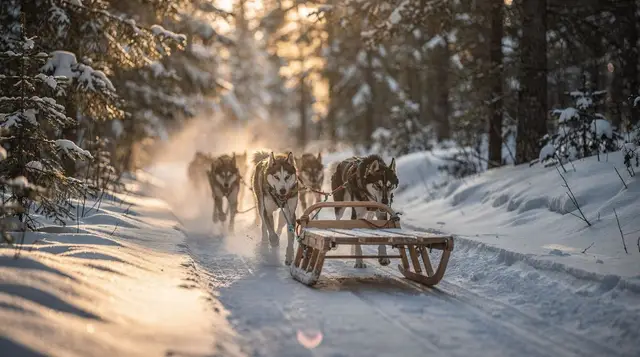
Riding is the simpler option to describe: you sit down, low in the sled, usually reclined against a backrest, wrapped in a thick blanket or reindeer hide provided by the kennel, and a guide or professional musher stands on the runners and drives. You do nothing except hold on and stay covered. There is no briefing beyond basic safety points, because there is nothing to operate.
This is the role that suits families with young children, since a child can sit on an adult’s lap or be tucked in alongside them rather than needing to stand and balance on moving runners. It is also the realistic option for anyone with limited mobility, an injury, or simply no interest in the physical side of the activity — sitting down and being wrapped in blankets is a manageable transfer for many people who would not attempt standing on a moving sled. Because a guide is driving, passenger sleds can also cover ground that some kennels reserve for experienced mushers only, including tighter turns or slightly longer stretches at higher speed, since there is no learner controlling the brake.
How to decide before you book
The easiest way to choose is to picture the moment you will remember. If it is the feeling of the dogs surging forward while you hold the sled steady yourself, you want to drive. If it is the quiet of the forest, the sound of paws on snow and having both hands free to wrap a blanket or hold a camera, you want to ride. Neither picture is wrong, but they rarely fit the same person on the same afternoon. Our wider husky sledding guide covers the rest of the experience, and the blog post is a husky sled worth it? gives a candid personal take on whether the whole outing earns its place in a short trip.
A second test is how you handle being responsible for something moving. Some travellers love the focus that driving demands and come away feeling they actually did something. Others find that concentrating on the brake, the bend ahead and the dogs in front leaves them with little attention for the landscape they travelled so far to see. If you are in the second group, riding is not a consolation prize: it is the version in which you notice the most.
What riding feels like from the sled
A passenger sits close to the ground, and that changes the experience more than most people expect. The dogs are only a short distance ahead, you hear their breathing and the rhythm of the run, and the trees pass at eye level. Because the guide handles every decision, passengers can look around, take photographs and talk to each other, which is much harder for a driver who must keep both hands on the sled. If photography matters to you, our notes on smartphone photography in the cold explain how phones behave in low temperatures, which is worth knowing before you lift one out of a blanket.
Passengers also tend to be the ones who get cold, because sitting still for the length of the run generates no warmth of its own. The kennel’s overalls and blankets do most of the work, but arriving properly dressed matters even more when you will not be moving. If the outing is meant to end under a dark sky, the pairing of dogs and aurora is covered in husky and reindeer sled aurora tours.
Reading the listing before you book
Tour pages use the words “drive”, “ride”, “mush” and “experience” loosely, so read the description for what you will actually be doing. A few things are worth looking for:
- whether the listing names a self-driven sled or only says you will “take part”;
- whether the sled is shared between two guests and how the driving is divided;
- whether a briefing is mentioned, which is a good sign for any self-driven option;
- whether the page describes a passenger-only variant for children or guests who prefer to sit;
- whether the kennel says anything about how its dogs are cared for, which you can check against our husky welfare questions.
If a listing is vague on any of these, ask before paying. A short message to the operator costs nothing, and the answer usually tells you a great deal about how the day is run. Anyone who is not sure they want to sled at all can also consider a husky farm visit without sledding, which keeps the dogs and drops the runners entirely.
Couples, friends and solo travellers
Two adults sharing a sled face the question most directly. One of you drives while the other rides, and the choice of who goes first can become a small negotiation. Agree in advance, and ask whether the kennel lets you swap partway. If both of you want to drive, check whether the booking gives you one sled each or only one between you; some operators sell the experience in a way that quietly assumes the second option.
Solo travellers often assume the driving option is closed to them, but a single guest can usually book a place in the same way as anyone else. Our notes on travelling solo in Rovaniemi explain how group activities tend to work when you arrive alone, and the same logic applies to a sled outing: you will be matched with a guide and a team, and the briefing treats everyone the same.
Families and teenagers
Parents of small children should read this page alongside Rovaniemi with toddlers, because the practical constraints of cold, naps and patience affect the choice as much as the age rules do. Passenger seating is the natural answer for the youngest children, while older teenagers may be old enough to drive under the kennel’s own rules. The advice in Rovaniemi with teenagers is useful for deciding whether a teenager will enjoy being in charge of a sled or would rather watch. A family itinerary such as the family-friendly Lapland itinerary shows how a sled outing can sit alongside gentler activities on other days.
Other ways to ride behind an engine or an animal
If neither driving nor riding behind dogs appeals, the region offers other seated, guided options. A snowmobile safari puts you in control of a machine rather than an animal, and the notes on two-person snowmobile rides explain how the driving is shared between a pair. Visitors who want the traditional experience at a slower pace can compare a reindeer sleigh ride in the same way, and the reindeer farm driving licence offers a hands-on option of its own for those who want to steer something themselves.
Fitting a sled outing into your trip
A sled outing is rarely the only thing on a Lapland itinerary, so think about where it sits in the week. Putting it early gives you time to rebook if the weather or the snow turns out badly, and it leaves later days free for other plans. Our guides to how many days to spend in Rovaniemi and the four-day winter adventure itinerary show how operators and travellers usually arrange these days, while the trip budget guide helps you decide how much of your spending to put into this one activity. Winter conditions shape what a kennel can offer on any given day, so the overview of winter and kaamos season is a useful read for setting expectations about light and snow.
Finally, take insurance seriously for an activity in which you stand on a moving sled. Check what your policy covers using our note on travel insurance for Lapland before you book, and read the kennel’s own safety conditions so that nothing in the briefing comes as a surprise.
Side by side
| Driving your own sled | Riding as a passenger | |
|---|---|---|
| Position | Standing on the runners | Sitting, wrapped in a blanket |
| Control | You brake and give voice commands | Guide or musher does everything |
| Briefing | Compulsory, 10–15 minutes on foot | Minimal safety points only |
| Suits | Fit adults, generally 15–18+ | Families with young children, limited mobility |
| Terrain used | Easier, wider trails | Can include tighter or busier sections |
| Physical demand | Active: balance, leg strength, focus | Passive: staying warm and holding on |
| Can be refused | Yes, at briefing or on the trail if unsafe | Rarely, beyond general safety limits |
Why some kennels split a shared sled
A number of routes near Rovaniemi are booked as a shared two-person sled, and several kennels handle the driving question by splitting the route: one person drives the first half while the other rides, then they swap for the return leg. This is worth asking about specifically when booking, since it is not always mentioned upfront and it changes what you should expect if you were hoping to drive the entire distance yourself, or conversely if you were hoping to sit the whole way and your booking partner assumed you would split it.
It is also worth asking, plainly, whether the operator’s “driving” option means you control your own dedicated sled and team, or whether you are the second person in a two-seat sled behind someone else who drives — both are sold as husky sledding, but the second is closer to riding with a longer view than to actually driving.
Choosing between the husky trips on offer
For a first taste of driving on a short, well-marked route, the sled dog tour near Ranua runs on forest tracks suited to guests driving for the first time, with the briefing built into the start of the trip. Around Levi, the husky sled ride from Sirkka and the evening husky sled ride in Levi both offer the same driving-or-riding choice on their own trail networks, with the evening option running after dark under headlamps, which some drivers find easier to focus on since there is less to look at beyond the trail itself.
If the group includes small children or anyone who would rather stay seated the whole time, a family sledge pulled behind a snowmobile is a passenger-only alternative that removes the driving decision altogether.
Booking the right one for your group
A group with mixed ages and abilities does not have to book the same role for everyone. Most kennels are used to some guests driving and others riding on the same outing, and will ask at booking, or at the briefing at the latest, who wants which role. What matters is saying so clearly in advance rather than assuming: a kennel that expects a driving group and gets several first-time toddlers, or the reverse, has to rearrange sleds on the spot, which slows the whole group down.
If you are planning a Rovaniemi trip around several activities and need to weigh a husky sled against a reindeer sleigh ride, our reindeer vs husky comparison covers pace, cost and what each animal-based activity actually feels like, separate from the driving question on this page.
Families weighing whether to book at all should also see what disappoints families in Rovaniemi and kid-friendly activities in Rovaniemi before choosing a slot, and travellers asking about wheelchair or mobility access more broadly should check accessibility in Rovaniemi alongside calling the kennel directly, since sled and loading-area access varies operator to operator.
What to wear either way
Whether you drive or ride, you are outdoors in Lapland winter temperatures for the length of the trip, and driving does not keep you warmer — standing still on runners in moving air can feel colder than sitting wrapped in a blanket. Dress in the same three layers regardless of role: merino wool next to skin, a fleece mid-layer, a windproof and, ideally, waterproof outer shell, plus the thermal overalls, boots and mittens most kennels lend out for the trip. See what to pack: the three-layer system for the full breakdown, and dressing a child for -25°C if a young passenger is coming along.
The honest bottom line
Driving your own dog sled is an active, hands-on 10 to 15 minutes of briefing followed by an active run where you are responsible for speed and balance — genuinely satisfying for a fit adult who wants to feel like more than a spectator, and genuinely refusable by a guide if the briefing or the day’s snow conditions say otherwise.
Riding as a passenger is the calmer, more accessible option, better suited to young children, anyone with limited mobility, or travellers who would simply rather watch the forest go by than concentrate on a brake pedal. Neither role is the “better” version of husky sledding — they are two different activities that happen to use the same dogs and the same trail, and the right one depends entirely on who is booking, not on which option sounds more adventurous on a tour listing.
Husky sledding tours on GetYourGuide
Verified deep-linked GetYourGuide tours. Book through these links and we earn a small commission at no cost to you.
GetYourGuide does not provide a product photo for this activity — the image shows the meeting point, photographed by us.