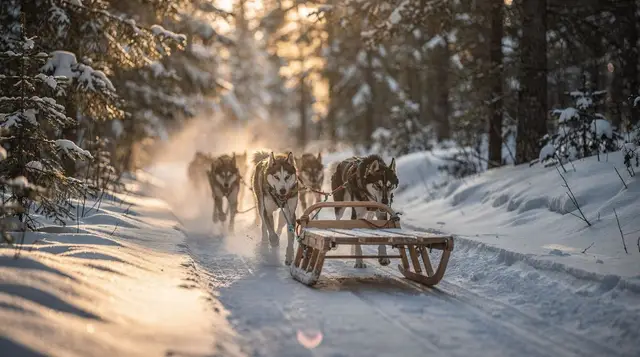
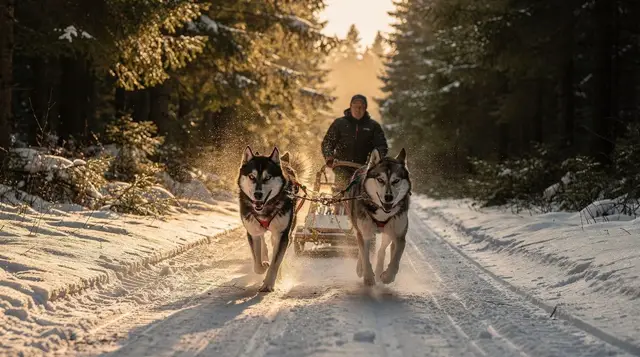
Husky sledding in Rovaniemi
What does husky sledding cost in Rovaniemi?
Prices vary hugely by duration: a short 1 to 3km taster ride starts around 60 to 90 EUR, a half-day tour with a longer route runs roughly 150 to 220 EUR, and full-day or overnight trips with a wilderness cabin can reach 300 to 500 EUR or more. Warm overalls, boots and mittens are normally lent by the operator, and December prices tend to sit at the top of every range.
Every operator around Rovaniemi sells some version of a husky sled ride, and the range hides three genuinely different products under one name. A 1 to 3km taster in a kennel yard is not the same trip as a half-day route through the forest, and neither is close to a full-day expedition that ends at a wilderness cabin. This page sorts out the formats, the passenger-versus-driver question, and what a realistic budget looks like, before pointing you to the pages that go deeper on each detail.
What “husky sledding” actually means
The dogs pulling the sled are not a single breed. Most working teams in Finnish Lapland are Alaskan huskies, a type bred purely for pulling power, speed and stamina rather than for looks or a kennel-club standard — you will also see some Siberian huskies and Alaskan malamutes, which are recognised breeds, mixed into or run alongside the working teams. A good kennel is judged on how it keeps and rests its dogs, not on how closely they match a picture. Teams typically run 4 to 8 dogs per sled depending on the load, the terrain and the length of the route.
Sledding happens on prepared trails through forest and, on longer routes, across frozen lakes and rivers. The season runs from roughly late November, once there is reliable snow cover, through to April.
The three formats on offer
Almost everything sold in Rovaniemi falls into one of three formats. The differences are mostly about how much time you actually spend moving behind the dogs, and that changes the price sharply.
| Format | Sledding time | Typical total time | Indicative price per person |
|---|---|---|---|
| Mini ride (1 to 3km) | 10 to 20 minutes | 1 to 1.5 hours with kennel visit | 60 to 90 EUR |
| Half-day tour | 1 to 2 hours on the trail | 3 to 4 hours including transfers and hot drinks | 150 to 220 EUR |
| Full-day or cabin trip | 2.5 hours or more | Full day, sometimes overnight | 300 to 500 EUR+ |
A mini ride is really a taster: you meet the dogs, get harnessed into a short loop around the kennel’s own trails, and leave with photos rather than a sense of having travelled anywhere. It suits families with young children, anyone short on time in Santa Claus Village, or a first husky encounter before deciding whether to book something longer.
A half-day tour is the format most visitors end up with. It leaves the kennel yard behind for a proper forest route, includes a stop for a hot drink or soup around a fire, and gives a real sense of what dog sledding involves without eating a whole day of a short trip. Transfers to and from central Rovaniemi are usually included and add 20 to 40 minutes each way.
A full-day or wilderness-cabin trip is a different order of activity: a longer route, a lunch or dinner cooked over a fire, and sometimes an overnight stay in a cabin with the dogs resting nearby. These are worth it for anyone who wants distance and quiet rather than a checklist experience, but they are a genuine commitment of time and money, not an add-on. For exactly how long each format keeps you on the trail versus standing around, see our dog sledding tour duration breakdown.
a 5km insider-route husky sledding tour sits toward the longer end of the half-day bracket, while a shorter 3km guide-driven husky cart ride with a kennel visit is closer to the mini-ride format and works well as a first taste.
Passenger or driver: two very different experiences
Every tour offers a choice, sometimes without spelling it out clearly at the point of booking: ride as a passenger, or drive your own team as a musher.
As a passenger, you sit low in the sled, usually wrapped in a reindeer skin or blanket, while a musher stands on the runners at the back controlling the dogs. It requires no skill, works for almost any age, and is the only realistic option for young children. As a musher, you stand on the runners yourself, control the brake, and steer the team through the turns, usually with a guide or another guest riding as passenger in front of you. Most operators set a minimum age for driving, commonly 16 to 18, and expect a reasonable level of fitness and balance — falling off on a corner is not rare.
Neither experience is objectively better; they are simply different. Driving gives you the physical sensation dog sledding is known for, while riding as a passenger lets you actually look around and take photos instead of concentrating on the brake. Many half-day tours split the route so guests swap partway through. For the mechanics of holding the brake, weighting the sled on corners and what a guide actually teaches you before setting off, read our page on driving versus riding a dog sled.
What to expect on the day
Cold is the main variable to plan around. Rovaniemi’s winter days commonly sit between -10 and -25C, and sledding feels colder than walking or standing still because you generate very little body heat sitting in a sled or holding a brake bar. Operators lend a full thermal overall, insulated boots, mittens and sometimes a balaclava as standard — check this when booking rather than buying gear you will not need again.
Underneath, the usual three-layer approach applies: a wool or synthetic base layer, a fleece or wool mid layer, and a windproof outer shell. Avoid cotton against the skin; once damp it stops insulating. Our full three-layer packing guide covers this in more detail, and if you are bringing children, see dressing a child for -25 degrees.
Most tours start with a kennel visit before harnessing: meeting the dogs, watching (and often hearing) the noise level spike as the team senses it is about to run, and a short safety briefing. The dogs themselves are usually calm and used to visitors, though excitable right before a run. A guide travels with every group, whether by snowmobile alongside the sleds or on the last sled in the line.
Choosing a kennel
Not every kennel treats its dogs the same way, and the differences are not always visible on a one-hour visit. Worth asking before booking, or on arrival if you did not ask beforehand: how much rest dogs get between tours, typical group and team sizes, what happens to dogs once they are too old to pull, and whether the kennel operates and cares for its dogs year-round rather than scaling down outside the winter season. These questions matter more than any marketing claim about “happy dogs,” and we have set them out in full on our husky welfare questions to ask page.
If you would rather meet the dogs without sledding at all — useful with very young children, limited mobility, or simply an interest in how a working kennel runs — a standalone husky farm visit is worth considering instead. a kennel visit built around meeting and learning about the dogs, without a sled ride is one option that keeps things simple and considerably cheaper.
For families staying near Santa Claus Village, several operators combine the village visit with a short ride on site, which avoids a separate transfer: a short husky ride within Santa Claus Village itself or the fuller a guided tour pairing Santa Claus Village with a husky sled ride both work as one combined half-day out rather than two separate bookings.
Husky sledding versus other winter activities
Husky sledding is often compared with reindeer sleigh rides, and the two are not interchangeable. A reindeer ride is slow, calm and short — 3 to 6km/h over a fixed 1 to 2km loop — while a husky team runs considerably faster and covers more ground even on a short tour. If you are trying to choose between the two, or wondering whether to book both, our reindeer versus husky comparison lays out the practical differences, and the reindeer sleigh ride guide covers that activity on its own terms.
Husky sledding also pairs naturally with an aurora hunt later the same evening — sledding by day, watching the sky after dark — since both are typically 3 to 5 hour commitments and neither requires the whole day.
Fitting it into a trip
A half-day husky tour is one of the easiest activities to slot into a short stay: it needs half a day, not a full one, and most operators run daily departures through the winter season with a transfer from central Rovaniemi. If you are planning a wider trip, our 3-day classic Lapland itinerary sets out where a husky tour fits alongside an aurora hunt and a day in town, and how many days in Rovaniemi covers the same question for longer or shorter stays.
On budget: husky sledding is one of the pricier activities on a Lapland trip relative to its length, largely because keeping and feeding a working dog team is expensive year-round, not just during the tourist season. Our Rovaniemi trip budget guide sets this cost against everything else — motorised safaris, aurora tours, museums — so you can see where it sits. If a listing’s price looks unusually low for a half-day slot, check exactly how much sledding time is included before booking; see scams and tourist traps in Rovaniemi for what else to watch for.
Husky sledding: your questions answered
Do I need experience to go husky sledding in Rovaniemi?
No. Most short and half-day tours are designed for complete beginners: a guide gives a briefing before you set off, mini rides where you sit as a passenger need no skill at all, and even self-driven trips start with basic instruction on braking and balance.
What is the difference between riding as a passenger and driving my own sled?
As a passenger you sit low in the sled under blankets while a musher controls the dogs from the back; driving means standing on the runners yourself, braking and steering your own team, usually with a musher or another guest riding along. See our dedicated page on driving versus riding a dog sled for the practical detail.
How cold does it get, and what should I wear?
Daytime winter temperatures in Rovaniemi commonly sit between -10 and -25C, with occasional dips below -30C, and sledding feels colder than walking because you are not generating much body heat. Operators normally lend a full thermal overall, boots, mittens and a hat; dress underneath in wool and fleece layers rather than cotton.
Are huskies a specific breed?
Not really. Most sled dogs used in Lapland are Alaskan huskies, a working type bred for speed and endurance rather than a breed recognised by kennel clubs, alongside some Siberian huskies and Alaskan malamutes. What matters more than pedigree is how a kennel treats and rests its dogs.
How long does a typical tour last?
It depends entirely on the format: a mini ride can be over in 15 to 20 minutes of actual sledding, a half-day tour usually fills 3 to 4 hours including kennel time and hot drinks, and longer trips with a wilderness cabin can run a full day. Our guide to dog sledding tour duration breaks down what each length actually includes.
Is husky sledding ethical?
It can be, but standards vary between kennels, and it is worth asking direct questions before booking: about rest days, group sizes, what happens to dogs when they are too old to run, and whether the kennel operates year-round rather than only in winter. Our page on husky welfare questions to ask lists what to ask.
How much does husky sledding cost in Rovaniemi?
Expect roughly 60 to 90 EUR for a short taster ride, 150 to 220 EUR for a half-day tour, and 300 EUR or more for a full-day trip with a cabin stop, with December prices often at the top of these ranges.
Husky sledding tours on GetYourGuide
Verified deep-linked GetYourGuide tours. Book through these links and we earn a small commission at no cost to you.
GetYourGuide does not provide a product photo for this activity — the image shows the meeting point, photographed by us.