The reindeer driving licence, and what it isn't
Is the reindeer 'driving licence' a real permit?
No. It's a printed souvenir certificate that farms hand out after a visitor steers a reindeer sleigh for a few hundred metres on a fenced, staff-supervised course. It has no legal standing, doesn't let you drive a sleigh unsupervised anywhere else, and exists purely as a keepsake.
What the “driving licence” actually is
Reindeer farms around Rovaniemi hand out a printed certificate after visitors take a short turn steering a sleigh on a fenced course. It’s usually called something like a “reindeer driving licence” or “reindeer sleigh licence” on the farm’s own signage, and it looks the part — a laminated card, sometimes with a wax-style stamp, occasionally with your name written in by hand. None of that makes it official. It has no connection to any transport authority, no register anywhere records it, and it doesn’t authorise you to handle a reindeer sleigh unsupervised, at this farm or any other. Treat it exactly like a certificate from a theme park ride: a nice thing to bring home, not a qualification.
That framing matters because the phrase gets repeated in marketing without the caveat, and first-time visitors sometimes ask, in all seriousness, whether they’re now allowed to drive a reindeer sleigh on their own. They aren’t, and no farm will let them try. A guide or farmhand stays within a few metres the entire time, the reindeer knows the route by heart, and the “driving” is closer to holding the reins on a well-trained horse led around a paddock than genuinely controlling the animal’s direction.
If you want a page that treats reindeer herding as the real Sámi livelihood it is — quotas, coasting seasons, open range, the economics of it — that’s a separate subject with its own Sámi reindeer herding as a livelihood guide. This page is about the tourist experience: a farm visit built around handling reindeer safely and taking home a fun souvenir.
How the visit is structured
Most farms near Rovaniemi run the same rough sequence, whether you book through Kuusamo, Sodankylä, or the more remote farms near Utsjoki. Expect this order:
- Arrival and introduction. A guide explains the farm, introduces a few named reindeer, and covers basic safety — no sudden movements, no grabbing antlers, no feeding anything except what’s handed to you.
- Hand-feeding. You’re given a small handful of lichen (the reindeer’s natural winter forage) or a dried feed pellet mix, and reindeer that are used to visitors will approach and eat directly from your open palm. It’s calm, close-up, and usually the part people photograph most.
- Antlers and biology explained. The guide talks through the antler cycle and the animal’s life, covered in detail below.
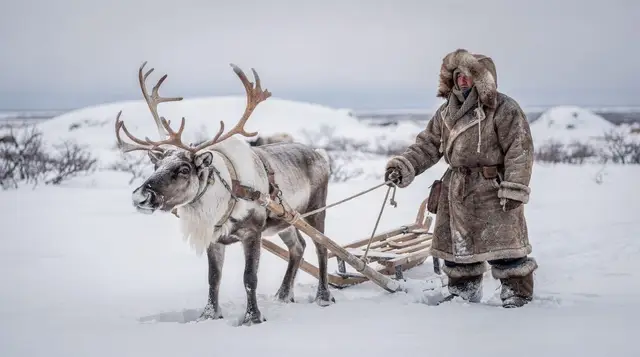
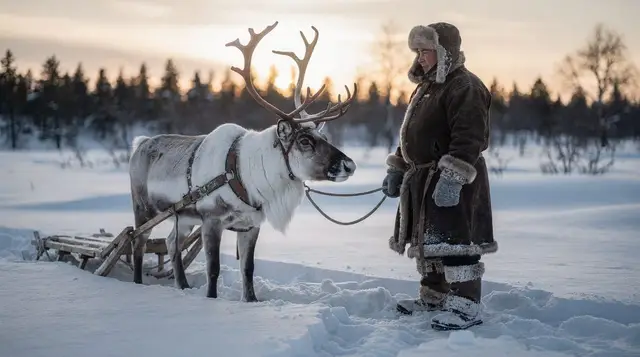
- The sleigh stretch. One or two people at a time sit in a small wooden sleigh pulled by a single reindeer, on a short fenced loop, typically a few hundred metres, at a slow walking pace. On some bookings you hold the reins for part of that loop; on others, particularly with young children, the guide keeps full control and simply lets you sit up front.
- The certificate. At the end, the farm hands out the driving licence — a keepsake, not a document.
A full visit runs roughly 45 minutes to 1.5 hours depending on group size and whether it’s combined with another activity. It’s a low-intensity, largely standing-and-waiting-your-turn experience, which is exactly why it suits families with small children better than, say, a snowmobile safari does.
Hand-feeding: what actually happens
Reindeer at these farms are used to people, but they’re not tame in the way a farm dog is tame — they’re semi-domesticated animals that tolerate close contact because feeding has been positive, repeated, and predictable. The lichen or pellets are handed to you by staff, not something you bring yourself, and you’re told to keep your palm flat and your fingers together, the same rule as feeding a horse. Reindeer lips and tongues are surprisingly soft; getting nipped is rare, but standing too close to an antlered male during autumn rutting behaviour is one of the few real cautions a guide will give.
Lichen is worth understanding because it’s the animal’s actual winter diet in the wild, not a novelty snack invented for tourists. Under Finland’s everyman’s right, wild lichen on the ground is protected from casual picking precisely because reindeer depend on it through the darkest, coldest months when almost nothing else is available. What you hand-feed at a farm is usually harvested or supplemented separately, not stripped from the surrounding forest floor.
Antlers, explained properly
This is the part of the visit that surprises most visitors, because popular imagery — reindeer pulling a sleigh, antlers included, at Christmas — doesn’t match the actual biology.
- Only males carry antlers for most of the year. Bulls grow a new set from spring through late summer, use them during the autumn rut to compete for mates, then shed them by early to mid-winter.
- Females are the ones more likely to have antlers at Christmas. Pregnant cows keep a smaller set of antlers through early winter, shedding them only after calving in spring — which means the reindeer you see antlered in a Rovaniemi farm visit in December is more often female than male.
- Antlers regrow every single year, covered in a soft, blood-rich skin called velvet while growing, which is shed off in strips once the antler hardens.
- Antlers are not horns. They’re bone, shed and regrown annually; horns, by contrast, are permanent and made of keratin. A guide who conflates the two is worth a polite correction, though most farm staff get this right.
Reindeer typically live 12 to 15 years. Calves are born in May, usually a single calf per cow, and are up and following their mother within hours — a defence against predators on open range. By late summer a calf is already several months into the same lichen-heavy diet as the adults. None of this is exotic information kept from the public; it’s simply not what postcards show, and a good farm guide will walk through it while you’re feeding the animals rather than rushing straight to the sleigh.
Driving licence vs a plain sleigh ride vs a working herd visit
These three experiences get blurred together in marketing copy, and they’re genuinely different products.
| Experience | What you actually do | Where to read more |
|---|---|---|
| Reindeer driving licence (this page) | Hand-feed, learn about antlers, steer a sleigh briefly on a fenced course with a guide alongside, get a souvenir certificate | You’re here |
| Plain reindeer sleigh ride | Sit in the sleigh while a guide leads the reindeer the whole way; no reins, no certificate emphasis | Reindeer sleigh ride guide |
| Sámi reindeer herding as a livelihood | The real working system — open-range herding, round-ups, cooperatives, and the economics behind it | Sámi reindeer herding as a livelihood |
If you’re choosing between the driving licence experience and a plain sleigh ride, the honest difference is small: a bit more hands-on time with the reins, a printed keepsake, and usually a slightly longer visit. Neither one gets you close to how herding actually works on the ground, which is a slower, harder, and far less photogenic livelihood than an afternoon farm stop can show.
A car for the reindeer farm visit
The licence is an afternoon farm stop: hand-feeding, a short lesson on antlers, a brief turn on the fenced course and a certificate to take home. That makes the journey to the farm the part you can still shape, and it is worth deciding early whether you want to arrive on your own or on someone else’s timetable.
Ask the farm whether transport from town is included, and what time your slot starts, so you know how much room you have either side. If you would rather arrive and leave when it suits you, and perhaps pair the visit with other plans in the area, you can look at a Rovaniemi pick-up through Localrent car hire in Finland.
Booking a farm visit
Three farm-visit tours cover different parts of the region, each pairing feeding and the sleigh course with a bit of local colour:
a reindeer farm visit near Kuusamo, run as a half-day trip that also touches the edge of Kuusamo and the Oulanka national park area if you’re basing yourself further east.
a farm visit outside Sodankylä, useful if your route already runs north through Sodankylä toward Inari or Saariselkä.
a reindeer farm experience near Utsjoki, for travellers who’ve pushed all the way north to Utsjoki, close to Finland’s northernmost point.
For visitors staying closer to Rovaniemi itself who’d rather not add driving time, a combined husky farm and reindeer experience covers both animals in one outing near the city, and it’s worth reading how the two compare if you’re only doing one: see reindeer vs husky, which to choose.
Prices for a standalone reindeer farm visit near Rovaniemi commonly sit in the 60–120 EUR per adult range for a half-day slot; combined husky-and-reindeer bookings run higher, often 120–200 EUR, since they cover two animal experiences and usually a longer transfer. Children are typically discounted, and family bundles are common — check the specific listing rather than assuming a flat rate, since farms price the sleigh-driving component differently from a pure feeding-and-photos stop.
Who this suits, and who it doesn’t
This is a gentle, largely standing, low-adrenaline visit, which makes it a strong match for young children and anyone who wants animal contact without the cold-exposure and physical demand of longer activities like husky sledding or snowmobiling. If your child is in the toddler-to-early-primary range and you’re trying to fill a half-day without exhausting anyone, a reindeer farm slot is one of the easier bookings on the itinerary — read dressing a child for -25°C beforehand regardless, since standing outdoors at a farm still means real cold.
It won’t suit visitors after a longer wilderness experience, genuine hands-on herding knowledge, or an adrenaline activity — the sleigh loop is short and slow by design, and the “driving” is supervised the entire way. For a longer, more physical animal encounter, husky sledding covers more ground and more independence, with its own welfare questions worth reading first at husky welfare, questions to ask and the choice between driving vs riding a dog sled.
The souvenir shopping trap next door
Farm gift shops sell reindeer-themed souvenirs alongside genuine Sámi handicraft, and the two are easy to mix up under one roof. A driving licence certificate is honestly sold as a novelty and nobody pretends otherwise; some of the “Sámi-style” hats, dolls, and printed textiles nearby are a different matter — mass-produced items marketed with Sámi imagery that has nothing to do with actual Sámi makers or communities.
It’s worth reading Sámi souvenirs, what to avoid before buying anything beyond the certificate itself, and if the culture is what actually interests you, the Siida museum in Inari and a broader look at Sámi culture explained are the accurate way in, not a farm gift shop shelf.
If your trip already includes a run north toward Inari, the eastern Lapland Sámi culture itinerary sequences a farm-style visit, Siida, and other stops into one coherent route rather than treating them as separate errands.
FAQ: the reindeer driving licence and farm visits
Is the reindeer driving licence a legal document?
No. It’s a novelty certificate printed by the farm, sometimes with your name and the date added by hand. It carries no legal weight in Finland or anywhere else, and it doesn’t qualify you to handle reindeer or drive a sleigh without a guide present.
Do I actually get to steer the sleigh myself?
Usually yes, for a short stretch. A staff member walks or rides alongside, the reindeer is used to the route, and the course is a fenced loop around the farm, typically a few hundred metres. It’s closer to a guided pony ride than independent driving.
How old do you need to be to try it?
Most farms let children hold the reins with an adult close by, and there’s rarely a strict minimum age, unlike snowmobiling. Ask the specific farm when booking if you’re travelling with a young child, since setups vary.
Can I feed the reindeer by hand?
At most farms, yes — you’re given a handful of lichen or dried feed to offer directly, and the reindeer will approach and eat from your palm. It’s usually the calmest, most photographed part of the visit.
Do reindeer keep their antlers all year?
No. Only males carry antlers through most of winter, and even they shed them by spring. Females that are pregnant keep smaller antlers into early winter, then shed too. Farms regrow a full set every year from spring through autumn.
Is this the same as a reindeer sleigh ride?
It overlaps but isn’t identical. A standard reindeer sleigh ride is a short, slow tow where you sit and a guide leads the animal on a lead rein. The driving licence experience specifically includes a stretch where you hold the reins yourself, which not every farm or every booking offers.
Does this teach me anything about real reindeer herding?
Only in a light, farm-tour way. What you see is a small tourism operation, not the working herding system that Sámi families run across open range. For that context, a Sámi-run herding page or the Siida museum in Inari gives a far more accurate picture.
Is it worth doing alongside a husky farm visit?
Many operators near Rovaniemi and Levi already pair the two on one afternoon, since both are farm-based, both are short, and both suit families. It’s an efficient way to cover two animal experiences without two separate transfers. a combined husky and reindeer farm outing with a sleigh ride is the version built specifically for that pairing.
Reindeer farms & sleigh rides on GetYourGuide
Verified deep-linked GetYourGuide tours. Book through these links and we earn a small commission at no cost to you.
GetYourGuide does not provide a product photo for this activity — the image shows the meeting point, photographed by us.