A river-carved park on the edge of two municipalities
Oulanka National Park covers roughly 270 square kilometres of gorge, rapids and old-growth forest cut by two rivers, the Oulankajoki and the Kitkajoki. It’s the single best reason to drive out from Rovaniemi towards Kuusamo if fast-flowing water, suspension bridges and river-canyon walking appeal more than another aurora tour or husky ride. The park was established in 1956 and sits hard against the Russian border, adjoining Paanajärvi National Park on the Russian side — the two parks cooperate loosely as a shared conservation area, though crossing between them isn’t an option for visitors.
A detail worth getting right before you plan a route: Oulanka is not entirely inside Kuusamo. The park’s boundary also runs into the neighbouring municipality of Salla to the north-east, and several of its wilder, less-visited corners sit on the Salla side. Most visitor facilities, and the main road access, are on the Kuusamo side, which is why the park gets filed under Kuusamo in most guidebooks — but don’t assume the whole thing is administratively Kuusamo, and don’t be surprised if a Salla-based operator also claims part of it.
The geology explains most of what makes Oulanka distinctive. The bedrock here is unusually rich in lime, in a region where Finnish soils are typically acidic. That produces an odd, welcome side effect: Oulanka supports far more plant diversity than the surrounding boreal forest, including rare orchids and calcium-loving species that don’t grow anywhere else in Finnish Lapland. It’s not a park people visit for botany, but it’s part of why the valley feels different from the pine-and-lichen landscape around Rovaniemi itself.
Getting there from Rovaniemi
Oulanka has several entrances rather than one gate, and which one you head for changes both the drive and the day. In round numbers, it’s about 100km and two hours by car from Rovaniemi, following road 5/78 towards Kuusamo and then branching off on smaller roads towards the park depending on the entrance.
| Entrance | Typical use | Notes |
|---|---|---|
| Käylä / Oulanka Visitor Centre | Main gateway, information and toilets | Closest to the park’s best-known short walks |
| Juuma | River and rapids access, boat rental | Popular starting point for a half-day loop |
| Kiutaköngäs | Direct to the park’s best-known rapids | Small car park, fills up in summer |
| Ristikallio | Southern access, quieter | Longer drive, fewer crowds |
There’s no public bus that runs directly into the park. A hire car is the practical option; a handful of summer-season shuttle services and organised day trips also run from Kuusamo and Ruka, and pairing the drive with an overnight in Ruka or Kuusamo makes more sense than a single long day from Rovaniemi if you also want to walk any real distance. See the Ruka and Kuusamo day trip guide for how people typically combine the two.
The gorges, rapids and suspension bridges
The park’s core appeal is straightforward: a river dropping through a steep-sided gorge, crossed at intervals by wooden suspension bridges that sway underfoot more than most visitors expect. The Oulankajoki and Kitkajoki carve through dolomite and quartzite, producing sheer rock walls in places and wide, pale rapids in others. Several of the bridges near Myllykoski and around the Kiutaköngäs stretch are genuinely photogenic, and crossing one on foot, with the water audible below, is most people’s single strongest memory of the park.
Kiutaköngäs itself — the park’s best-known rapids, on the Oulankajoki — deserves its reputation and a page of its own; see the dedicated Kiutaköngäs guide for what to expect there rather than a rundown here. The short version: it’s a wide, powerful stretch of white water reachable on an easy path from the Kiutaköngäs car park, and it’s usually the single stop people make if they only have an hour or two.
Wildlife: realistic expectations
Oulanka’s rivers attract goosanders year-round, and whooper swans use the calmer stretches and nearby lakes, especially in spring and autumn. Neither requires luck or a guide — both are commonly seen from the main paths along the river.
Brown bears are a different matter. They do range through this wider corner of eastern Finland, along the border zone that includes Oulanka, but sightings inside the park itself are rare and not something to plan a visit around. The reliable way to see a brown bear near Kuusamo is a dedicated hide-based wildlife watching trip, timed for the animals’ active months and run by an operator who knows the local territories — see the brown bear watching guide for Kuusamo for how that actually works, and the broader wildlife watching in Lapland guide for what else is realistically on offer.
Birders should also check the Finnish Lapland birdwatching guide — the river corridor and surrounding old-growth forest hold a wider range of species than the swans and goosanders most people notice first.
When to visit
The rivers run ice-free from roughly late May to October, which is also when every trail, bridge and the visitor centre are running at full capacity — this is the season to visit if the point is walking beside open water and standing on a swaying bridge over real rapids.
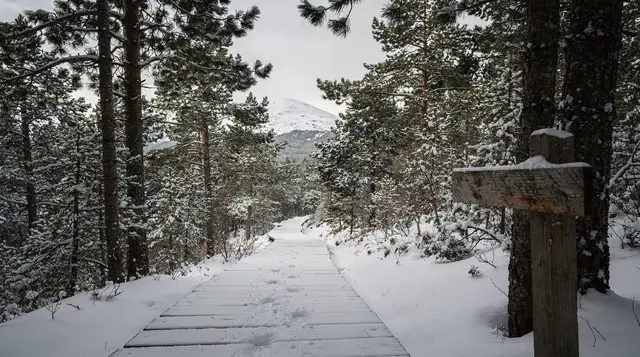
Winter turns the same landscape into something else entirely. The rivers partly freeze, though rapids rarely freeze over completely, and the trails become ski or snowshoe routes rather than summer footpaths. Snowshoeing through Oulanka in February or March, with the gorge under snow and the rapids still visibly moving through the ice, is a legitimate alternative to the summer visit and considerably quieter — see the snowshoeing near Rovaniemi guide for gear and logistics, since this isn’t a groomed-trail activity.
| Season | What you get | What to expect |
|---|---|---|
| Late May–June | Rivers in full flow, long daylight | Some mud, biting insects near the water |
| July–August | Warmest weather, all facilities open | Busiest period, especially at Kiutaköngäs |
| September–early October | Ruska colour on the valley slopes | Fewer people, cooler water, still fully accessible |
| November–April | Snow-covered trails, partly frozen rivers | Snowshoes or skis needed; some access roads unplowed |
Early autumn is arguably the sweet spot: the ruska colour season paints the valley in reds and golds while the rapids are still running freely, and the crowds of July have thinned. Anyone planning around summer generally should read the summer hiking in Lapland guide for what daylight, insects and trail conditions actually mean this far north.
The trails, without repeating the trail notes
Oulanka’s fame as a hiking destination rests heavily on the Karhunkierros Trail, Finland’s best-known long-distance route, which runs roughly 80km and passes through the park’s most dramatic scenery, including several of its suspension bridges and the Kiutaköngäs rapids. This page won’t repeat that route stage by stage — the walking the Karhunkierros guide covers distances, huts and logistics in the detail a multi-day hike actually needs.
For a single visit, the shorter Pieni Karhunkierros (“Little Bear’s Trail”) loop, roughly 12km and typically started from Käylä via Myllykoski, is the realistic option: it takes in gorge, bridges and rapids in an afternoon rather than several days, and it’s the loop most day-trippers from Rovaniemi actually walk. Shorter still, the path from the Kiutaköngäs car park to the rapids and back can be done in well under an hour.
Two other lime-rich, gorge-cut parks sit within striking distance and make sense to compare rather than combine on the same day: Korouoma Canyon, known for its frozen waterfalls in winter, and Riisitunturi National Park, known for snow-laden “ghost trees.” Both are covered in their own guides — the Korouoma frozen waterfalls guide and the Riisitunturi snow trees guide — and neither substitutes for Oulanka; they’re different landscapes worth a separate trip.
Camping, fires and the right to roam — what’s different inside a national park
Finland’s jokamiehenoikeus, the everyman’s right to roam, lets you walk, pick berries and camp for a night on most unfarmed land without asking permission. Inside a national park like Oulanka, that right is narrower. Camping is restricted to designated sites — marked tent areas and the wilderness huts and lean-to shelters (laavu) spaced along the main trails — rather than anywhere that looks flat and quiet. Lighting a fire is even more restricted: fires are only permitted at maintained fire sites, most of which have a supply of cut firewood provided, and open fires elsewhere in the park are not allowed, including in dry summer conditions when the whole of Lapland can be under a fire ban regardless.
This is stricter than the general right-to-roam rules that apply on ordinary forest land outside protected areas — see the everyman’s right guide for the difference, since it’s easy to assume national park land works the same way as the rest of the countryside and it doesn’t. Rubbish goes out with you; there’s no collection inside the park beyond the visitor centre itself.
Visitor centre and practical notes
The Oulanka Visitor Centre, near Käylä, is the main source of maps, trail condition updates and toilets, and it’s worth a stop before setting out even for a short walk — trail closures after storm damage or high water aren’t unusual and aren’t always signed at every entrance. Facilities thin out fast once you’re on the trails themselves: expect composting toilets at a handful of huts and shelters, and nothing beyond that.
Mobile signal is patchy in the gorge sections. Bring paper or a downloaded map rather than relying on a phone, wear boots that can handle wet rock on the bridge approaches, and budget more time than the trail distance suggests — the paths are narrow and the bridges aren’t built for a crowd to cross quickly.
If the visit is part of a longer stay based in Ruka or Kuusamo, most people pair a morning in the park with an afternoon activity back in town — an evening aurora walk being the most obvious fit given how dark and clear the Ruka fells can get once autumn arrives. A guided evening hike out from Ruka to look for the aurora works well the same day as a river walk in Oulanka, since it doesn’t compete for daylight.
For a version with a fallback if the sky doesn’t cooperate, a Ruka aurora tour that includes photography support and a rebooking guarantee removes some of the risk, though it guarantees the trip, not the lights themselves.
Families or anyone wanting a gentler day than a gorge trail can swap the second half of the day for something calmer: a short husky safari from Ruka with lunch included covers similar forest terrain at a much easier pace, and a combined husky and reindeer sleigh outing based in Kuusamo pairs conveniently with a Kuusamo-side entrance to the park.
For a broader look at what else the town itself and the surrounding things to do around Kuusamo and Oulanka National Park pages cover, both list the park’s neighbouring activities without repeating the trail-by-trail detail here. A fuller standalone walkthrough of the park also lives on the Oulanka National Park guide page, aimed at trip planning rather than the overview given here.
Oulanka National Park: your questions answered
Is Oulanka National Park free to enter?
Yes. There’s no admission fee for the park itself. You may pay for parking at some car parks, for a shuttle if you use one, or for guided activities, but walking the trails costs nothing.
How far is Oulanka National Park from Rovaniemi?
Roughly 100km and about two hours’ drive, depending on which entrance you head for — Käylä, Juuma, Kiutaköngäs and Ristikallio all involve slightly different routes once you’re past Kuusamo.
Is Oulanka National Park in Kuusamo?
Mostly, but not entirely. Most access points and the main visitor centre sit within Kuusamo, but the park’s boundary also extends into the neighbouring municipality of Salla, so it isn’t correct to describe it as wholly a Kuusamo park.
Can you swim in the rapids at Oulanka?
No — the rapids are fast, cold and genuinely dangerous, and swimming in them isn’t something the park encourages or that any sensible visitor should attempt. Admire them from the bridges and banks instead.
Can you camp anywhere in the park?
No. Camping is limited to designated tent sites and the wilderness huts and lean-to shelters along the main trails, not anywhere that looks convenient, which is stricter than Finland’s general everyman’s right to roam.
Do you need to walk the whole Karhunkierros Trail to see the best of the park?
No. The full Karhunkierros runs roughly 80km over several days, but the shorter Pieni Karhunkierros loop, around 12km, and the short walk from the Kiutaköngäs car park both cover the park’s best-known scenery in a few hours.
Will I see a brown bear in Oulanka National Park?
It’s unlikely on a standard visit. Bears do range through the wider border region, but sightings inside the park aren’t something to expect — a dedicated hide-based wildlife trip elsewhere near Kuusamo is the realistic way to see one.
What’s the best time of year to visit Oulanka National Park?
Late May to October, when the rivers run ice-free and every trail and bridge is open. Early autumn adds ruska colour with fewer visitors; winter offers a quieter, snowshoe-based version of the same landscape.