Summer hiking around Rovaniemi and Finnish Lapland
Is summer a good time to hike around Rovaniemi?
Yes, from June to August, with long daylight (midnight sun from 6 June to 7 July) and mild temperatures of 15-25°C. Trails range from easy riverside paths near Rovaniemi to the multi-day Karhunkierros in Oulanka National Park. The one real downside is mosquitoes, which are genuinely bothersome in June and July near lakes and in forest.
Summer is a different Lapland
Most people who search for Rovaniemi are thinking about the aurora season, the Christmas season or snowmobiles. Summer hiking is a quieter story: long daylight, mild ground, and forests, fells and rivers that spend eight months a year under snow. It runs roughly June to August, and it is a genuinely different trip from the winter one, not a lesser version of it.
This page covers timing, difficulty and what to pack. For the trail-by-trail detail on the region’s best-known routes, see the dedicated pages on hiking around Rovaniemi, the Arctic Circle hiking area and walking the Karhunkierros.
The midnight sun changes the rhythm
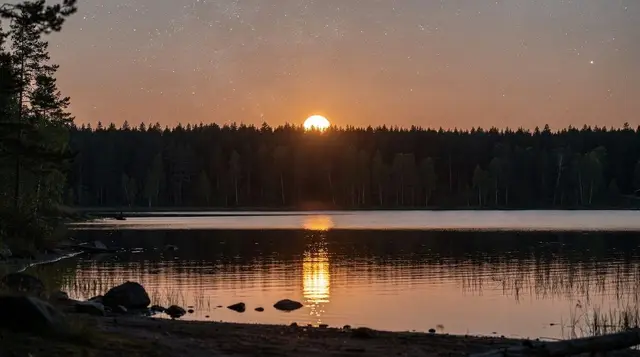
Rovaniemi sits close enough to the Arctic Circle that the sun does not set at all from 6 June to 7 July. Outside that exact window, on either side, nights stay pale rather than dark well into August. Practically, this means there is no real deadline on a summer hiking day: a group can start a trail at 6pm and still have hours of full daylight left, and it is common for guided walks or berry-picking evenings to run late without anyone needing a torch.
It also means sleep can get tricky for visitors not used to a bright room at midnight — pack an eye mask if you are sensitive to it. For the wider seasonal picture, including how this compares with the dark winter months, see Rovaniemi in summer: midnight sun and the shoulder seasons.
Temperatures in June to August typically run 15 to 25°C, occasionally warmer on a still, sunny day. That is comfortable hiking weather, but Lapland’s summer weather turns quickly: a clear morning can produce a heavy shower by early afternoon, so a waterproof shell earns its place in the pack even on a day that starts warm.
The part the brochures skip: mosquitoes
This needs to be said plainly, because it is the single most common thing that catches visitors out. June and July bring real numbers of mosquitoes and midges across Finnish Lapland, particularly near lakes, slow rivers and in still spruce forest. It is not a minor nuisance you can wave off with a single spray. A head net is standard kit for guides working in this season, not a joke item, and a proper repellent goes in the bag alongside water and a map.
Wind and open, dry terrain — a fell top rather than a lakeside forest path — bring noticeable relief, which is one reason exposed routes on Ounasvaara or the higher ground around Luosto and Pyhä can feel more pleasant than a shaded riverside trail on a still day. Late August, once night temperatures start dropping, sees numbers fall away sharply, which is one of the trade-offs worth weighing against the shorter days and cooler air of that period.
None of this is a reason to skip summer hiking. It is a reason to pack for it honestly rather than discover it on the trail.
Difficulty levels: what actually suits whom
| Level | Example | Distance | Who it suits |
|---|---|---|---|
| Easy, flat | Riverside paths around Rovaniemi, short Ounasvaara loops | 2-6 km | Anyone, including families and first-time hikers |
| Moderate | Arctic Circle hiking area trails, Pyhä-Luosto short loops | 6-12 km | Reasonably fit walkers, no technical experience needed |
| Full day | A Karhunkierros day segment near Kiutaköngäs, longer Oulanka loops | 12-20 km | Hikers comfortable with a full day on uneven ground |
| Multi-day | The full Karhunkierros trail | Around 80 km over several days | Hikers with backpacking experience and proper gear |
The gap between the top two rows and the bottom two is bigger than the table suggests. Short and moderate trails near Rovaniemi are genuinely low-commitment: flat or gently rolling ground, well-marked paths, and an easy retreat if the weather turns or someone in the group has had enough. The Karhunkierros is a different undertaking entirely — wild huts, river crossings on cable ferries or bridges, and stretches with no phone signal. Treat the two as separate trips rather than points on the same easy scale.
What to pack for warm-weather Lapland hiking
Lapland summer hiking rewards a light pack, not a heavy one, but a few items are close to non-negotiable:
- A head net and insect repellent — see the note above, this is not optional in June and July
- A waterproof shell, even on a day that starts sunny
- Sturdy, broken-in footwear; trainers are fine for the shortest riverside paths, proper boots for anything on the moderate list or longer
- More water than feels necessary; there is little reliable shade on open fell sections
- A basic first-aid kit and, for anything beyond the easy trails, a paper map as backup to a phone, since signal thins out around Oulanka and the more remote fells
- Sun protection — the low, glancing Arctic sun and long exposure add up even at mild temperatures
For a fuller rundown that also covers winter gear, see what to pack: the three-layer system. Most of that advice about layering still applies in summer, just with much lighter fabrics.
Trails reachable from Rovaniemi without a car
The Arctic Circle hiking area, close to Santa Claus Village and reachable on the same bus 8 route, has a network of marked paths through pine forest that suit an afternoon out without a rental car. Closer still, Ounasvaara sits directly across the Kemijoki from the town centre and offers short forest trails and a viewpoint over Rovaniemi, walkable within an hour or two round trip. Neither is a wilderness experience — both see other walkers, cyclists and dog owners — but both are genuine, unhurried trail time within reach of the city. Getting around Rovaniemi has the bus and transfer detail for both.
For something wilder without driving yourself, a guided option covers the logistics: a guided summer hiking tour into the arctic wilderness around Rovaniemi takes care of route-finding and transport, which suits visitors without a car or without the confidence to navigate unmarked ground alone.
Karhunkierros and Oulanka National Park
The Karhunkierros trail is Finland’s best-known long walk, threading around 80 km through Oulanka National Park near Kuusamo and Ruka, a little over two hours from Rovaniemi. The Kiutaköngäs rapids are the trail’s best-known short stretch and a realistic target for a day visit rather than the full route.
Suspension bridges over the Oulankajoki, wild campsites, and open riverside terrain make this the region’s benchmark hike; the full guide on walking the Karhunkierros and the wider Oulanka National Park guide cover route planning, huts and how many days to allow. This is far enough from Rovaniemi that it works better as a dedicated trip or an overnight than a rushed day return; the Ruka and Kuusamo day trip page sets out what is and is not realistic in a single day.
Further east, the Korouoma canyon near Posio offers a different kind of walking — a steep-sided gorge that is spectacular under winter ice and still worth a summer visit for the cliffs and forest alone; see Korouoma’s frozen waterfalls for the seasonal contrast. Near Saariselkä, a guided option covers open fell country rather than forest trail: a hiking trip through the Muotka wilderness area near Saariselkä is worth considering for visitors basing themselves further north around Inari or Ivalo rather than Rovaniemi.
Guided hiking if you would rather not plan the logistics
Route-finding, transport and local knowledge of where the ground is boggy or the insects worst are genuine value in a guide, especially for a first visit. Around Luosto, a shorter guided walk through pristine forest and fell terrain is available as a guided hiking tour through untouched nature near Luosto, which suits visitors staying in the Pyhä-Luosto area rather than driving back to Rovaniemi each evening.
Further east near Ruka, summer visitors sometimes swap boots for a cooler activity altogether: a summer river floating trip near Ruka is a low-effort way to spend an afternoon by water after a morning on the trail, and a reasonable answer to a hot, midge-heavy day when a forest walk holds less appeal.
Water, foraging and the right to roam
Finland’s everyman’s right, jokamiehenoikeus, allows walking, a night or two of low-impact camping, and picking berries and mushrooms on most unfenced, uncultivated land without asking permission, so long as it does not disturb anyone. It does not extend to cutting live wood, lighting fires without permission, or approaching close to houses.
National parks like Oulanka often layer their own, stricter rules on top — camping restricted to marked sites and lean-tos, fires only at designated spots — so check the specific park guidance rather than assuming the general right applies everywhere. Late summer into the ruska season is also berry season; see berry and mushroom picking for what is worth gathering and when, and the general right to nature access page for the fuller rules.
Wildlife on the trail
Reindeer are common on and near trails throughout the region — they are farmed animals, not wild ones, and mostly indifferent to walkers. Genuinely wild fauna is quieter and harder to see: elk, and, further east towards the Russian border near Kuusamo, brown bears, which are best approached through a dedicated hide tour rather than hoped for on a day hike; see brown bear watching near Kuusamo.
Birdlife is more visible day to day, especially around Oulanka’s river corridors — the birdwatching in Finnish Lapland guide has specifics, and the general wildlife watching page covers what to realistically expect to see without a specialist tour.
Autumn as an alternative
Late August into September brings the ruska, the turning colour of birch and tundra vegetation, alongside cooler air, fewer insects and the return of night darkness that marks the start of the aurora season. Many hikers who dislike the idea of mosquitoes altogether do better shifting their trip to this window; see the ruska in autumn for what changes and when it peaks.
Planning around the rest of a trip
Summer hiking rarely fills an entire Lapland itinerary on its own, and pairs naturally with river and lake activities, museum time in town, or a day trip further afield. For overall trip length, see how many days in Rovaniemi; for costs across accommodation, transport and guided activities, see the Rovaniemi trip budget guide. Visitors without a car should read getting around Rovaniemi before committing to anything beyond Ounasvaara and the Arctic Circle hiking area, since Karhunkierros and Oulanka are a proper drive or transfer away, not a bus hop.
Frequently asked questions about summer hiking in Lapland
When is the best time to hike in Finnish Lapland?
June to August is the summer hiking window. Late June and July have the longest daylight and warmest ground, but also the most mosquitoes. Late August into September trades some warmth for fewer insects and the start of the ruska colours.
Are there mosquitoes when hiking in summer?
Yes, and this is worth being honest about. June and July bring real numbers of mosquitoes and midges, especially near lakes, rivers and in spruce forest with little wind. A head net and repellent are not optional extras, they are standard kit for this season.
Do I need hiking experience for trails near Rovaniemi?
No. Short, flat paths around Rovaniemi and Ounasvaara suit complete beginners. Multi-day routes like the Karhunkierros are a different proposition and reward prior hiking experience, proper boots and a tested pack.
What should I pack for summer hiking in Lapland?
Layers rather than heavy kit: a base layer, a light insulating layer for cool evenings, and a waterproof shell, since Lapland summers bring sudden showers. Add a head net, insect repellent, sturdy footwear and more water than you think you need.
Is the Karhunkierros trail suitable for a day hike?
Only in short sections. The full Karhunkierros runs about 80 km and is normally walked over several days with wild huts along the way. Day visitors usually walk a segment near the Kiutaköngäs rapids in Oulanka National Park rather than the whole route.
Can I hike without a car from Rovaniemi?
Around Rovaniemi itself, yes: Ounasvaara and the Arctic Circle hiking area are reachable by bus and on foot. Karhunkierros and Oulanka National Park are near Kuusamo, roughly two and a half hours from Rovaniemi, and are far easier to reach with a car or an organised transfer.
Is wild camping allowed on these trails?
Finland’s everyman’s right allows a night or two of low-impact camping on most unfenced, uncultivated land, but national parks like Oulanka often restrict camping to marked sites and lean-tos. Check the specific park rules before pitching a tent.
Hiking & nature tours on GetYourGuide
Verified deep-linked GetYourGuide tours. Book through these links and we earn a small commission at no cost to you.
GetYourGuide does not provide a product photo for this activity — the image shows the meeting point, photographed by us.