Oulanka National Park: rivers, gorges and short trails
Is Oulanka National Park a day trip from Rovaniemi?
Not comfortably. Oulanka is around 190 km from Rovaniemi via Kuusamo, roughly two and a half to three hours' drive each way, so a same-day round trip leaves only a few hours in the park. Basing yourself in Kuusamo or Ruka for a night is the more realistic plan.
Where Oulanka fits into a Lapland trip
Oulanka National Park is best known, if it’s known at all, as the setting for the Karhunkierros trail, Finland’s most famous long-distance hike. That association undersells the park badly. Oulanka is a real place in its own right — a river valley cut into limestone and rapids, with a working visitor centre, marked short trails, canoe routes and a wildlife list that has nothing to do with whether anyone is walking the full 80 km trek that season. This page is about that place: what’s there if you drive in for a day or two, without committing to the multi-day route.
The one thing to get straight before anything else is distance. Oulanka sits close to Kuusamo, not close to Rovaniemi. The drive from Rovaniemi is around 190 km, mostly via Kuusamo on Highway 5 and then minor roads into the park, and it takes roughly two and a half to three hours each way in good conditions — longer with snow or an unhurried pace. Treating this as a straightforward Rovaniemi day trip is the mistake worth heading off early: a round trip eats five to six hours of driving alone, which is most of a day gone before you’ve set foot on a trail. If Oulanka is the point of your visit, plan to sleep near it, in Kuusamo or Ruka, rather than bolting it onto a Rovaniemi-based itinerary.
Getting there
There’s no direct public transport link built for this specific trip. The practical options are a hire car, an organised day or overnight tour departing from Rovaniemi or Kuusamo, or reaching Kuusamo by bus or by air and arranging transport on from there.
| From | Route | Distance | Typical driving time |
|---|---|---|---|
| Rovaniemi | via Kuusamo (Hwy 5, then minor roads) | ~190 km | 2.5–3 hours |
| Kuusamo | via Hwy 5 and Käylä | ~40 km | 45–60 minutes |
| Ruka | via Käylä | ~25 km | 30–40 minutes |
| Kuusamo Airport (KAO) | via Hwy 5 | ~50 km | 50–70 minutes |
Kuusamo has its own small airport with seasonal connections, which some visitors use instead of flying into Rovaniemi Airport and driving the extra distance. Winter tyres are compulsory on Finnish roads through the cold months, and the last stretch into the park is a minor road that gets less priority for ploughing than the highway — build in extra time after snowfall.
The Oulanka Visitor Centre
The park’s visitor centre, run by Metsähallitus (the state agency that manages Finland’s national parks), sits near the village of Käylä on the park’s western edge. It’s the sensible first stop: current trail conditions, river levels, wildlife sightings and any closures are posted here, along with maps that are more reliable than anything printed in advance. There’s an exhibition on the park’s geology and history, toilets, and — depending on the season — a café.
Entry to Oulanka itself costs nothing. Finland’s national parks are free to enter; you only pay for extras such as guided activities, equipment hire, or a bookable rental hut. That’s worth knowing because some visitors arrive expecting a gate and a ticket booth, and there isn’t one — just a car park, the visitor centre, and trailheads leading off from it.
Kiutaköngäs: the rapid everyone photographs
The single most photographed spot in the park is Kiutaköngäs, a rapid on the Oulankajoki river often cited as the most powerful in Finland by volume of water. It’s reached by an easy, mostly flat trail from the visitor centre area — under an hour there and back at a gentle pace — with viewing platforms set right above the white water and a suspension bridge crossing the river nearby. The rock on this stretch is limestone rather than the granite that dominates most of Lapland, and it shows: paler cliffs, and pockets of plant life that don’t grow elsewhere in the region because of the different soil chemistry.
This short walk to Kiutaköngäs and back is, realistically, the single activity most visitors to Oulanka actually do, and it’s a fair one to build a short visit around. It needs no booking, no guide, and no particular fitness — just decent footwear, since the path can be wet or icy depending on the season.
Myllykoski and the old mill
A few kilometres downstream, reached by trail from the same general area, is Myllykoski — a smaller, gentler rapid with the ruins of an old watermill on its bank. It’s quieter than Kiutaköngäs, with fewer people stopping, and it’s a reasonable place to actually sit for ten minutes rather than photograph and move on. Combining Kiutaköngäs and Myllykoski into a single loop, rather than walking to one and back, is the version of “seeing Oulanka” that fits into two or three hours without touching any part of the long-distance trek.
Short trails that don’t need the full Karhunkierros
The Karhunkierros gets the attention, but it isn’t the only way to walk in this park, and you don’t need to plan a multi-day trip to spend real time on foot here. The park maintains several shorter loops that use sections of the main trail network without committing to the whole route:
| Route | Distance | Time | Notes |
|---|---|---|---|
| Kiutaköngäs loop | ~4 km | 1–1.5 hours | Flat, well marked, the default short walk |
| Kiutaköngäs–Myllykoski loop | ~8–9 km | 2.5–3.5 hours | Two rapids, one old mill site, more solitude |
| Pieni Karhunkierros (“Little Bear’s Trail”) | ~12 km | 4–5 hours | A genuine loop hike, distinct from the long trek, doable in a day |
| Short shelter-to-shelter stroll near the visitor centre | 1–2 km | 30–45 minutes | Fits around a lunch stop, suitable for most fitness levels |
Pieni Karhunkierros is worth flagging on its own: it’s a real day hike with river views, suspension bridges and a proper sense of remoteness, and it’s often overlooked because its name so closely echoes the trek it isn’t. If a full multi-day Karhunkierros isn’t in your plans this trip — and for most visitors basing themselves in Rovaniemi, it won’t be — this loop is the closest substitute that still counts as a serious walk rather than a stroll to a viewpoint.
Canoeing the Oulankajoki
The Oulankajoki isn’t only a hiking backdrop; stretches of it are paddled. Calmer sections away from Kiutaköngäs and Myllykoski suit a self-guided canoe outing, and this is one of the few genuinely low-key ways to see the park from the water rather than the bank.
a self-guided canoe rental on the Oulankajoki gets you onto one of these calmer stretches with your own pace and no fixed schedule — useful if you’d rather explore than follow a guide’s timetable. It is not a route onto the rapids themselves: Kiutaköngäs and Myllykoski are real whitewater, and self-guided routes are planned to avoid them. If running a rapid by canoe or raft appeals, that’s a separate guided whitewater activity, not something to attempt independently.
Wildlife: what you’ll realistically see
Set expectations honestly here, because Oulanka’s reputation as wildlife country runs ahead of what a day visitor typically encounters. Dippers — small, dark birds that walk underwater hunting insects — work the fast sections around Kiutaköngäs and Myllykoski year-round and are genuinely easy to spot if you stand still for a few minutes. Whooper swans and other waterfowl use the calmer stretches of the Oulankajoki in the warmer months. Reindeer, which are semi-domesticated and belong to local herding cooperatives, are commonly seen near roads and clearings throughout the wider area.
Brown bears and wolverines live in the forests around Kuusamo, and the region is genuinely one of Europe’s better places to see bears — but not on a park trail. Bear watching here is done from purpose-built hides on evening or overnight sits, a completely different activity with its own booking, its own guide, and its own patience required. Don’t plan an Oulanka day walk expecting to see a bear; that’s not how it works, and any operator suggesting otherwise on a standard trail walk is overselling it.
For a broader sense of what’s around the wider region beyond Oulanka specifically, wildlife watching in Lapland and birdwatching in Finnish Lapland cover more ground.
Snow season: a different park
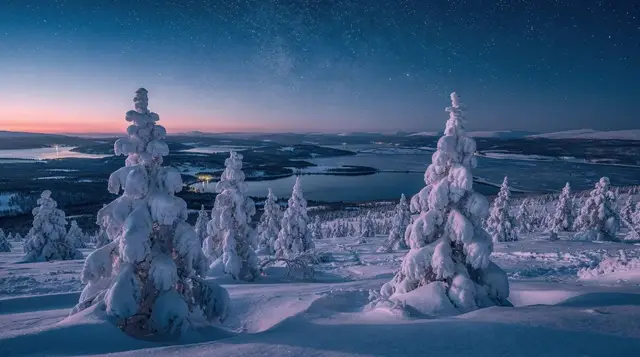
Oulanka doesn’t close for winter, though the visitor centre runs shorter hours and some trail markings disappear under snow, so a map or a guide matters more than in summer. The frozen river, the snow-loaded spruce along the banks, and the rapids that stay partly open even in deep cold make it a genuinely different place to walk through, not simply a colder version of the summer trail.
a guided snowshoeing tour into the park from Ruka is the straightforward way to do this without route-finding yourself through snow-covered trail junctions, and it includes the kit. If you’d rather move at your own pace on a shorter, marked loop, a self-guided snowshoeing option within the park covers that instead.
Clear winter nights here also mean dark skies well away from any town’s glow, which is part of why some visitors extend a Ruka base night with a guided northern lights walk out of Ruka rather than driving back to Rovaniemi after dark. As with any aurora activity, this is a chance to see the lights under good sky conditions, not a guarantee that they’ll appear.
For general winter hiking context that applies here too, see snowshoeing near Rovaniemi and hiking the Arctic Circle trails, though both of those cover routes closer to the city rather than Oulanka specifically.
Camping, huts and the right to roam
Finland’s everyman’s right lets you walk and camp for a night on most uncultivated land without asking permission, and the general version of that is covered in everyman’s right and nature access. Inside a national park like Oulanka, it’s narrowed by practical rules: open fires are allowed only at marked fireplaces with dry firewood supplied, tents pitched only at designated camping spots rather than anywhere that looks scenic, and rubbish carried back out.
The park has open wilderness huts, free and unbooked, first come first served, plus a smaller number of reservable rental huts that need booking in advance through Metsähallitus. None of this is specific to the Karhunkierros trek — day walkers using the short loops around Kiutaköngäs are covered by the same rules if they stop for lunch at a shelter or fireplace.
Practicalities: fees, safety and timing
Entry is free, as noted, and the short trails described here need no permit. Mobile signal is patchy in the river valley itself, so don’t rely on it for navigation — the visitor centre’s paper maps and posted signage are more dependable. River banks near Kiutaköngäs and Myllykoski are steep and slippery in places; the marked platforms exist for a reason, and getting close to the water’s edge off-trail for a photograph is a genuine cause of accidents here, not an exaggerated warning.
For timing, late spring through early autumn gives the most reliable trail conditions and the longest daylight — summer hiking in Lapland and autumn colours (ruska) in Lapland both apply directly to Oulanka’s valley, where the birch and rowan colour up in September. Winter access is real but slower and requires more planning, as covered above.
If Oulanka is one stop among several rather than the whole trip, it pairs naturally with a Ruka and Kuusamo day trip, or with the wider question of what genuinely counts as a day trip from Rovaniemi and what doesn’t — Oulanka sits closer to that second category than most visitors assume before checking the map.
For nearby comparisons within the same general region, Korouoma’s frozen waterfalls and Riisitunturi’s snow-laden trees are both further activities that make more sense from a Kuusamo or Ruka base than from Rovaniemi directly, and are worth combining with an Oulanka visit rather than treated as separate trips back to the city in between. The broader Oulanka National Park guide to the region’s things-to-do listings and the nature and hiking category round out the options if you’re building a multi-day itinerary around this side of Lapland rather than a single stop.
Oulanka National Park: questions answered
Is Oulanka National Park a day trip from Rovaniemi?
Not comfortably. The drive is around 190 km via Kuusamo, roughly two and a half to three hours each way on ordinary roads, longer in winter. A round trip from Rovaniemi in a single day is possible but leaves only two or three hours actually in the park. Staying a night in Kuusamo or Ruka, both much closer, makes far more sense.
Do I need to hike the whole Karhunkierros trail to see Oulanka?
No. The Karhunkierros is an 80 km multi-day trek that passes through Oulanka, but it is a separate undertaking with its own logistics. The park’s river valley, its rapids and its short loop trails can all be seen on walks of one to four hours, without booking huts or carrying overnight kit.
Is there an entrance fee for Oulanka National Park?
No. Finnish national parks, Oulanka included, have free entry. You pay only for things like guided tours, canoe or equipment hire, and reservable rental huts — the trails, the visitor centre and the day shelters cost nothing.
What is Kiutaköngäs and why is it well known?
Kiutaköngäs is a rapid on the Oulankajoki, often described as the most powerful in Finland by water volume. It is reached by a short, level trail from the visitor centre area, with viewing platforms and a suspension bridge, which is why it appears in so many photographs of the park.
Can I canoe on the Oulankajoki without a guide?
Yes, on the calmer stretches, using a self-guided canoe rental — but Kiutaköngäs and Myllykoski are genuine rapids, not something to paddle into by accident, and routes are chosen to keep you away from them unless you’re on a guided whitewater trip.
Is Oulanka open in winter?
Yes, all year. The visitor centre keeps shorter winter hours and some trail sections are unmarked or ungroomed after snowfall, but snowshoeing and winter walking are both possible, and the frozen river and snow-loaded spruce are a different park from the summer one.
What wildlife might I actually see?
Realistically: dippers working the rapids year-round, whooper swans and other waterfowl on calmer stretches in summer, and reindeer near the roads. Brown bears and wolverines live in the wider Kuusamo region but are shy and rarely seen on day trails — bear watching is its own separate activity, done from hides, not a park walk.
Where should I stay near the park?
Kuusamo, around 40 km away, has the most beds and services. Ruka, closer still at around 25 km, is smaller and quieter outside the ski season. Both work far better as a base than trying to reach Oulanka and back from Rovaniemi in one go.
Hiking & nature tours on GetYourGuide
Verified deep-linked GetYourGuide tours. Book through these links and we earn a small commission at no cost to you.
GetYourGuide does not provide a product photo for this activity — the image shows the meeting point, photographed by us.