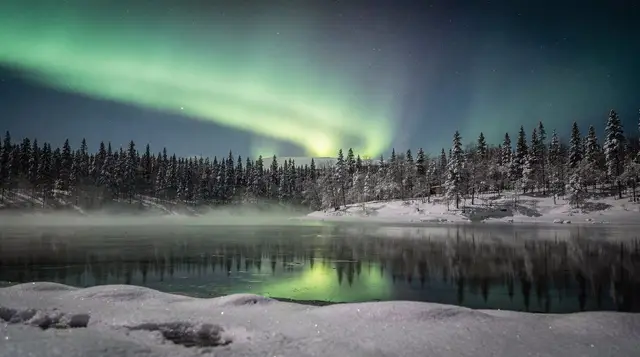
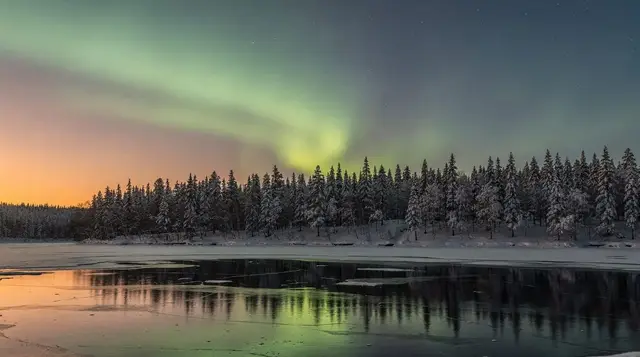
Finnish Lapland vs Swedish Lapland vs Norwegian Lapland
What is the real difference between Finnish, Swedish and Norwegian Lapland?
Finnish Lapland (Rovaniemi) is flat forest and lake country with a dry continental climate, easy logistics and Santa Claus tourism. Swedish Lapland (Kiruna, Abisko) is sparser wilderness built around an iron-ore railway. Norwegian Lapland is really the Arctic fjord coast around Tromsø, milder and wetter, with mountains dropping straight into the sea. They share Sámi culture but are separate national tourism regions, not one continuous trip.
Three countries, one word
“Lapland” gets used as if it were a single destination you can book a flight to. It isn’t. It is a historical region, home to the Sámi people for thousands of years, that today sits inside three separate nation-states: Finland, Sweden and Norway (plus a small part of Russia’s Kola Peninsula, effectively closed to tourism). Each country has drawn its own administrative Lapland, and each has built its own tourism industry on top of that, with its own gateway city, its own signature landscape and its own idea of what a visitor is there to do. The three do not overlap the way the shared name suggests, and travellers who assume they can hop between them on a single trip usually end up disappointed by the distances involved.
This guide sets the three side by side at a high level: what each one actually is, how the climate and landscape differ, where Sámi culture fits into all three, and how to think about choosing between them. It does not walk through Rovaniemi against Tromsø or Rovaniemi against Abisko point by point — those pairings have their own dedicated comparisons, linked at the end, and are covered in more depth there than a three-way overview allows.
Finnish Lapland: forests, lakes and a working town
Finnish Lapland is built around Rovaniemi, a flat, forested town of around 64,000 people at the confluence of two rivers, roughly 8 km south of the Arctic Circle line itself. It is the largest municipality in the region by some distance, with a compact grid centre you can walk in fifteen minutes, and it is also the official home of Santa Claus, a branding decision that now drives a large part of the local economy through Santa Claus Village.
The landscape is gentle rather than dramatic: pine and birch forest, frozen lakes, the occasional low fell rather than genuine mountains. Ounasvaara, the hill across the river from the centre, tops out at 204 m — a viewpoint and a short ski slope, not an Arctic peak. What Finnish Lapland trades landscape drama for is logistics: a direct airport ten minutes from the centre, an overnight train from Helsinki, English spoken everywhere, and the country’s densest concentration of husky farms, reindeer farms and organised aurora tours within an hour’s drive.
Climate-wise, Rovaniemi sits far enough from open sea to have a continental winter: dry cold, commonly -10 to -25°C from December to March, with the kind of stable, high-pressure skies that make for good aurora-hunting conditions in a good week. Whole guides on this site cover that season in detail, including how the winter and kaamos season actually plays out and what the summer midnight sun period looks like at the other end of the year.
Swedish Lapland: wilderness on an iron-ore railway
Swedish Lapland is a different proposition. Its main town, Kiruna, exists because of an iron ore mine — one of the largest underground mines in the world — and the town has spent the last decade physically relocating itself, building by building, as the mine workings undermine the old town centre. That single fact says a lot about how Swedish Lapland presents itself: less packaged around a family-friendly mascot, more built around industry, distance and genuine wilderness.
The signature stop is Abisko, roughly two hours by train or road from Kiruna, sitting in a rain shadow created by the surrounding mountains that gives it an unusually high number of clear nights for aurora viewing — a specific microclimate that has made it something of a cult destination among aurora chasers, and the subject of its own comparison with Rovaniemi on this site. Further south, the Icehotel at Jukkasjärvi, rebuilt from river ice every winter, is Swedish Lapland’s answer to Finland’s snow and ice hotels.
Distances in Swedish Lapland are longer and the infrastructure thinner: fewer day-trip operators, more independent hiking and cross-country skiing, and travel that leans on Sweden’s night train network (the “Snow Train”) rather than a dense web of minibus tours. It suits travellers who want fewer organised activities and more open space, and who are comfortable planning their own transport rather than being collected from a hotel lobby.
Norwegian Lapland: really the Arctic fjord coast
Strictly, Norway does not use “Lapland” as an official regional name at all — the term applied to Norway’s north is more of a loose, marketing-driven label. What travellers usually mean by it is Arctic Norway around Tromsø: a genuinely different landscape from either Finland or Sweden, where steep mountains drop directly into fjords and the open sea, rather than the flat interior of forests and lakes further east.
The Gulf Stream keeps this coast milder and considerably wetter than the Finnish or Swedish interior — winter temperatures hover closer to freezing rather than deep below it, but that comes with far more cloud, rain and sudden weather changes, which cuts against aurora viewing even though the town sits well inside the auroral oval.
What Norwegian Lapland offers instead is a landscape with genuine vertical drama, whale watching off the coast in winter, and a seafaring culture built around fishing rather than reindeer herding, alongside excellent public transport within Tromsø itself. It is a fundamentally different trip from Rovaniemi or Kiruna, not a wetter version of the same one, and the trade-offs are covered in full in the dedicated Rovaniemi-versus-Tromsø piece.
Climate and landscape, side by side
| Finnish Lapland (Rovaniemi) | Swedish Lapland (Kiruna/Abisko) | Norwegian Lapland (Tromsø area) | |
|---|---|---|---|
| Landscape | Flat forest, lakes, low fells | Sparser wilderness, higher fells | Fjords, steep coastal mountains |
| Winter climate | Dry, continental, -10 to -25°C | Dry, continental, similarly cold | Milder, wetter, closer to 0°C |
| Typical cloud cover | Moderate, more stable in autumn/spring | Lower in the Abisko rain shadow | Higher, frequent Atlantic cloud |
| Gateway | Rovaniemi airport (RVN), 10 km out | Kiruna airport, plus night train | Tromsø airport, well connected |
| Tourism style | Packaged day trips, family-friendly | Independent, hiking-led | City base, coastal and marine |
None of these figures are a promise for any single week — weather in the Arctic is variable everywhere, and a bad week in Rovaniemi can easily beat a good week in Tromsø or vice versa. The table describes the pattern over a season, not a guarantee for your dates.
One Sámi culture, three sets of institutions
All three countries sit inside Sápmi, the traditional Sámi homeland, and Sámi language, reindeer herding and craft traditions run through Finnish, Swedish and Norwegian Lapland alike. But “shared culture” does not mean “one system.” Each country has its own Sámi parliament, its own herding legislation and its own relationship with the communities living there — Finland’s Sámi Parliament sits at Sajos in Inari, home to the Siida museum, the best single place in Finnish Lapland to learn the history properly rather than through a staged “Sámi village” show aimed at coach tours.
Sweden and Norway each have their own parliaments and their own museums, and reindeer herding law differs enough between the three that a herding family’s rights in one country do not automatically carry across a border. Treat “Lapland” as one culture spread across three legal systems, not one country with three names — a distinction worth reading up on before you go, in our fuller piece on Sámi culture.
So which one should you actually choose?
The honest answer depends on what kind of trip you want, more than on which country is “better.”
- Choose Finnish Lapland if you want an easy first Arctic trip: a family-friendly base, short transfers from the airport, husky and reindeer activities within reach of the Kemijoki river, and the Santa Claus branding that makes Rovaniemi the obvious choice for a Christmas trip with children — see the full picture in our how many days in Rovaniemi planning guide.
- Choose Swedish Lapland if you want wilderness and space over packaged activities, you’re comfortable with independent travel by train and car, and Abisko’s clear-sky reputation matters more to you than convenience.
- Choose Norwegian Lapland if fjords, mountains and the sea are the picture in your head rather than forest and snow, and you’re willing to trade some aurora reliability for a genuinely different landscape and a city, Tromsø, built around it.
A surprising number of visitors end up doing a version of Finnish Lapland activities anyway, because Rovaniemi remains the easiest place in the wider region to actually book them.
A VIP aurora chase heading out from Levi, a small-group ice-fishing outing on a frozen lake, or a sauna and jacuzzi session in Inari are all things you can turn up and book within Finnish Lapland’s tourism infrastructure in a way that is genuinely harder to arrange, at short notice, further along the coast in Norway or out on the Swedish rail line.
What this comparison deliberately leaves out
This page stays at the level of “which country,” on purpose. If you’re weighing Rovaniemi against a specific town rather than a whole country, the bilateral comparisons go into far more detail than a three-way overview can: Rovaniemi versus Tromsø covers the fjord-versus-forest trade-off directly, Rovaniemi versus Abisko covers the two main aurora-hunting bases head to head, and Rovaniemi versus Saariselkä and Rovaniemi versus Levi cover the choice within Finnish Lapland itself, for readers who have already ruled out crossing a border.
For getting to Rovaniemi specifically, once you’ve settled on Finland, see how to get to Rovaniemi and the night train from Helsinki.
Finnish, Swedish and Norwegian Lapland: your questions
Is Lapland one country or three?
Neither. Lapland is a historical region inhabited by the Sámi people, and it stretches across the far north of Finland, Sweden and Norway, plus a slice of Russia’s Kola Peninsula. Each country has drawn its own administrative and touristic boundaries around its share, and those boundaries do not line up with each other or with the old Sámi homeland, Sápmi.
Which Lapland has the best chance of seeing the northern lights?
All three sit under the same auroral oval, so activity levels are similar. What differs is cloud cover and light pollution, not the lights themselves. Finnish Lapland’s continental climate tends to give more stable, drier skies in autumn and late winter; the Norwegian coast sees more cloud and rain off the Atlantic. None of the three can promise clear sky on any given night.
Is Finnish Lapland or Swedish Lapland better for families?
Finnish Lapland, and Rovaniemi specifically, is built for families: short transfers, Santa Claus Village, husky and reindeer farms within an hour of the airport, and English spoken everywhere. Swedish Lapland is more spread out, with longer distances between Kiruna, Abisko and the smaller villages, and it leans towards independent hiking and train travel rather than packaged day trips.
Can I visit Rovaniemi and Tromsø on the same trip?
Not as a day trip. The road distance between Rovaniemi and Tromsø is around 600 km, roughly seven to eight hours’ drive one way, so it needs its own two or three days rather than being tacked onto a Finnish Lapland itinerary. See our dedicated Rovaniemi versus Tromsø comparison for the logistics.
Do Finland, Sweden and Norway share Sámi culture?
Yes. The Sámi are one people with a shared language family, and reindeer herding, the gákti costume and joik singing appear across all three countries. Each country also has its own Sámi parliament and its own relationship with herding law and land rights, so the culture is shared but the institutions around it are not.
Is Norwegian Lapland the same thing as the Norwegian fjords further south?
No. The fjords most visitors picture, around Bergen and Geirangerfjord, are hundreds of kilometres further south and outside the Arctic. Arctic Norway around Tromsø has its own, starker fjord landscape, with mountains rising straight from the sea and a shorter, darker winter day than the postcard fjords.
Popular Rovaniemi experiences on GetYourGuide
Verified deep-linked GetYourGuide tours. Book through these links and we earn a small commission at no cost to you.
GetYourGuide does not provide a product photo for this activity — the image shows the meeting point, photographed by us.