Rovaniemi to Kakslauttanen: a 3-day glass igloo itinerary
Glass igloos get sold as a package: fall asleep watching for the northern lights, wake up under Lapland snow. What the marketing usually leaves out is the drive to get there and the fact that the glass roof changes nothing about whether the sky actually cooperates. This itinerary keeps Kakslauttanen, near Saariselkä, as the reference point — it’s the best-known operator of this kind of room in Finnish Lapland — while building in a realistic first day in Rovaniemi and a travel day that doesn’t try to squeeze 260 km of driving into a few rushed hours after lunch.
Three days is tight for this route. It works if Day 1 stays local, Day 2 is dedicated entirely to getting north, and Day 3 leaves room for either a slow morning at Kakslauttanen or the drive back, not both at a sprint.
Day 1: Rovaniemi, before the long drive north
Spend the first day in and around town rather than on the road. Land at Rovaniemi Airport or step off the night train, settle in, and use the afternoon for Santa Claus Village, about 8 km north of the centre on bus 8. Entry is free; you pay for the photo with Santa, the activities and the Arctic Circle line certificate if you want the paperwork. Our full guide to the village covers what’s worth paying for and what isn’t — worth a read before you go so you’re not deciding on the spot.
If you’d rather stay in town, the centre is walkable in fifteen minutes, and Arktikum is the best single stop for context on the region’s history, the 1944 reconstruction and Sámi culture before you head further north into it. Either way, don’t plan a late night: Day 2 goes better with an early start than a lie-in.
Sleep in Rovaniemi. Don’t be tempted to push straight through to Saariselkä on arrival day — jet lag, a delayed flight or a late train makes a 3-hour-plus winter drive a bad idea, and starting fresh the next morning is worth far more than the hours it costs.
Day 2: North to Saariselkä — leave early, not late
This is the day that makes or breaks the trip. The distance from Rovaniemi to Saariselkä is around 260 km, and in good winter conditions that’s roughly 3 hours 30 minutes of driving — but “good conditions” isn’t guaranteed either, and the number rarely accounts for stops.
Leave in the morning. The common mistake is treating this as an afternoon drive: check out late, grab lunch in town, and set off around 2 or 3pm expecting to arrive by dinner. In winter, daylight is short, the road runs through open stretches where reindeer and elk cross without warning, and arriving at an unfamiliar site after dark with luggage and tired kids is a rough start to a stay that’s supposed to feel like a treat. Leave by mid-morning instead, and you arrive with daylight or early dusk still on your side, time to settle in, and enough energy left to actually enjoy the evening.
A rough breakdown of the day:
| Segment | Distance | Approx. time |
|---|---|---|
| Rovaniemi to Sodankylä | ~130 km | 1h 45m |
| Sodankylä to Saariselkä | ~130 km | 1h 45m |
| Total, with a stop | ~260 km | 3h 30m–4h |
Sodankylä makes a natural halfway break — fuel, food, and a look at the 1689 wooden church if you’ve got twenty minutes to spare. If you’re driving yourself, read our notes on winter driving and reindeer on the road before you set off; if that sounds like more than you want to take on, most Kakslauttanen-area operators can arrange a transfer from Rovaniemi instead.
Check in, get oriented, and don’t expect fireworks the first evening just because you’ve arrived — see below on why the aurora is never part of the booking, whatever the photos on the website suggest.
The glass igloo itself
The idea is simple: a bedroom with a glass or clear-panel roof (and often a heated glass wall) so you can watch the sky without leaving your bed or stepping outside into the cold. It’s a genuinely comfortable way to wait for an aurora, and one of the few options that suits people who don’t want to stand outside for hours in the dark. It is also priced at the luxury end of Lapland accommodation, and rates vary enough by room type, season and how far ahead you book that quoting a single figure here would be more misleading than useful — check current pricing directly with the operator before you commit.
What it doesn’t do is improve your odds. Glass igloos and the northern lights covers this in more detail, and our honest verdict piece on whether glass igloos are worth it is worth reading before you book rather than after.
Why the aurora is never guaranteed — glass roof or not
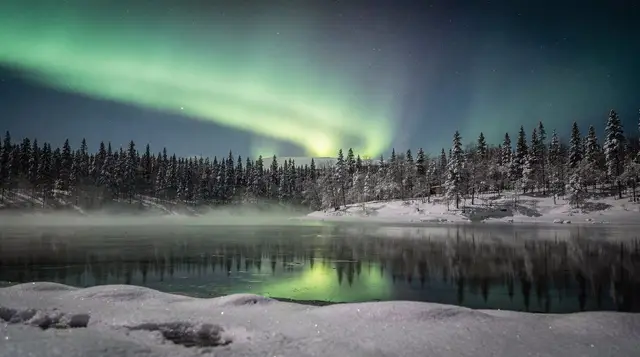
However the booking page phrases it, no accommodation and no tour can promise you a northern light. Seeing one needs three things at once: geomagnetic activity, a clear sky and darkness. Rovaniemi and the wider region sit under a band of frequent activity, but cloud cover is the factor nobody controls, and it’s the one that decides most nights. Some operators sell “guaranteed” northern lights tours; what’s actually guaranteed is usually a refund or a repeat visit, never the phenomenon. Our guide to what “guaranteed” really means spells this out plainly.
It’s also worth knowing before your first night under the glass that what you see with your own eyes is often a faint, moving grey-green band, not the saturated curtain of colour in a long-exposure photograph. Neither is wrong — the camera sensor genuinely gathers more colour than the eye does — but the gap between the two is the single biggest cause of disappointment among first-time viewers. Our piece on what you actually see versus what the camera shows sets expectations before you’re standing outside at midnight wondering if you’re missing something.
If the sky at Kakslauttanen stays stubbornly overcast, a guided search elsewhere near Saariselkä at least gets you away from the site’s own lighting and gives a guide a better shot at reading the cloud. Options include a guided aurora search around Saariselkä or, for something more active, an ATV aurora hunt out of Saariselkä.
Day 3: A slow morning, then the road home
Use the morning at your own pace rather than rushing to check out. If you’re up for it before breakfast, Urho Kekkonen National Park starts right at the edge of Saariselkä, and even a short walk on marked trails is a good way to see the fells in daylight rather than only from a car window or a glass roof at night. Kiilopää, with its wood-fired smoke sauna, is a short drive further and worth the detour if your schedule and legs allow it.
For a more structured last morning, an aurora hunting overview or a dedicated outing such as an aurora photography workshop up in Inari can double as a way to learn camera settings you’ll actually use again, rather than just another evening spent looking up.
Then it’s the same 260 km, 3 hours 30 minutes back to Rovaniemi — the same logic applies in reverse. Leave with enough daylight left that a fuel stop or a delayed departure doesn’t turn into a late arrival on unfamiliar roads. If you’re flying out the same evening, build in a buffer rather than cutting it to the minute; winter driving times are estimates, not guarantees, same as the aurora itself.
What to pack, and what not to bother with
Most operators supply thermal overalls, boots, hats and mitts for any organised outdoor activity, and a glass igloo room is heated — you won’t need expedition gear just to sleep there. What’s worth bringing yourself is the basic three-layer system: a merino or synthetic base layer, a fleece or wool mid-layer, and a windproof, water-resistant outer shell, plus a warm hat and gloves for the short walk between buildings. Skip buying a full snowsuit before you arrive; between what’s provided and three proper layers, most travellers on this itinerary are overdressed by the time they check out.
| Item | Needed for | Bring or borrow? |
|---|---|---|
| Merino base layers | Every outdoor stretch | Bring |
| Windproof outer shell | Driving stops, short walks | Bring |
| Thermal overalls | Guided activities | Usually provided |
| Insulated boots | Guided activities | Usually provided |
| Warm hat and mitts | Everything outdoors | Bring |
| Camera tripod | Aurora photography | Bring if you’re serious about photos |
A realistic take on the pace
Three days is enough to see one glass igloo stay through properly, but it isn’t enough to also squeeze in Levi, Inari or a full day trip beyond Saariselkä without turning Day 2 or Day 3 into another long drive. If you have more time, extending to four or five days and splitting the return journey, or adding a second night at Kakslauttanen, does more for the odds of clear sky than any tour booking can. If you’re set on three days exactly, the version above — one day in Rovaniemi, one full travel day north, one slower morning before the drive back — is the version that doesn’t leave anyone exhausted on the least controllable night of the trip.
Kakslauttanen and glass igloo FAQ
How far is Kakslauttanen from Rovaniemi, and how long does the drive take?
About 260 km, roughly 3 hours 30 minutes in good winter conditions. That is longer than the number suggests once you add fuel or charging stops, food and a few kilometres of packed snow at reduced speed. Treat it as a full travel day, not an afternoon errand.
Is a glass igloo aurora sighting guaranteed?
No. The glass roof lets you watch the sky from bed if the aurora appears and the sky is clear, but neither is under anyone’s control. Some brochures use the word “guaranteed” about a refund or a second night, never about the phenomenon itself.
Do I need a car for this itinerary, or can I go by tour or bus?
A car gives you control over departure time, which matters most on Day 2. Matkahuolto buses run to Saariselkä, but on a lower frequency, and most operators up there also run private transfers from Rovaniemi airport or the town centre if you’d rather not drive.
Should I book one night or two in a glass igloo?
One night lets you sample the format without over-committing budget or itinerary days to weather you can’t control. Two nights roughly doubles the odds of at least one clear stretch of sky, which matters more here than almost anywhere else on this trip.
What does a glass igloo actually cost?
It sits at the luxury end of Lapland accommodation and varies widely by operator, room type, season and how far ahead you book — check current rates directly with Kakslauttanen or another glass igloo operator rather than relying on a fixed figure.
What should I pack for a glass igloo stay?
The three-layer system — merino base, fleece or wool mid-layer, windproof outer — plus a proper hat and mitts for the short walk between the igloo and the main building. Most operators supply thermal overalls and boots for organised activities, but not for lounging by the glass roof at 2am.
Is Kakslauttanen the only glass igloo option near Rovaniemi?
No, but it’s the best-known and the one most itineraries reference. Several other operators around Saariselkä, Levi and closer to Rovaniemi itself offer glass-roofed rooms or cabins; compare the drive time and site lighting against Kakslauttanen before booking.
What happens if it’s cloudy during my glass igloo night?
You still sleep somewhere memorable, but you won’t see an aurora — clouds block the view regardless of how much geomagnetic activity is happening above them. Some operators offer a wake-up call service if the sky clears overnight and activity is detected, which is worth asking about at check-in.
Ice fishing, ice floating & snow experiences on GetYourGuide
Verified deep-linked GetYourGuide tours. Book through these links and we earn a small commission at no cost to you.
GetYourGuide does not provide a product photo for this activity — the image shows the meeting point, photographed by us.