Rovaniemi vs Tromsø for the northern lights
Is Rovaniemi or Tromsø better for seeing the northern lights?
Neither has a proven edge: Rovaniemi's continental climate gives statistically more clear winter nights, while Tromsø's coastal climate is milder but cloudier. Both sit under the auroral oval and depend on the same solar activity and local weather on the night you're there.
Two arctic bases, one shared uncertainty
Rovaniemi and Tromsø turn up on the same shortlists for the same reason: both sit well inside the auroral oval, both have airports with direct European connections in winter, and both have built a genuine tourism industry around a phenomenon that neither one can promise. That last point matters more than either destination’s marketing usually admits. Picking between them is not a question of which place “has” the northern lights and which doesn’t — it’s a question of climate, of what else there is to do on the cloudy nights, and of what kind of trip you actually want to take.
This comparison sticks to what can be stated honestly: how the weather in each location tends to behave, how the two destinations differ in logistics and activities, and what trade-offs you’re actually making. It will not tell you that one place sees the aurora more often than the other in any precise, quotable number — nobody can responsibly give you that, and any operator who does is selling you a marketing line, not a forecast.
Same latitude band, very different weather machines
Rovaniemi sits inland, in Finnish Lapland, at the confluence of two rivers, roughly 8 km south of the Arctic Circle. Its climate is continental: cold, dry air that settles over the interior for long stretches in winter, producing the kind of stable, high-pressure skies that make for good stargazing. December and January are, in fact, its cloudiest months, with the more reliably clear stretches tending to fall in September–October and February–March.
Tromsø sits on the Norwegian coast, at roughly the same latitude, but its climate is shaped by the Atlantic and the Gulf Stream. That ocean influence keeps winter temperatures noticeably milder than Rovaniemi’s — often close to freezing rather than deep into the minus twenties — but it comes at the cost of more frequent cloud, wind and precipitation blowing in off the sea. A coastal climate that spares you the worst of the cold is, by the same mechanism, a climate that spares you fewer clear nights.
Neither pattern is absolute. Rovaniemi can sit under cloud for a week straight in December. Tromsø can get a run of crisp, clear coastal nights in October. The honest summary is a tendency, not a rule: statistically, Rovaniemi’s dry continental interior produces more clear winter skies than Tromsø’s damp coastal one, and that is the one directional claim this comparison will make.
| Rovaniemi | Tromsø | |
|---|---|---|
| Climate type | Continental, inland | Coastal, Atlantic-influenced |
| Typical winter temperature | -10 to -25°C, spells below -30°C | Milder, often near or just below freezing |
| Cloud tendency | Generally drier, more stable high-pressure spells | More frequent cloud, wind and rain or sleet |
| Aurora tour format | Minibus, chasing clear sky inland, 100–200 km range | Boat or minibus, chasing clear sky along the fjords |
| Best statistical months | September–October, February–March | Varies with Atlantic weather systems, less predictable by month |
What each place is actually selling
The climate difference is only half the story, because Rovaniemi and Tromsø are selling two different trips, and that should weigh as heavily in your decision as the sky.
Rovaniemi’s identity is built around family travel and the Santa Claus Village, a commercial park at the Arctic Circle where entry is free and you pay for individual activities, the photo with Santa, and the certificate for crossing the circle line. Around that centrepiece sits a genuinely broad activity catalogue: husky and reindeer sled rides, snowmobiling, ice fishing, and aurora hunts that double as a first taste of Lapland’s winter landscape. It is a destination built for a family with children as much as for adults chasing the sky, and its whole tourism economy — hotels, restaurants, transfers — is scaled around that.
Tromsø’s identity is built around fjords, mountains that rise straight out of the sea, and boat-based aurora hunting that can reposition along the coast in search of a break in the cloud. It leans towards couples and adult travellers more than towards young families, and its “second reason to go” is coastal scenery and whale watching rather than a theme-park-style attraction. Neither approach is better in the abstract; they suit different travellers.
If you are planning around young children, Rovaniemi’s infrastructure — short rides, indoor fallback activities, a compact walkable centre — tends to work more smoothly than Tromsø’s, where more of the programme assumes reasonably mobile adults on a boat deck in the cold. If you want dramatic coastal and mountain scenery as the backdrop to your aurora hunt, that’s what Tromsø offers and Rovaniemi, an inland town on flat river terrain, does not.
Chasing the sky: minibus versus boat
Because neither destination can guarantee the aurora, both have built an entire tour industry around the same underlying task: getting you under clear sky, in the dark, away from artificial light, for long enough that if something happens overhead, you’re there to see it.
a Rovaniemi aurora hunt follows the inland model: a minibus drives away from Rovaniemi’s own light pollution and the nearest cloud bank, sometimes 100 to 200 km round trip, to a spot the guide judges has the best chance of clear sky that night. The outing typically runs four to six hours, often from around 8pm to 1am or 2am, with a campfire and a hot drink built in. If you’d rather not share a minibus with a dozen other travellers, a private aurora tour out of Rovaniemi does the same chase on your own schedule.
Tromsø’s aurora hunts more often use a boat, working the fjords and open coastal water to find a gap in the cloud cover that a minibus on Norway’s mountain roads can’t easily reach. Both formats exist for the identical reason: the aurora itself is not the variable anyone controls. Cloud is. A guide’s job, in either city, is reading weather radar and driving or sailing towards the clearest patch of sky within reach, not producing lights on demand.
Whichever base you choose, treat any tour marketed as “guaranteed” with the same scepticism in both places: read our guide to what a guaranteed northern lights tour actually promises before you book. It is almost always a refund-or-repeat guarantee on the tour, never a guarantee of the phenomenon.
What you’ll actually see, wherever you go
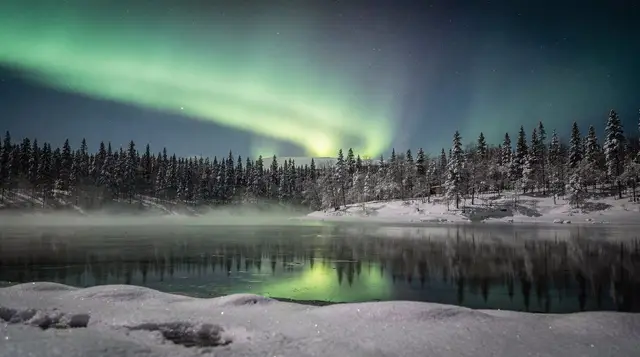
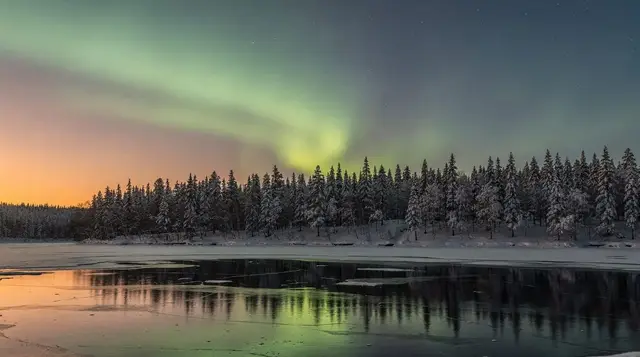
This is worth stating plainly for both destinations, because it is the single biggest source of disappointment in aurora tourism anywhere: the naked eye usually sees a pale, moving band of grey or faint green, not the saturated curtain of colour in the photographs. Camera sensors, especially on a long exposure, pick up colour and detail the eye can’t. That’s true over the fells outside Rovaniemi and it’s true over the Norwegian fjords — read what you actually see with the naked eye versus a camera before you go, in either location, so the brochure images don’t set an impossible bar.
Timing works the same way in both places too. The core season runs from late August to early April, and you need geomagnetic activity, a clear sky and darkness all at once. For a month-by-month breakdown that applies broadly across the auroral zone — not specific to either town — see our guide to the best months for the northern lights, and check a live aurora forecast app on the day rather than relying on the season alone.
Getting there, and getting between them
Rovaniemi Airport has direct Finnair and Norwegian flights from Helsinki in about 1 hour 25 minutes, plus seasonal direct flights from several European cities in December. The overnight VR train from Helsinki takes around 12 hours and, unusually, has a car-carrying wagon, so you can arrive with your own vehicle.
Tromsø has its own airport with direct connections from Oslo and a number of European cities, generally a shorter domestic hop from mainland Norway than the Helsinki–Rovaniemi route.
What the two are not is a comfortable combination on one trip. The road distance between Rovaniemi and Tromsø runs to roughly 600 km through Finnish and Norwegian Lapland — a genuine multi-day proposition in winter conditions, not a side trip.
If you’re weighing this pairing against a similar one further east, our comparison of Rovaniemi versus Saariselkä covers a much shorter distance that does work as an add-on, and Rovaniemi versus Abisko covers a third option on the Swedish side, closer to the Norwegian border than Rovaniemi but still a separate trip from Tromsø. Treat Rovaniemi and Tromsø as alternatives to choose between, not stops on the same itinerary — see our fuller guide to reaching Rovaniemi for the practical routes.
If you do rent a car around either base, winter driving conditions are serious in both countries: studded or winter tyres are compulsory through the coldest months, reindeer and elk cross roads without warning, and darkness in the deep-winter weeks changes how far your headlights actually help. Our guide to driving in Lapland covers the specifics for the Finnish side; Norway’s mountain roads around Tromsø carry their own weather closures and require the same caution.
A week in either place, without the aurora as the only plan
Because clear-sky nights aren’t something you can schedule, both destinations work best as trips built around a full daytime programme, with the aurora hunt bolted on as an evening activity rather than the entire point of the visit. That’s true whichever base you choose, but it plays out differently.
Around Rovaniemi, a typical day might combine a snowmobile safari with an evening aurora minibus: a full-day snowmobile adventure covers a proper distance through the forest rather than a short taster loop, and pairs naturally with a late aurora hunt once the light drops.
Families or anyone wanting a gentler pace often prefer a combined husky and reindeer outing, which introduces both animals without committing a full day to either. None of this exists in the same form around Tromsø, where the daytime programme leans towards fjord cruises, hiking where conditions allow, and whale watching in season rather than dog sledding or reindeer farms at Rovaniemi’s scale.
For planning a Rovaniemi-based week specifically, our northern lights hunting itinerary lays out how to combine daytime activities with aurora evenings without over-scheduling either. If children are coming, our guide to Rovaniemi with toddlers is worth reading regardless of which broader itinerary you follow, since it flags what actually works at that age and what doesn’t — useful context even if you ultimately choose Tromsø, since the same “how much can a toddler realistically do outdoors at -15°C” questions apply.
One more comparison worth making honestly: glass igloos are sold around both destinations as a way to watch for the aurora from a warm bed, but the site’s own light pollution and the dome’s orientation often limit what you can actually see from inside one. That caveat holds in Rovaniemi’s forests and in Tromsø’s fjord-side lodges alike — a glass roof is comfort, not a better vantage point.
Money, roughly
Both destinations are expensive by general European standards, and neither is meaningfully cheaper than the other once you account for currency and typical pricing. Finland prices in euros; Norway prices in Norwegian kroner, which tends to make headline numbers look larger even when the underlying cost is comparable.
| Rovaniemi (Finland, EUR) | Tromsø (Norway, NOK equivalent) | |
|---|---|---|
| Half-day guided activity | Roughly €100–€200 per person | Broadly comparable once converted, sometimes higher for boat tours |
| December/Christmas premium | Accommodation rises sharply | Accommodation and tours also rise, less tied to a single Christmas peak |
| Currency | Euro, cards accepted everywhere | Norwegian krone, cards also accepted everywhere |
| Tipping | Not expected, service included | Not expected, service included |
Rovaniemi’s price spike is heavily concentrated around the Christmas period, driven by Santa Claus Village demand; Tromsø’s pricing is somewhat less tied to a single calendar peak but rises with the general winter aurora season regardless.
Which one, honestly
If a dry, cold, statistically clearer winter sky matters more to you than mild coastal temperatures, and you want the broadest single-location catalogue of snow activities plus a genuine family draw, Rovaniemi is the more complete package — see things to do in Rovaniemi for the fuller picture of what fills the days between aurora hunts.
If dramatic fjord and mountain scenery, milder temperatures, and boat-based aurora chasing appeal more than an inland forest setting — and you’re travelling as a couple or adult group rather than with young children — Tromsø is the better fit, on the understanding that its coastal climate means more cloud to contend with on any given night.
What neither destination can honestly claim is a meaningfully higher chance of showing you the aurora than the other. Both sit under the same auroral oval, both depend on the same solar activity, and both are ultimately at the mercy of the sky on the specific night you’re there. Choose on climate character, activities and the kind of trip you want — not on a promise either marketing department can’t actually keep. For a broader look at how Rovaniemi’s own winter unfolds month to month, including the kaamos period when the sun doesn’t rise, see our guide to Rovaniemi’s winter and kaamos season.
For a lighter, quieter alternative to a full minibus tour, a northern lights picnic with campfire sausages keeps things simple: a fire, food, and time under the sky, with no long drive attached.
Rovaniemi versus Tromsø: your questions answered
Which place has more clear nights for aurora viewing, Rovaniemi or Tromsø?
Rovaniemi’s continental climate is drier and statistically produces more clear winter skies than Tromsø’s Atlantic-facing coast, which sees more cloud and precipitation. That is a tendency, not a guarantee: either location can hand you a week of cloud or a clear night on the first try.
Is it warmer in Tromsø than in Rovaniemi in winter?
Usually, yes. Tromsø sits on the coast and is warmed by the Gulf Stream, so its winter temperatures are milder and closer to freezing on many days. Rovaniemi’s continental interior runs colder and drier, commonly -10 to -25°C with sharp cold snaps below -30°C.
Can I combine Rovaniemi and Tromsø in one trip?
Not as a day trip. The road distance between them is roughly 600 km through Finnish and Norwegian Lapland, which is a proper multi-day drive, not an excursion. Treat them as two separate bases and pick one per trip, or one after the other with its own dedicated days.
Which is better for families, Rovaniemi or Tromsø?
Rovaniemi has the stronger family infrastructure: Santa Claus Village, reindeer and husky farms built around short rides, and a compact town centre. Tromsø’s programme leans towards fjord cruises and coastal scenery, which work for families too but with less built specifically around young children.
Do I need a car in Tromsø the way I do around Rovaniemi?
Less so. Tromsø’s aurora tours are commonly boat-based, chasing clear patches of sky along the fjords, while Rovaniemi’s tours are minibus-based, driving away from cloud cover and town lights over land. Neither destination requires you to self-drive if you book guided tours.
Is a boat-based aurora tour in Tromsø better than a minibus tour from Rovaniemi?
They are different tools for the same problem. A boat can reposition along the coast to find a break in the cloud over open water; a minibus does the same by road, often covering 100 to 200 km inland. Both exist because chasing clear sky, not the aurora itself, is the real job on any given night.
Popular Rovaniemi experiences on GetYourGuide
Verified deep-linked GetYourGuide tours. Book through these links and we earn a small commission at no cost to you.
GetYourGuide does not provide a product photo for this activity — the image shows the meeting point, photographed by us.