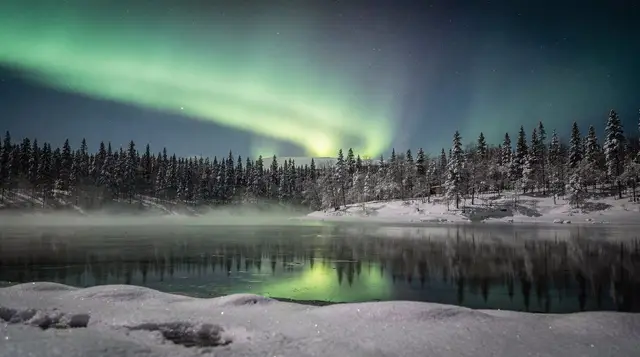
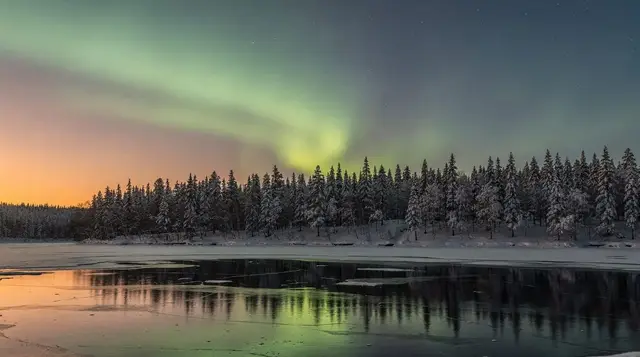
Rovaniemi vs Abisko for the northern lights
Should I choose Rovaniemi or Abisko for the northern lights?
Abisko has a genuine microclimate advantage that gives it more statistically clear nights than most of Scandinavia, but it is a tiny village with almost nothing beyond aurora-watching and limited off-season services. Rovaniemi has lower average clear-sky odds but offers a full town, an airport, and a week's worth of other activities if the sky doesn't cooperate.
Two very different bases for the same sky
Rovaniemi and Abisko turn up on the same shortlists because both sit under the auroral oval and both get marketed hard on northern lights odds. That comparison is fair as far as it goes, but it skips the more useful question: what is the rest of the trip like if you’re not standing outside at midnight? Rovaniemi is a working Finnish town of around 64,000 people, with an airport, a high street, museums, and enough non-aurora activities to fill a week even under total cloud cover. Abisko is a village in Swedish Lapland built almost entirely around one thing — a microclimate that gives it unusually clear skies — and once you step outside that purpose, there isn’t much else there.
Neither place is wrong. They serve different trips. This guide sets out exactly where each one wins, so you can pick based on what you actually want from the days you’re not watching the sky.
The quick comparison
| Rovaniemi, Finland | Abisko, Sweden | |
|---|---|---|
| What it is | A regional town, ~64,000 people | A small settlement around a mountain lodge |
| Getting there | Direct flights to Rovaniemi Airport | Fly to Kiruna, then train or bus onward |
| Aurora advantage | Standard auroral-oval odds, cloud-dependent | Rain-shadow microclimate, statistically clearer skies |
| Guarantee of a sighting | None — no operator anywhere can promise this | None — the microclimate helps odds, not certainty |
| Non-aurora activities | Extensive: town, museums, huskies, reindeer, snowmobiling | Minimal: hiking (summer), the Sky Station viewpoint |
| Family suitability | Strong — Santa Claus Village, wildlife park, indoor options | Weak — built for adults on an aurora-focused trip |
| Off-season services | A full town, open year-round | Sparse outside the main visiting season |
| Typical trip length | 3–7 days, easily filled | 1–3 nights is common; longer needs planning |
What Abisko actually is — and isn’t
It’s worth saying plainly, because the marketing around Abisko can blur it: this is a village, not a town. There is the STF mountain lodge and its surrounding buildings, the base station for the Aurora Sky Station chairlift, a small shop, and very little else. Outside the core aurora season and the summer hiking window, services thin out sharply — don’t expect a choice of restaurants, a run of shops, or the kind of everyday town infrastructure you get in Rovaniemi without thinking about it. If your picture of Abisko is a Nordic village with a main street and cafés, recalibrate before you book: it’s closer to a single lodge with a train stop attached.
That’s not a criticism of the place — Abisko was never built to be a destination town. It exists because of what happens above it on clear nights, and it does that one job well.
The microclimate case for Abisko
Abisko National Park sits in a rain shadow created by the mountains to its west, which means storm systems coming off the Norwegian coast tend to drop their moisture before reaching the valley. The practical result is more clear-sky nights over a winter than most comparable spots in Scandinavia, Rovaniemi included. This is the entire reason Abisko has a reputation among aurora chasers, and it’s a real, physical effect rather than marketing.
What it doesn’t do is guarantee anything on a given night. The Aurora Sky Station sits on Mount Nuolja, reached by chairlift, and functions as an elevated, open viewpoint above valley-level cloud and light — a genuinely useful setup when conditions allow. But geomagnetic activity still has to show up, and even a statistically favourable sky can sit stubbornly grey for several nights running. Read our guide to how the aurora actually works and the honest breakdown of what “guaranteed” tours really promise before you build a whole trip around one location’s odds.
Rovaniemi doesn’t have Abisko’s microclimate, but it compensates with volume and flexibility: tours here routinely drive 100–200 km away from the town’s own light and cloud to find a clear patch, using local knowledge of forecasts built up over a long-running industry. A Rovaniemi aurora hunt or a private aurora tour with a smaller group can chase clear sky across a wide radius on a bad night, rather than being tied to one fixed viewpoint. Neither approach beats physics — cloud cover is cloud cover — but Rovaniemi’s spread of operators and roads gives you more ways to try again the next night without changing your accommodation.
Getting there: a real difference, not a rounding error
This is where the two trips diverge hardest. Rovaniemi has its own airport 10 km from the town centre, with direct flights from Helsinki and seasonal direct routes from several European cities in December — see our guide to getting to Rovaniemi for the options, including the night train from Helsinki, which is a genuinely pleasant way to arrive.
Abisko has no airport of its own. The usual route is to fly into Kiruna, which does have direct connections to Stockholm, and then continue by train or bus for roughly another hour to reach Abisko. That’s not a hardship exactly — the train line is scenic and reliable — but it’s an extra leg that adds cost and time to every arrival and departure, and it matters more on a short trip than a long one. If you’re weighing a rental car for either leg, our note on winter tyres and driving conditions applies on both sides of the border.
What there is to do besides look up
This is the clearest gap between the two. Rovaniemi is a full town: you can spend a morning at Arktikum learning the region’s history, an afternoon on a short husky and reindeer sledding trip, and an evening eating in a proper restaurant, all without leaving the town or repeating yourself. Add snowmobiling, ice fishing, an ATV run with a campfire lunch, Santa Claus Village, and the surrounding day trips, and a week fills itself even if every single night is cloudy.
Abisko, outside the summer hiking season on the Kungsleden trail, offers the Sky Station viewpoint and not a great deal else. It’s a place built for people whose trip has one purpose. That’s a perfectly reasonable way to travel if aurora-watching genuinely is the whole point and you’re comfortable with quiet evenings at the lodge in between attempts — but it’s a mismatch if you want variety, or if you’re travelling with anyone who isn’t equally committed to standing outside after dark.
Families: not a close call
If children are coming, this comparison mostly answers itself. Rovaniemi has Santa Claus Village, Ranua Wildlife Park within reach as a day trip, museums for the inevitable bad-weather afternoon, and a town with normal shops and restaurants. Abisko has none of that scaffolding: it’s a lodge oriented towards adults on an aurora mission, with limited indoor options and nothing resembling a family attraction nearby. Bring children to Rovaniemi. Save Abisko for a trip built around the sky alone.
Cost: neither is cheap, but for different reasons
Lapland tourism runs expensive on both sides of the Finland–Sweden border, and neither destination is a budget pick. The difference is in what drives the cost. Rovaniemi’s prices sit across a genuine range — supermarket self-catering, mid-range guesthouses, and premium hotels all coexist, because it’s a real town with a mixed economy. See our budgeting guide for concrete figures.
Abisko’s accommodation options are narrower, centred heavily on the STF lodge, which limits how much you can trade down on a tight budget. Add the extra Kiruna connection to every arrival and departure, and a short Abisko trip can end up costing more per night than a comparable Rovaniemi stay, even before activities are counted.
Trip length: how long to actually stay
A single night rarely gives good odds anywhere in the aurora zone — you’re gambling on one roll of the weather. In Rovaniemi, three to five days is comfortable, because there’s enough else to do that a run of cloudy nights doesn’t sink the trip; pair it with our northern lights hunting itinerary for a shape that works. In Abisko, most visitors stay one to three nights specifically for the aurora attempt, since there’s little to fill extra days with once the Sky Station and a hike or two are done. If you want a longer stay in Abisko, plan around the summer hiking season instead, when the Kungsleden trail is the actual draw.
So which one — a straight answer
Choose Abisko if the trip is specifically and only about maximising clear-sky odds for the northern lights, you’re comfortable with a quiet, service-light village for a couple of nights, and you don’t mind the Kiruna connection. Choose Rovaniemi if you want a real town as your base, activities and family options beyond the sky, an airport on your doorstep, and the flexibility to have a good week even if half the nights are cloudy. For most first-time visitors to Lapland — and almost anyone travelling with children — that points to Rovaniemi. For a dedicated, adults-only aurora mission with a few days to spare and a plan for the Kiruna leg, Abisko’s microclimate is a genuine edge.
Either way, go in with realistic expectations about what you’ll see with your own eyes rather than through a camera — our guide to what the aurora actually looks like is worth five minutes before you travel, wherever you end up. And if the sky stays stubborn, a northern lights picnic with a campfire in Rovaniemi is still a good evening even on a night with no display at all — which is more than can be said for a quiet lodge with the same result.
Rovaniemi vs Abisko: your questions answered
Is Abisko a town or a village?
Abisko is a small settlement, not a town. Outside the STF mountain lodge, the Aurora Sky Station operation and a handful of guiding businesses, there is very little infrastructure — no real high street, no range of restaurants, and few shops open once the peak aurora months end.
Which gives better odds of actually seeing the northern lights, Rovaniemi or Abisko?
Abisko sits in a rain shadow created by surrounding mountains, which statistically gives it more clear nights than Rovaniemi over a winter season. Neither place can guarantee a sighting on any given night, since geomagnetic activity still has to cooperate.
How do you get to Abisko?
There is no airport at Abisko. Most visitors fly into Kiruna, then take a train or bus roughly an hour further to Abisko, compared with flying directly into Rovaniemi and being in the town centre within minutes.
Is there anything to do in Abisko besides watching for auroras?
Summer hiking on the Kungsleden trail is genuinely good, and the Aurora Sky Station chairlift runs as a viewpoint outside winter too. Outside those windows, options are limited to the lodge itself, a short shop, and the surrounding wilderness — there is no equivalent to a husky farm, a science centre, or a town to wander.
Which is better for a family trip with children?
Rovaniemi, clearly. It has Santa Claus Village, Ranua Wildlife Park within a day trip, indoor museums for bad weather, and a town with restaurants and shops. Abisko has none of that infrastructure and is built around adults staying up for a night sky.
Which is cheaper, Rovaniemi or Abisko?
Neither is cheap, but Rovaniemi offers more price tiers, from supermarket self-catering to budget guesthouses, because it is a working town rather than a single-purpose lodge. Abisko’s accommodation options are narrow, and the STF lodge sets much of the going rate.
Popular Rovaniemi experiences on GetYourGuide
Verified deep-linked GetYourGuide tours. Book through these links and we earn a small commission at no cost to you.
GetYourGuide does not provide a product photo for this activity — the image shows the meeting point, photographed by us.