Things to do in Rovaniemi city
What can you actually do inside Rovaniemi city centre, without a car or a tour?
Walk the compact grid Alvar Aalto laid out after 1944, cross the Jätkänkynttilä bridge over the Kemijoki, browse the covered market, and follow the riverside paths. It is a 90-minute loop at a slow pace, best paired with one museum (Arktikum, Pilke or Korundi) rather than treated as a full day on its own.
Walking a city that was rebuilt from nothing
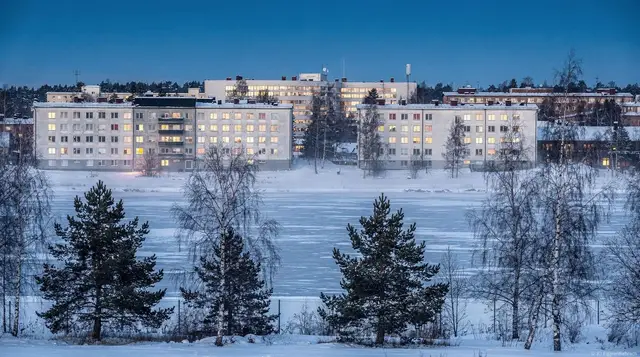
Most guidebooks describe Rovaniemi’s centre the way they would any regional capital, with talk of “streets to wander” and “historic charm.” That’s misleading, and worth correcting before you set out: there is no historic charm to find, because there is almost nothing left from before 1944. On the night of 6 October that year, retreating German troops burned Rovaniemi to the ground during the Lapland War. More than 90% of the buildings were destroyed. What you’re walking through today is, almost without exception, post-war construction, and treating it as an old town leads to disappointment for no reason — the actual value of the centre is different, and worth knowing in advance.
What’s here instead is a compact, flat, deliberately planned city that rebuilt itself in a few decades and still functions as a working town of about 64,000 people, not a museum piece. The city centre sits at the confluence of the Kemijoki river and the smaller Ounasjoki, and the whole walkable core — market square, main shopping streets, the Lumberjack’s Candle Bridge, the riverside paths — fits inside about a 15-minute walk end to end.
This page covers what’s actually inside that core, as a standalone stroll rather than a day trip. For the excursions further out, see the separate day-trip guides; for the museums, Arktikum, Pilke and Korundi each have their own dedicated pages linked below.
If you’d rather have someone explain the layout as you walk it, a two-hour guided loop such as the Rovaniemi city and nature guided walking tour covers the same ground with context on the 1944 reconstruction and the river, which is hard to get from a map alone.
The reindeer-head street plan
The one genuinely distinctive thing about central Rovaniemi is invisible at street level. When the city was rebuilt after the war, the reconstruction plan was drawn up by Alvar Aalto, Finland’s best-known architect, and the resulting street network — seen from above, not from the pavement — traces the outline of a reindeer’s head, with the stadium and surrounding roads forming the antlers. It’s a genuinely nice piece of design history, but be realistic about what it gives you as a visitor: nothing to look at while walking.
You won’t see it, you’ll only understand it if someone points it out or you look at a map. If the idea interests you, the dedicated guide on Aalto’s reconstruction of the street plan goes into the detail; the fuller account of what the city looked like before and after 1944 is worth reading before you arrive, because it recalibrates what you should expect from the centre.
What the plan does give you at ground level is a city that’s genuinely easy to navigate. The grid is regular, mostly flat, and small enough that getting lost is difficult. Rovaniemi’s own church, rebuilt after the war with a large fresco by Lennart Segerstråle inside, sits within this grid and is a reasonable five-minute stop if the door is open.
Jätkänkynttilä and the riverbanks
The single most recognisable landmark in the centre is the Jätkänkynttilä bridge — “the lumberjack’s candle” — over the Kemijoki at the southern edge of downtown. Its tall central pylon is lit at night in a shape meant to resemble a burning log candle, a nod to the region’s logging history, and it’s the natural turnaround point for a riverside walk. Cross it and you get a clean view back over the water toward the centre and, on a clear evening, it’s one of the more photogenic spots in town without needing to leave the city on foot.
From the bridge, paths run along both the Kemijoki and the Ounasjoki, Rovaniemi’s second river, which joins the Kemijoki right at the city’s edge. Neither riverbank is dramatic scenery — this is a working river town, not a gorge — but the paths are flat, well maintained, and genuinely pleasant for 20 to 30 minutes regardless of season.
In winter the rivers freeze over and the paths get packed snow rather than ice underfoot in most years; in summer, during the midnight sun weeks either side of the solstice, this is a good stretch to walk late in the evening simply because the light never really fades. Across the Kemijoki to the east rises Ounasvaara, the low hill — 204 metres, not a fell in any dramatic sense — that gives the closest thing to a wide view over the city, reachable on foot from the centre if you’re willing to add another 40 minutes to your loop.
If you’d rather see the same stretch of river from the water instead of the bank, the culture and history highlights boat tour runs along the Kemijoki past the bridge and gives a different angle on the same landmarks, with commentary on the 1944 rebuilding worked in.
The covered market and the main streets
Near the centre of the grid is Rovaniemi’s small covered market hall (kauppahalli) — modest by the standards of Helsinki or Turku, with a handful of food stalls, a bakery counter, and a few stands selling local handicrafts and reindeer products. It’s not a destination in itself, but it’s a sensible stop for a coffee, a quick lunch, or to pick up something to eat without sitting down in a restaurant, and it gives a more everyday view of the city than the tourist-facing shops nearer the main squares. For a broader read on where the food is actually good rather than just convenient, the where to eat in Rovaniemi guide is the better reference.
The main shopping street, Koskikatu, runs roughly parallel to the river and carries most of the ordinary retail — clothing chains, a supermarket or two, a scattering of outdoor-gear shops that are genuinely useful if you’ve arrived under-equipped for the cold.
Knife enthusiasts should know that Marttiini, the well-known Finnish knife maker, has its factory outlet in Rovaniemi; the separate guide to Marttiini knives covers what’s worth buying there versus what’s marked up for tourists. None of this is essential sightseeing, but it fills the gaps between the landmarks on a slow afternoon, and it’s the most realistic place to buy a proper winter layer if your packing plan went wrong.
Rovaniemi city library
Less visited than it should be, given the design pedigree: Rovaniemi’s main library is itself an Aalto building, part of the same civic complex that includes the concert hall and theatre a short walk from the market square. It’s a working public library, not a tourist attraction with an entry fee, so the experience is simply walking in, looking at the interior — Aalto’s characteristic use of natural light and curved lines — and walking out again.
Ten minutes is enough unless you want to sit and read. It pairs naturally with a stop at Korundi a few minutes’ walk away, which houses the city’s contemporary art museum in a converted bus depot and is a genuinely good half-hour if modern art interests you at all.
What the centre is not, and why that’s fine
It’s worth being blunt about this because so much marketing copy dances around it: Rovaniemi city centre is not a place with cobbled lanes, centuries-old façades, or a cathedral square that predates the war. If that’s what you’re picturing from “Finnish Lapland’s capital,” recalibrate before you arrive. What you get instead is a small, orderly, rebuilt town that’s pleasant to walk for an hour or two, genuinely easy to navigate, and honest about its own history in a way that’s more interesting than a fake old town would be — the 1944 reconstruction guide makes that case in more detail, including photographs of what stood here before the fire.
The centre’s real job, for most visitors, is to be the base you return to between the things that actually justify the trip: the aurora tours, the husky and reindeer farms, Santa Claus Village 8km to the north, and the day trips out to Ranua, Kemi or the fells. Treat it as a pleasant interlude rather than the main event, and it delivers exactly what it promises. For a photographer’s take on the same streets and riverbanks, worked into a structured route rather than a loose loop, the city photography tour is built around getting the light right on the bridge and the river rather than covering distance.
The Arctic Circle is not in the city
One confusion worth clearing up directly: the Arctic Circle line does not pass through downtown Rovaniemi. It runs about 8km to the north, close to Santa Claus Village, where a painted line and a certificate booth mark the crossing for visitors who want the photo. Nobody walking central Rovaniemi steps over any marked circle, and no landmark downtown sits “on” the Arctic Circle regardless of what a shop sign might imply.
If ticking off the crossing matters to you, it’s a separate short trip on bus 8, not part of the city walk. Some visitors combine the two into one day using something like the Santa Claus Village and city tour with private car, which links the centre and the village without needing to work out the bus timetable yourself.
How much time to actually give it
As a standalone activity, the core walking loop — market square, main streets, the candle bridge, a stretch of riverbank — takes 60 to 90 minutes at a relaxed pace, and there’s little value in stretching it much further on foot alone. A sensible half-day plan is: walk the centre in the morning or on arrival, then spend the rest of the afternoon at Arktikum (the full museum guide covers what to expect) or, with children, at Pilke next door.
If you’re only in Rovaniemi briefly, the one-day highlights itinerary slots the city walk in alongside one museum and one outdoor activity, which is a more realistic use of a short visit than trying to see everything the city has to offer inside the centre itself. For visitors without a rental car, the car-free Rovaniemi itinerary is built entirely around what’s reachable on foot or by bus, and the centre forms its backbone.
None of this needs booking in advance, and none of it needs specialist gear beyond what the weather demands — proper boots and a windproof layer in winter, nothing more. It’s the one part of a Rovaniemi trip that costs nothing beyond a coffee, and the honest advice is to give it the hour and a half it deserves rather than either skipping it entirely or over-scheduling a full day around streets that, however well designed, are genuinely small.
Rovaniemi city centre, questions people actually ask
Does Rovaniemi have an old town?
No. More than 90% of the city was destroyed in October 1944 when retreating German forces burned it during the Lapland War. Everything standing in the centre today was built after that, mostly from the late 1940s onward, so there is no historic quarter to walk through.
How long does it take to see central Rovaniemi on foot?
The core loop, from the market square down to the Jätkänkynttilä bridge and back along the Kemijoki, takes about 60 to 90 minutes at an unhurried pace. Add an hour if you stop for coffee or browse the covered market properly.
Is the Arctic Circle in Rovaniemi city centre?
No. The line crosses about 8km north of the centre, near Santa Claus Village, not anywhere downtown. Nobody physically steps over a marked circle while walking around the city itself.
What’s the difference between Arktikum, Pilke and Korundi?
Arktikum is the main regional museum, covering Lapland’s history, the 1944 destruction and Sámi culture, and takes about two hours. Pilke, next door, is a forest-science centre aimed mostly at children. Korundi, in a former bus depot, is the contemporary art museum. All three sit within walking distance of the centre and have their own dedicated guides.
Is Rovaniemi city centre worth a full day?
On its own, not really. The centre is small and can be walked in under two hours. It works best as half a day combined with one museum, or as the bookend to a day trip elsewhere, rather than as a standalone full-day plan.
What’s the reindeer-head street plan?
When Rovaniemi was rebuilt after 1944, architect Alvar Aalto designed the street layout so that, seen from above, the road network resembles a reindeer’s head and antlers. It is not something you notice walking at street level, but it explains why the centre’s streets curve the way they do.
Is there a covered market in Rovaniemi?
Yes, a small covered market hall (kauppahalli) sits near the centre with food stalls, a bakery counter and a few handicraft vendors. It’s modest compared to markets in bigger Finnish cities, but a reasonable stop for a coffee or a quick lunch.
Rovaniemi sightseeing tours on GetYourGuide
Verified deep-linked GetYourGuide tours. Book through these links and we earn a small commission at no cost to you.
GetYourGuide does not provide a product photo for this activity — the image shows the meeting point, photographed by us.