The 1944 destruction of Rovaniemi and its rebuilding
Why was Rovaniemi rebuilt from scratch after 1944?
Retreating German forces burned more than 90% of Rovaniemi in October 1944 during the Lapland War, using scorched-earth tactics against their former Finnish allies. With almost nothing standing, the town was rebuilt after the war on a new plan, so today's centre is a postwar design rather than a restored historic town.
A capital that burned in a matter of days
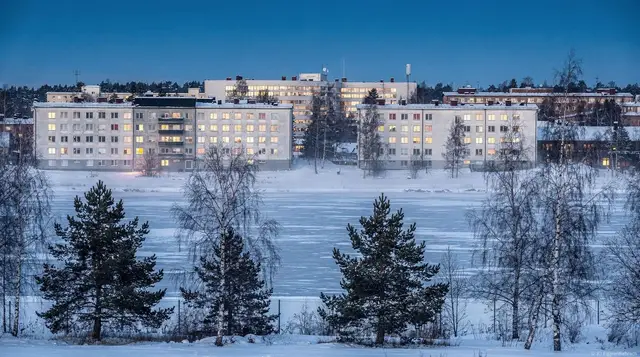
Walk through central Rovaniemi today and nothing about the low, orderly blocks along Koskikatu or the plain postwar façades around the market square suggests a town with roots stretching back centuries. That is not an accident of taste. It is because almost the entire town was burned to the ground in October 1944, and what stands now was built afterwards, mostly within about fifteen years.
Understanding why that happened, and how the town came back from it, explains more about the way Rovaniemi looks and feels than any single building or museum can on its own. This page covers the events of 1944 and the rebuilding that followed; the resulting street plan and its individual buildings are covered separately in the guide to Rovaniemi’s Aalto-era architecture.
Allies turned enemies: the road to the Lapland War
To understand why German troops burned a Finnish town, it helps to remember that for most of the Second World War, Finland and Germany were not enemies. From 1941, Finland fought the Soviet Union as a co-belligerent alongside Germany in what Finns call the Continuation War, aiming to reclaim territory lost in the earlier Winter War. German troops were stationed across northern Finland, including in and around Rovaniemi, as part of a joint front against Soviet forces in the Arctic.
That arrangement collapsed in September 1944. Facing a renewed Soviet offensive, Finland signed an armistice with Moscow that ended its war with the Soviet Union on harsh terms, one of which required Finland to expel all German forces from its territory, and to do so quickly. Germany, unwilling to withdraw its roughly 200,000 troops from Lapland without a fight, refused to leave on Finnish terms. What followed, from September 1944 to April 1945, is known in Finland as the Lapland War: a conflict between two former allies, fought almost entirely across the far north of the country as German forces retreated toward occupied Norway and Finnish troops pushed them out.
Scorched earth: why Rovaniemi was burned, not just fought over
The Lapland War was not primarily a war of large battles for Rovaniemi itself. It was, for the retreating German army, a war of denial. As units withdrew north along the region’s few usable roads, they applied scorched-earth tactics on a scale rarely seen elsewhere in the Nordic countries during the war: burning towns, blowing up bridges, mining roads and destroying infrastructure that could otherwise have supported a Finnish or Soviet pursuit, or simply sheltered Finnish civilians and soldiers through the coming winter.
Rovaniemi sat at a key road and rail junction at the confluence of the Kemijoki and Ounasjoki rivers, which made it strategically significant and, for the same reason, a priority target for destruction rather than a place to be spared. German forces set fire to the town in mid-October 1944 as they withdrew, and the fires spread through blocks of largely wooden buildings with brutal efficiency.
Estimates cited locally and in Finnish historical accounts put the destruction at more than 90% of the town’s buildings, a figure repeated so often it has become close to civic shorthand for what happened, and for good reason: it is not an exaggeration. Public buildings, homes, shops, the church, the rail station’s surroundings, almost the entire built town was lost in a matter of days.
It is worth being precise about scale rather than reaching for a single dramatic image. This was not one fire on one night so much as a sustained campaign of demolition and burning across the town and the wider region through October 1944, part of a broader scorched-earth withdrawal that also devastated other Lapland towns such as Kemi, Tornio and Sodankylä to varying degrees, alongside rural villages, bridges and roads across the province. Rovaniemi’s losses were among the most complete of any Finnish town in the war.
What was actually lost
It helps to be concrete about what “more than 90% destroyed” meant on the ground, because the phrase can become abstract with repetition. Rovaniemi before 1944 was a modest wooden-built provincial town, grown up around trade, timber and its position as a road and river junction rather than around any grand civic architecture.
Its church, its shops, ordinary housing stock built up over decades, all of it was overwhelmingly wooden construction, which is exactly the kind of built environment that burns fastest and most completely. There was no substantial stone or brick core of the kind that survived Allied bombing in some Central European cities even after severe damage. When the wooden buildings went, there was very little left standing to serve as a skeleton for repair.
That is the central fact to hold onto: this was not a town that was badly damaged and then patched up. It was a town that had to be almost entirely reinvented, on cleared ground, because there was next to nothing left to renovate around. A small number of structures on the edges of the built-up area, or in outlying parts of what is now the municipality, escaped the fires, either because German units did not reach them, ran out of time, or judged them not worth the effort. These survivors are genuinely few, scattered, and mostly unremarkable to look at; they are not concentrated into anything resembling a historic quarter, and no serious account of the town presents them that way.
Rebuilding a capital from cleared ground
Reconstruction began almost as soon as the fighting moved on, though the practical work of clearing debris, restoring basic services and finding shelter for a displaced population through a Lapland winter took priority over any grand architectural vision in the first months. The scale of the task facing planners was unusual even by the standards of postwar Europe: this was not a matter of infilling gaps in an existing street pattern, but of deciding, on largely open ground, what a Finnish provincial capital should look like from scratch.
That decision fell substantially to the architect Alvar Aalto, already established as one of Finland’s leading architects, who was commissioned to produce a general plan for the rebuilt town, delivered in 1945. Aalto’s plan set out the layout of streets, public spaces and zones for housing, administration and industry that the rebuilt centre would follow, and it remains the reason the town’s modern street pattern looks the way it does, including the much-repeated observation that the road network, seen on a map, traces the outline of a reindeer’s head and antlers.
That detail, and the specific public buildings Aalto later designed within his own plan, are covered in full in the separate guide to Rovaniemi’s Alvar Aalto architecture; the point that matters for the historical record here is that the plan itself was fundamentally a response to total destruction, not an aesthetic exercise layered onto an existing town.
Reconstruction through the late 1940s and into the 1950s was, by necessity, pragmatic and largely functional: modest housing, straightforward commercial buildings and basic infrastructure took priority, built to house a population returning to a town with almost no existing stock. The more architecturally notable public buildings associated with Aalto and his contemporaries came somewhat later, through the 1950s and into the 1960s, as the town had the resources and stability to invest in civic architecture beyond immediate necessity. By the early 1950s Rovaniemi was functioning again as a working town; by the 1960s much of what visitors now recognise as its centre was in place.
| Period | What happened |
|---|---|
| 1941–1944 | Finland and Germany fight the Soviet Union as co-belligerents; German troops stationed across Lapland, including Rovaniemi |
| September 1944 | Finland signs armistice with the Soviet Union, agreeing to expel German forces; the Lapland War begins |
| October 1944 | Retreating German forces burn more than 90% of Rovaniemi’s buildings during their withdrawal north |
| 1944–1945 | Fighting continues across Lapland until German forces are pushed into Norway; the Lapland War ends in April 1945 |
| 1945 | Alvar Aalto delivers his general plan for the rebuilt town centre |
| Late 1940s–1950s | Bulk of reconstruction: housing, infrastructure and basic commercial buildings |
| 1950s–1960s | Aalto and contemporaries complete notable public buildings within the new plan |
What survives from before the war, and what doesn’t
This is the point worth stating plainly, because it is easy for a visitor moving between the Arktikum museum, the Lumberjack’s Candle Bridge and the shops along Koskikatu to assume that at least some corner of the centre must be original. It isn’t, in any meaningful sense. There is no old town, no pre-1944 quarter, no cluster of historic buildings to seek out in central Rovaniemi.
What survives predates the fire only in a scattered, incidental way: a handful of buildings on the fringes of the built-up area, a few structures in outlying districts, and, in a different register, the physical setting itself, the Kemijoki and Ounasjoki rivers, the general lie of the land, which no fire could touch and which still shapes where the town sits and how it grew back.
What was lost went beyond buildings. A town’s fire in 1944 also erased much of its everyday material history, the accumulated small stuff of shopfronts, homes and civic life that historic towns elsewhere in Finland retained. This is part of why the Arktikum museum matters more here than a typical regional museum might elsewhere: it is one of the primary places where the story of the fire, the Lapland War and the region’s broader history is actually told and documented, rather than something visitors can piece together by wandering the streets, because the streets themselves carry almost no physical trace of what came before.
None of this means the rebuilt town lacks interest. A complete, mid-century reconstruction of a small provincial capital, carried out under real material shortages and shaped by one of the twentieth century’s significant architects, is itself an unusual and specific piece of history, worth taking seriously on its own terms rather than as a diminished substitute for something older.
But it is a different kind of place than a town with visible medieval or nineteenth-century roots, and it is worth setting that expectation correctly before arriving. For a fuller account of daily life in the rebuilt centre and where to spend time in it now, the general guide to things to do in Rovaniemi covers the ground this page deliberately leaves aside.
Beyond Rovaniemi: a regional war
Rovaniemi’s fire tends to dominate the story because it was the regional capital and because the destruction there was so close to total, but the Lapland War was fought across the wider province, and its scars are visible, in different forms, well beyond the town itself.
Sodankylä, further north, lost much of its own centre in the same withdrawal, though its wooden church, dating from 1689, survived and is now one of the oldest buildings left standing anywhere in Finnish Lapland, a genuine rarity precisely because so little else from before 1944 remains in the region. Kemi and Tornio, both on routes the German army used during its withdrawal toward Sweden and Norway, also suffered significant destruction, though neither was as comprehensively burned as Rovaniemi.
Further north still, the war’s final phases pushed German forces out through Ivalo and toward the Norwegian border, a retreat that left its own trail of destroyed bridges and infrastructure across a sparsely populated landscape that was, and remains, harder to rebuild than a town centre.
The Sámi communities of the region, whose herding livelihoods depended on infrastructure, reindeer stock and seasonal movement across this same ground, were displaced and disrupted by the fighting in ways that are less visible in the rebuilt streets of Rovaniemi but are part of the same history, and are covered in more detail in the guide to Sámi culture and the Siida museum in Inari.
Seeing this history for yourself
Because so little of pre-1944 Rovaniemi survives to be looked at directly, understanding this period mostly means engaging with how it is told rather than what is left standing. The Arktikum museum is the clearest starting point, with dedicated material on the 1944 destruction, the Lapland War and the reconstruction, alongside its broader coverage of Arctic and Lapland history. A guided walk or boat tour that frames the town’s layout against this history can also make Aalto’s postwar plan easier to read on the ground than it is from a map alone.
a guided boat tour covering Rovaniemi’s culture and history along the Kemijoki takes in the riverfront setting that shaped both the original town and its rebuilding, with commentary that places the postwar centre in context rather than treating it as generic sightseeing.
On land, a guided walking tour through the city centre and its riverside nature covers much of the same ground on foot, useful for spotting the reindeer-antler street pattern and the specific Aalto-designed buildings discussed in the architecture guide. A shorter option, a city highlights tour with hotel pickup and photos included, works well for visitors with limited time who still want the historical framing rather than a purely scenic loop.
None of these tours will show you an old town, because there isn’t one to show. What they can do is make sense of why the streets look the way they do, why the Rovaniemi Church is a mid-century building rather than a historic one, and why a museum, more than a walk through the centre, is where this particular history actually lives.
For those specifically drawn to craft and material culture that did carry through the rebuilding in continuous, if adapted, form, the Marttiini knife factory and its guide on Marttiini knives offer one thread of local production history that predates and survived the war, even as the buildings around it did not. For a broader sense of how much time this history, alongside the town’s other draws, deserves on a first visit, see the guide to how many days to spend in Rovaniemi.
Frequently asked questions about Rovaniemi’s wartime destruction and rebuilding
Why did German troops burn Rovaniemi in 1944?
Germany and Finland had fought as co-belligerents against the Soviet Union until Finland signed an armistice with Moscow in September 1944, one condition of which was expelling German forces from Finnish territory. As the Wehrmacht withdrew north toward Norway, it applied scorched-earth tactics across Lapland, destroying roads, bridges and towns, including Rovaniemi, to slow any Finnish or Soviet pursuit and deny usable infrastructure.
How much of Rovaniemi was destroyed?
More than 90% of the town’s buildings were destroyed, most of them in a matter of days around mid-October 1944. Estimates commonly cited put the loss at well over 90%, leaving only a small number of structures standing on the outskirts.
Is there an old town left to see in Rovaniemi?
No. There is essentially no intact pre-1944 quarter to visit. The centre visitors walk through today was built after the war, mostly from the late 1940s through the 1950s and 1960s, so it reads as postwar rather than historic.
What is the Lapland War?
The Lapland War was the September 1944 to April 1945 conflict between Finland and Germany, fought after Finland’s armistice with the Soviet Union required it to remove German troops from its territory. It was fought almost entirely in Finnish Lapland and is the direct cause of Rovaniemi’s destruction.
Did Alvar Aalto design all of Rovaniemi?
No. Aalto drew the 1945 general plan that shaped the street layout of the rebuilt centre, and he later designed specific public buildings such as the library and administrative and cultural buildings around Hallituskatu. Most ordinary housing and commercial buildings were designed and built by others working within, or sometimes departing from, his framework.
Are there any pre-1944 buildings still standing in Rovaniemi?
A handful survive, mostly on the edges of the town centre or in outlying areas that the retreating troops did not reach or chose not to burn, plus a few structures that were spared or rebuilt from salvageable remains. They are the exception rather than a neighbourhood, and nothing resembling a historic old town remains in the centre.
Why does Rovaniemi’s street plan look like a reindeer head?
Aalto’s 1945 plan organised the new centre’s main roads and public spaces in a form that, seen from above, resembles antlers branching from a head, with the stadium and surrounding routes forming the antler shapes. It is usually described as a deliberate regional reference rather than a strict functional requirement, and it is best appreciated on a map rather than at street level.
How long did the reconstruction take?
The most intensive rebuilding ran through the late 1940s and 1950s, with the town largely reconstructed and functioning again within about a decade, though individual public buildings, including several of Aalto’s, were completed later into the 1960s and beyond.
Rovaniemi sightseeing tours on GetYourGuide
Verified deep-linked GetYourGuide tours. Book through these links and we earn a small commission at no cost to you.
GetYourGuide does not provide a product photo for this activity — the image shows the meeting point, photographed by us.