Northern lights snowmobile safari
What is a northern lights snowmobile safari?
It's a snowmobile ride, usually 2 to 4 hours after dark between late August and early April, out to an open, unlit spot away from town where the group waits and watches for the aurora. No operator can guarantee the lights will appear; they depend on solar activity and, above all, on whether the sky is clear that night.
What a night snowmobile safari for the aurora actually is
A northern lights snowmobile safari is exactly two activities stacked on top of each other: a guided ride on a snowmobile, and a stop at a dark, open spot to watch the sky. It’s sold across Finnish Lapland from late August through to early April, the same window that applies to any aurora hunting in the region, because that’s when the nights are dark enough to see anything at all.
The format is fairly consistent between operators. A minibus or a short ride gets the group to the snowmobiles, everyone is fitted with a thermal suit, boots, gloves and a helmet, and then the convoy heads out on marked trails, single file, headlights on, following the guide’s machine at the front and a sweep machine at the back. After somewhere between 20 minutes and an hour of riding, the group stops at a location the guide has picked for its distance from town lights and, ideally, its clear view of open sky. That’s where the waiting starts. A fire is usually lit, hot berry juice or coffee gets passed round, and everyone looks up.
It’s worth being clear from the outset about what this page does and doesn’t cover. It’s about the aurora-specific, after-dark version of the safari — the one built around a viewing stop rather than around covering ground.
It isn’t about the licence you need to drive rather than ride, which has its own page on snowmobile licence requirements, and it isn’t about the surcharge for riding your own machine solo rather than sharing with a passenger, covered separately under the single-driver supplement. Both of those apply here exactly as they do on a daytime safari; this page assumes you’ve already sorted out who’s driving and focuses on the night and the sky.
Why nobody can promise you the aurora
Three things have to line up for the aurora to be visible: geomagnetic activity strong enough to push the aurora down to a latitude where Rovaniemi and its surrounding towns sit, a clear sky, and darkness. Rovaniemi and the wider region sit under the auroral oval, and operators here commonly cite something in the region of 200 active nights a year — meaning nights where activity is happening somewhere above the cloud. That figure gets used a lot in marketing, and it’s roughly accurate, but it answers the wrong question. The one that actually decides whether you see anything is cloud cover, and that’s the one nobody can control or reliably forecast more than a day or two out.
This is why “guaranteed northern lights” tours exist and why the guarantee needs reading carefully — it’s explained in full on a dedicated page about how these guarantees actually work, but the short version is that the guarantee covers a refund or a free second attempt, never the phenomenon itself. No snowmobile guide, however experienced, can move you to clear sky if a front has settled over the entire region that night. What a good guide can do is read forecasts, know which valleys tend to clear first, and be willing to drive somewhere the brochure map doesn’t show if that’s where the gap in the cloud is.
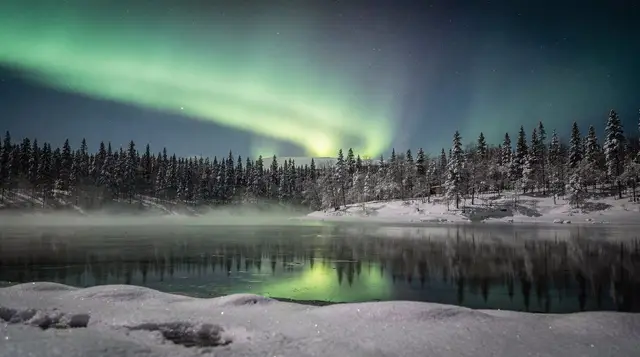
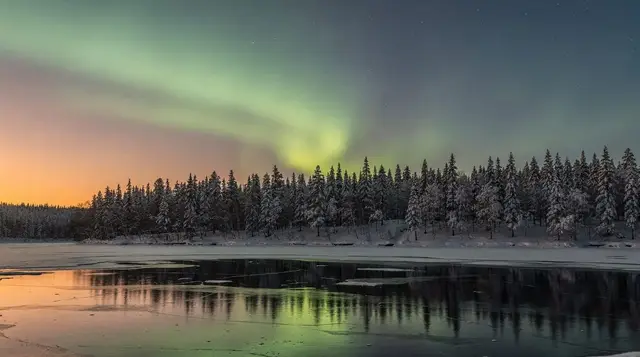
It also helps to know what you’re actually looking for. To the naked eye, an aurora is very often a pale grey-green band moving slowly across the sky, not the saturated green curtain from the tour operator’s photos, which is usually a long camera exposure. That gap between the photo and the lived view is covered properly on the page about what your eyes see versus what a camera captures, and it’s worth reading before you go, because it’s the single biggest source of disappointment on these trips — people who do see an aurora, but don’t recognise it because they were expecting the poster.
Night versus day: what actually changes
Daytime snowmobile safaris and night aurora safaris use the same machines and largely the same trail network, but the experience differs in three concrete ways.
| Daytime safari | Night aurora safari | |
|---|---|---|
| Lighting | Natural daylight, or the low winter sun | Headlights only, on marked forest trails |
| Feel of the cold | Cold, but you keep moving | Colder in practice, because of the extended stop |
| Group size | Often larger convoys | Usually smaller groups |
| Focus | Covering distance and scenery | Riding out, then stopping and waiting |
The lighting change is more noticeable than it sounds. Riding at night behind a single headlight beam, on a trail through forest, is a different sensation from riding in daylight — some visitors find it more atmospheric, some find the reduced visibility a little unnerving at first, and either reaction is normal. Guides ride these trails constantly and keep pace accordingly.
The temperature point matters for what you wear. A day tour that keeps you moving rarely lets the cold build up the way a night tour does, because a night safari’s whole point is to stop for 30 minutes to an hour or more at the viewing spot, engine off, standing or sitting still, while the group watches the sky. That’s when fingers and toes get cold fastest. The three-layer approach — merino base layer, fleece or wool mid layer, and a wind- and waterproof outer shell — matters more here than on a shorter, moving-only ride, even though the operator’s thermal suit does most of the heavy lifting.
Group sizes tend to be smaller on the aurora-specific version, partly because operators cap numbers to keep the convoy manageable in the dark and partly because a long stationary stop works better with fewer machines and fewer people to keep an eye on around a fire.
Not the same as an aurora tour without a snowmobile
It’s easy to conflate this with a plain northern lights tour and book the wrong thing. A standard aurora hunting trip, run by minibus, takes a group away from town lights and cloud to a dark spot, much like the snowmobile version, but the transport is incidental — you sit in a vehicle and get out to watch. The snowmobile version puts riding at the centre of the evening: part of what you’re paying for is the ride itself, headlights cutting through the forest, not just the arrival at a dark field.
If what you actually want is simply the best chance of seeing the sky, with no interest in driving or riding a machine, the minibus and walking options are worth comparing directly — see the pages on walking aurora spots near Rovaniemi and the full aurora hunting guide, which lays out the minibus format, and also the general snowmobile safari guide if you’re more interested in the machine and less in the sky.
Some operators blur the line by adding a short, half-hearted snowmobile leg onto what’s essentially a minibus tour; read the itinerary closely rather than the title, and check how much riding time is actually included versus how much is spent parked.
Where these safaris run: Levi, Inari, Ylläs and Ruka
These tours run across the wider region rather than from Rovaniemi itself, since the trail networks and the darkest, most reliably cloud-free pockets tend to sit further out. Four hubs account for most of the bookable options.
In Levi, in the municipality of Kittilä, the trail network is extensive and well maintained, and safaris typically run out toward open fell terrain where the tree line thins and the sky opens up.
a night snowmobile safari from Levi built around a stop at an open aurora viewing pointAround Inari, close to the lake itself, some operators run the safari as part of a longer evening that also touches on Sámi reindeer herding country, since this is where the region’s reindeer economy is most visible.
an aurora-focused snowmobile hunt run from Inari, out toward the lake’s open shorelineYlläs, split between Äkäslompolo and Ylläsjärvi inside the Pallas-Yllästunturi national park boundary, runs safaris with transfers included from either village, useful if you’re staying without a car.
a Ylläs aurora snowmobile safari with hotel transfers built into the priceFurther east, Ruka near Kuusamo runs a version pitched more around scenery than a hard aurora focus, riding through open fell country that’s striking with or without lights overhead.
a scenic Ruka snowmobile safari that also doubles as an aurora-watching stop on clear nightsNone of these locations has a meaningful statistical edge over the others for actually seeing the aurora. They all sit within the same auroral zone that covers Rovaniemi, and the deciding factor each specific night is local cloud, which can differ sharply between towns only 100 to 150km apart. Pick based on where you’re staying and how the itinerary reads, not on a belief that one town sees more lights than another.
What a typical night looks like
Pickup is usually from a hotel or a central meeting point in the early evening, often somewhere between 6pm and 9pm depending on the season and how far the group needs to travel to get clear of town lights. After the safety briefing and suit fitting, the ride out typically covers anywhere from 10 to 40km of trail, broken into stages with short stops to regroup.
The main stop is where the evening slows down. Depending on the operator, this might be a fell clearing, a frozen lake edge, or simply a wide, unlit stretch of forest trail. A fire gets built, drinks come out, and the group settles in to wait, sometimes for well over an hour. This is the part that tests patience more than it tests riding skill: some nights the sky clears within minutes of arriving, others it never really does, and a guide with good judgement will sometimes relocate the group partway through if a gap in the cloud looks more promising a short ride away.
Total time out is usually 3 to 5 hours door to door, and the trip typically ends back at the pickup point sometime between midnight and 2am. Read the listing for exact timing before booking, since it varies by operator and by how far the darkest, clearest ground happens to be that season.
What to wear and what’s provided
Nearly every operator running this trip lends a full outer setup: a one-piece or two-piece thermal snowmobile suit, insulated boots, mittens and a balaclava, all fitted before you head out. Buying specialist winter gear for a single evening is rarely worth it. What is worth bringing is what goes underneath: a merino wool or synthetic base layer, a mid layer such as fleece or wool, and thick wool socks — the three-layer principle that applies across every outdoor activity in the region. Avoid cotton next to the skin; it holds moisture and cools you down rather than keeping you warm.
A helmet is provided and required for anyone driving or riding as a passenger. If you wear glasses, check with the operator about visor compatibility in advance rather than at the meeting point. A head torch is handy for the stationary stop but not essential, since the fire and the guide’s equipment usually provide enough light to move around safely.
Prices and what’s included
Prices vary by group size, whether you’re driving or riding as a passenger, and how far the operator has to travel to reach clear, dark ground. As a rough range, expect a night aurora snowmobile safari to run somewhere from 130 to 250 EUR per person sharing a machine, with a solo-driver supplement on top where that’s offered — covered in detail on the single-driver supplement page. Most listings include the suit and boots, hot drinks and a light snack at the viewing stop, and hotel transfers within the relevant town; camera rental, professional photos and a full dinner are usually extras where offered at all.
Alcohol is off the table before and during the ride, exactly as it would be behind the wheel of a car — this is a legal requirement, not an operator preference, and it’s checked before departure.
Northern lights snowmobile safari: questions before you book
Is the aurora guaranteed on a snowmobile safari?
No. Some tours are sold as guaranteed, but that refers to a refund or a repeat trip if nothing is seen, not to the phenomenon itself. Clear sky and solar activity have to align on the night you’re out, and neither is under the operator’s control.
How is a night safari different from a daytime snowmobile safari?
You ride with headlights on a groomed trail rather than in daylight, groups tend to be smaller, and it feels noticeably colder because you’re standing still at a viewing stop for longer than on a day tour, which is usually all riding.
Do I need a driving licence to ride?
To drive the snowmobile yourself you need a valid car licence, covered on a dedicated page. Riding as a passenger behind a driver, with no licence needed, is offered on most of these tours too.
How cold does it actually feel at night?
Colder than the thermometer suggests, because riding and then standing at a viewing stop both cut down on the movement that normally keeps you warm. Operators lend a full thermal suit, boots and mittens; check what’s included before you book.
What if it’s cloudy all night?
You still get the ride, the stop, the fire and the hot drink; you just may not see the aurora. Some operators build in a second, farther stop if the first location is clouded over, but a clear gap in the cloud is never guaranteed.
Which is better for the aurora: Levi, Inari, Ylläs or Ruka?
None has a real edge. All sit under the same auroral zone as Rovaniemi and the deciding factor each night is local cloud cover, which varies unpredictably by location and can differ between towns 100km apart.
Can I bring my own camera?
Most guides allow it and some pause at the viewing stop specifically for photos, but check in advance: a few tours run a fast pace with short stops that don’t suit a tripod setup.
Is this the same as a northern lights tour without a snowmobile?
No. Minibus and walking aurora tours exist as a separate option and are covered on their own pages; this page is specifically about the snowmobile version, where the ride itself is part of the activity, not just the transport.
Northern lights tours on GetYourGuide
Verified deep-linked GetYourGuide tours. Book through these links and we earn a small commission at no cost to you.
GetYourGuide does not provide a product photo for this activity — the image shows the meeting point, photographed by us.