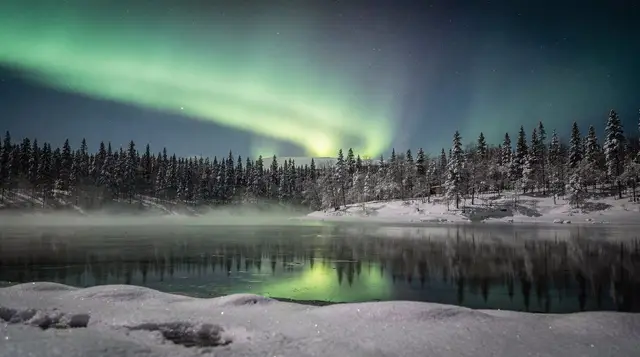
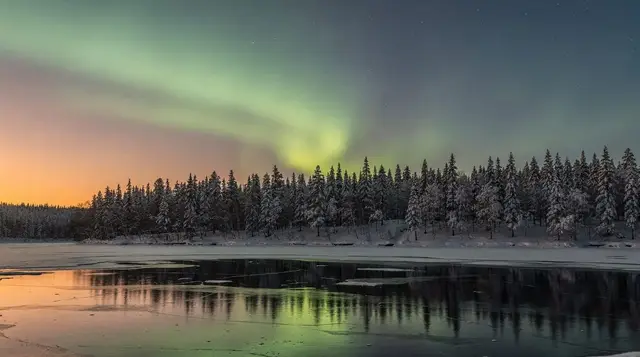
Arctic landscape photography beyond the aurora
Is there anything worth photographing around Rovaniemi besides the northern lights?
Yes, and most visitors miss it. The kaamos gives several hours of deep blue light even in December, the low winter sun creates long shadows for weeks either side of midday, June and early July run on continuous midnight sun, and late August to early October brings the ruska colour season across the forests and fells.
Most people who fly to Rovaniemi with a camera are chasing one thing after dark. That is a fair reason to come, but it leaves the other twenty hours of the day unused. The light around Rovaniemi changes completely with the season, and none of the four daylight conditions below have anything to do with the aurora: they are about the sun, or the lack of it, doing something unusual this far north.
Four kinds of daylight, one arctic landscape
Rovaniemi sits about 8 km south of the Arctic Circle, which is the reason its light behaves the way it does. In December the sun barely clears the horizon, or does not clear it at all, for about ten days. In June it does not set for a month. In between, the low winter sun and the short autumn colour season each give a narrow, specific window. None of this is about chasing a phenomenon: it is about knowing which weeks give which kind of light, then being there.
This guide covers daylight work only — the blue hours of the polar night, the low winter sun, snow and forest contrast, the midnight sun, and the ruska colour season. Photographing the aurora itself, the cameras and settings that suit it, is covered separately; see how northern lights actually look through the eye versus a camera and the dedicated aurora hunting guide if that is what brought you here.
The blue hours of kaamos, 2 to 12 December
Kaamos is the Finnish word for the polar night: the period when the sun stays below the horizon all day. At Rovaniemi’s latitude that runs roughly from 2 to 12 December, a short and often misunderstood window. It gets confused with total darkness, and it is not that. For several hours around midday the sky holds a deep, saturated blue, sometimes shading into violet or a faint rose at the horizon, strong enough to photograph a snow-covered landscape, a frozen stretch of the Kemijoki, or the timber buildings of the centre without any artificial light. It is closer to a very long, very blue dusk than to night.
The blue hour outside kaamos proper — the weeks either side of the exact polar night, through most of the winter — behaves similarly but for a shorter stretch each day, bracketing a brief, low sun around noon. Snow amplifies whatever light is available, bouncing it back up into shadows, which is part of why winter photography in Lapland reads as brighter than the actual sun angle would suggest anywhere else. For background on how the season sits inside the wider Rovaniemi winter, see the guide to Rovaniemi’s winter and kaamos season.
Practical point: exposures during kaamos blue light run long, often a second or more even at a moderate aperture, so a tripod is not optional gear here the way it might be for a summer walk. Battery drain is real: keep spares warm against the body, not in an outer pocket.
Low sun, long shadows: photographing the short winter day
Outside the exact kaamos window, December through February gives a winter day where the sun, when it appears, never climbs high. It rises late, arcs low across the southern sky, and sets again a few hours later, which means the raking, golden-hour quality that photographers elsewhere get for twenty minutes at dawn and dusk can last for most of the available daylight in Rovaniemi. Shadows stretch long across snow, texture on tree bark and frost shows up at almost any hour, and there is rarely a harsh overhead sun to fight.
This is also, honestly, the cloudiest stretch of the Rovaniemi year — December and January see more overcast days than the shoulder months — so a clear midday in deep winter is worth using rather than assuming it will repeat tomorrow. A viewpoint over the city and the river, such as Ounasvaara on the far bank of the Kemijoki, gives a quick, low-effort payoff: the walk up is short and the outlook over the frozen Kemijoki river and the rooftops of the centre works well in this low, angled light without needing a full day trip.
Snow and forest: reading contrast in a white landscape
A snow-covered forest is a harder subject than it looks. Cameras meter for middle grey, and a frame that is eighty per cent white snow gets read as too bright and pulled down, which is why snow scenes shot on auto settings routinely come back looking grey and flat instead of white. The fix is simple and has nothing to do with expensive gear: dial in positive exposure compensation, typically half a stop to a full stop, and shoot raw so the extra highlight detail is there to pull back later if a frame runs too hot.
Contrast is the other issue. Snow on branches, called tykky when it builds into thick, wind-sculpted collars on spruce, reads almost pure white against near-black tree trunks and a flat grey sky, a combination that either looks striking or blows out one end of the range depending on timing. The most reliable light for this is not a clear bluebird day but a soft, overcast one, where the even light lets the eye read the texture of the snow itself rather than fighting glare.
Riisitunturi National Park, about 170 km from Rovaniemi, is built almost entirely around this: heavily loaded spruce known locally as ghost trees, reachable after roughly an hour’s walk up from the car park. See the dedicated guide to Riisitunturi’s snow-laden trees before planning that trip, since the effect depends on how the winter’s snow has actually fallen and is not guaranteed every visit.
A polarising filter earns its place in this kind of light: it cuts glare off wet or icy snow surfaces and deepens a pale winter sky on the rare clear day, though on an overcast day it does little and is safe to leave off.
Midnight sun: continuous light from 6 June to 7 July
From around 6 June to 7 July, the sun does not set at Rovaniemi. It circles low across the northern sky through the night hours rather than dropping below the horizon, so there is no true blue hour and no dusk in the usual sense — daylight simply continues at a lower, warmer angle through what would be night anywhere further south. Outside that exact window, late May through most of July still runs on very long, very late light, even if the sun technically dips out of sight for a short stretch.
For landscape work this removes the usual pressure of a closing window: a 1 a.m. shot over the river or the fells is lit by the same low, warm sun as an 8 p.m. one, just from a different compass direction. It suits long, unhurried sessions rather than a rushed golden hour, and it is one of the few times of year when a late-night walk out to Ounasvaara or along the Kemijoki makes photographic sense without needing a car.
The trade-off is that the light stays fairly constant for weeks — dramatic, fast-changing skies are less common than in the shoulder seasons — and mosquitoes are active in the forest and near water through June and into July, which is a real nuisance for a photographer trying to stand still. See the guide to Rovaniemi’s midnight sun and shoulder seasons and, for a structured few days built around it, the midnight sun itinerary.
Ruska: the colour season, late August to early October
Ruska is the Finnish term for the autumn colour change, and around Rovaniemi it runs roughly from late August to early October, peaking for a shifting window of about two weeks somewhere in mid-September depending on that year’s frosts. Birch turns yellow first, low ground cover on the fells turns deep red, and against evergreen forest and often an early dusting of snow on higher ground, the colour combination is dense and short-lived rather than the long, gradual autumn familiar further south.
Photographically, ruska rewards places with elevation and open ground rather than dense, uniform forest, where the colour reads as a carpet rather than scattered patches between tree trunks. Korouoma Canyon, about 140 km out, combines ruska colour on its slopes with the start of its waterfalls beginning to ice at the very end of the season; see the guide to Korouoma’s frozen waterfalls for how the two overlap at the season’s edge.
For open fell terrain closer to the colour’s peak, the wider guide to ruska in Lapland and the matching autumn colour itinerary lay out a realistic few days without over-promising on timing, since the exact peak week cannot be fixed months in advance.
Ruska also has a practical bonus for anyone extending a trip: it is the point in the year when dark nights return, so a ruska visit can end each day with an early attempt at the aurora, without the trip needing two separate seasons.
A rough seasonal comparison
| Season | Window | What it gives | Main risk |
|---|---|---|---|
| Kaamos blue light | 2–12 Dec | Deep blue midday light, no true sunrise | Cloud cover, very short usable hours |
| Low winter sun | Dec–Feb | Long shadows, golden light most of the day | Frequent overcast in Dec–Jan |
| Snow and forest contrast | Dec–Mar | Tykky-loaded trees, high-contrast scenes | Metering errors, cold-drained batteries |
| Midnight sun | 6 Jun–7 Jul | Continuous low light, no closing window | Flat, unchanging skies; mosquitoes |
| Ruska | Late Aug–early Oct | Red and yellow colour on fells and forest | Short, weather-dependent peak |
Where to point the camera around Rovaniemi
Inside the city, Arktikum and the river frontage it sits on give an easy, low-commitment session at any time of year, and Ounasvaara across the water adds height without a full day trip. Further out, Riisitunturi National Park and Korouoma Canyon both reward the drive in winter, while a wider network of paths, including sections that connect toward Oulanka National Park, works better in the long light of summer; the hiking trails around Rovaniemi guide covers routes closer to town for anyone without a full day to spend.
A local photographer who already knows where a given week’s light is falling removes a lot of the guesswork, particularly in winter when a clear window can close within an hour. A guided city photography walk around Rovaniemi’s centre and riverfront is a reasonable way to learn the local light before heading out further alone, and for wildlife rather than pure landscape work, a guided photography session with Arctic wildlife at Ranua pairs animal subjects with the same low winter light discussed above.
Portrait and event photographers working in the region also offer sessions built around this light, such as a professional engagement or after-wedding shoot around Levi for anyone combining travel photography with a personal occasion.
Gear and settings, without the aurora-specific advice
None of this needs specialised night equipment. A tripod matters for the low-light stretches of kaamos and deep winter, less so in the constant brightness of midsummer. Positive exposure compensation for snow scenes, as above, is the single most useful habit to build. Cold drains batteries fast: below about -15°C, a battery reading half-full can die within minutes and then recover charge once warmed in an inner pocket, so carrying two or three spares kept close to the body matters more in Rovaniemi than any lens choice.
Condensation is the other real risk, not from the cold itself but from bringing a cold camera straight into a warm room; sealing it in a bag before going indoors and letting it warm up slowly avoids moisture forming inside the body and lens. For the wider clothing question that affects how long anyone can stand still holding a camera in these temperatures, see the three-layer packing guide.
Photographing Rovaniemi’s daylight seasons: your questions
What is kaamos, and is it too dark to photograph?
Kaamos is the polar night, when the sun stays below the horizon; at Rovaniemi’s latitude it runs roughly from 2 to 12 December. It is not total darkness. The sky holds several hours of blue and grey light around midday, strong enough for landscape work, before fading back towards the long winter night.
When exactly is the midnight sun in Rovaniemi?
The sun does not set from around 6 June to 7 July. Outside that exact window it still stays up very late through most of May, June and July, so light for photography runs far longer than a typical summer evening.
Is ruska worth a dedicated trip?
For photography, yes. The colour season runs roughly from late August to early October, peaking for about two weeks that shift year to year with the weather. It coincides with the return of dark nights, so a ruska trip can combine daytime colour photography with a first attempt at the aurora.
What camera settings suit the low winter sun?
There is no aurora-specific trick here: normal daylight exposure applies, but snow fools a camera’s meter into underexposing, so most photographers add half a stop to a full stop of positive exposure compensation and shoot in raw to recover highlight detail later.
Do I need special gear for snow and forest contrast shots?
A polarising filter helps cut glare off snow and deepen a blue sky, and spare batteries matter more than any lens: lithium batteries lose charge fast below -15°C and recover once warmed back up in a pocket.
Where around Rovaniemi has the best daylight scenery?
Ounasvaara for a quick view over the city and the Kemijoki, Riisitunturi National Park for snow-laden trees in winter, Korouoma Canyon for frozen waterfalls, and Oulanka National Park further out for the Karhunkierros trail; each suits a different season and a different amount of driving.
Can I combine daylight photography with an aurora trip?
Easily, and it is the efficient way to travel: shoot the low sun or the snow-laden forest in daylight hours, then join or continue into an aurora outing after dark, since the two activities do not compete for the same hours.
Is a guided photography tour worth the cost?
For unfamiliar terrain, changeable light and short winter days, a local guide who already knows where the light falls and when saves more shooting time than it costs, though a confident photographer with a rental car and this guide can do the daylight side alone.
Northern lights tours on GetYourGuide
Verified deep-linked GetYourGuide tours. Book through these links and we earn a small commission at no cost to you.
GetYourGuide does not provide a product photo for this activity — the image shows the meeting point, photographed by us.