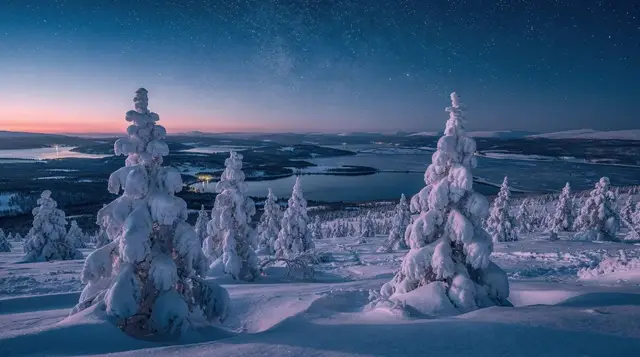
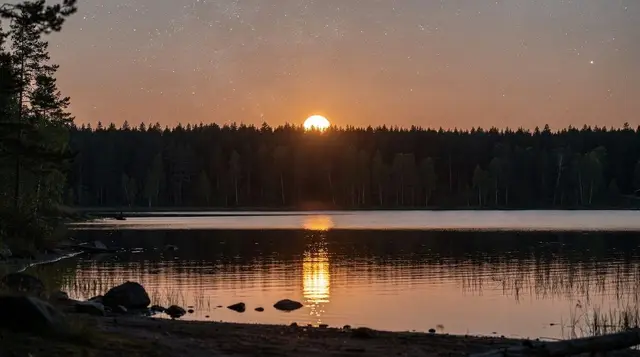
Muonio doesn’t try to be a resort, and that’s mostly the point. It’s a working village on the Muonio River, a bridge crossing to Sweden, and a stopping point on the long north-south road through western Lapland — not a destination with a brochure’s worth of its own attractions. Travellers end up here for three reasons: it’s dark enough for reliable aurora viewing, it’s a convenient dog sledding base without Levi’s crowds, and it sits almost exactly between Ylläs and Enontekiö/Hetta, which makes it a natural place to break a longer trip.
It’s worth being direct about what Muonio is not. It has no downhill ski resort, no lift network, no piste map. If a package tour lists “Muonio” alongside Ylläs skiing, the skiing itself happens in Äkäslompolo or Ylläsjärvi, roughly 45 minutes away — Muonio supplies transport or accommodation, not the mountain. Confusing the two is the single most common mistake people make when booking around this part of Finnish Lapland.
A crossroads village, not a resort
Muonio sits where road 79 (the road north towards Kilpisjärvi and Norway) meets the route between Kittilä and Enontekiö. That’s the entire logic of the place: everyone driving north through western Lapland passes through or near it. The village itself is small — a main street, a church, a handful of supermarkets and cafés, a school — with none of the purpose-built tourist infrastructure you’ll find in Levi or Ylläs. Accommodation is a mix of guesthouses, a few hotels and self-catering cabins rather than large resort complexes.
What Muonio does have is the Muonio River itself and, just across it, the bridge to Karesuando in Sweden. Crossing takes minutes and needs no paperwork inside the Schengen area — it’s a genuinely ordinary daily commute for people on both sides, not a border crossing in any dramatic sense. That bridge is also the reason Muonio makes sense as a base for anyone weighing up Finnish Lapland against its Swedish or Norwegian equivalents; if you want to compare what’s actually different about each side of the border, see our guide to Finnish, Swedish and Norwegian Lapland.
Getting to Muonio and getting around
There’s no train station in Muonio — the nearest rail access is via Kolari or Rovaniemi, followed by a bus or transfer. From Rovaniemi it’s around 250 km, roughly three hours by car on reasonable winter roads, longer if conditions are poor. Long-distance buses run the route, connecting Muonio to Kittilä, Rovaniemi and on to Enontekiö, but frequencies outside the main season are thin, and you should check timetables before relying on them for a same-day plan. For the general logistics of getting into the region in the first place, see how to get to Rovaniemi.
Once you’re in Muonio, a car changes what’s realistically possible. Without one, you’re dependent on bus schedules and whatever pickups a tour operator offers from the village — workable for a single booked activity, frustrating if you want to explore independently. If you’re driving yourself, winter tyres are mandatory and the road rules that apply across the region apply here too, including slowing for reindeer that wander onto the carriageway without warning; see driving in Lapland before you set off.
Why Muonio’s skies get so dark
Muonio’s reputation for aurora viewing comes down to something unglamorous: there simply isn’t much artificial light here. It’s a small population spread along a river valley, without the concentrated hotel and shop lighting of a resort centre like Levi or Äkäslompolo. Step a short distance from the main street and you’re already looking at a genuinely dark sky, without needing to drive 30–40 minutes out of town the way you often do from busier bases.
That’s a real practical advantage, but it doesn’t change the physics. An aurora still needs geomagnetic activity and, just as importantly, a clear sky — cloud cover is what actually decides most nights, in Muonio exactly as everywhere else in the region. Nobody can sell you a guaranteed sighting, only a good, dark vantage point and a reasonable chance.
For the fuller picture of how timing, weather and viewing spots interact, our northern lights hunting guide covers the mechanics in more depth. Locally bookable options include a campfire aurora watch out of Levi, a short drive from Muonio, for anyone who’d rather join a guided group with a heated shelter and hot drinks than stand alone by the river.
Dog sledding from a quieter base
Dog sledding is the other reason people choose Muonio over a resort town. Several kennels operate in the wider Kittilä–Muonio–Enontekiö area, running trips out into forest and fell that don’t depend on lift infrastructure the way skiing does, which is part of why Muonio can support this kind of activity without a resort attached. A guided visit to a husky farm near Levi is a straightforward, well-established option within reach of Muonio, combining kennel time with a sledding run; if you’d rather stay closer to Muonio itself, ask locally, since smaller operators here don’t always show up in the big booking platforms.
Whichever kennel you choose, ask the same honest questions everywhere: how big are the dog teams and how much rest do they get between runs, what happens to dogs once they’re too old to sled, and is the farm staffed and visited year-round rather than only during the winter rush. Our dog sledding guide sets out what a fair sledding operation looks like in more detail. If you want time with the dogs without the cold or the running, a nature walk with huskies near Levi is a gentler, warm-weather-friendly alternative.
The road to Sweden and Norway
Muonio’s position on the river makes it the natural last stop before the long, sparsely populated road north. Cross the bridge and you’re in Karesuando, Sweden’s northernmost village, in minutes. Continue on the Finnish side and the road climbs towards Kilpisjärvi and, eventually, the Norwegian coast — a serious undertaking, not a day trip, and well outside what’s realistic from Rovaniemi in a single day; see what isn’t a day trip from Rovaniemi for the full picture of distances that get routinely underestimated.
For travellers building a longer road trip rather than a day excursion, Muonio to Kilpisjärvi and beyond is a genuine route, not a detour, and a snowmobile tour on the scenic trail near Kilpisjärvi is a way to get out into that landscape without driving the whole distance yourself. Our six-day Lapland road trip itinerary sketches out how a stop in Muonio can sit inside a longer loop through the western fells rather than as an isolated destination.
Where Muonio fits between Ylläs and Enontekiö/Hetta
Most visitors reach Muonio as a link, not an endpoint. Coming from Ylläs, it’s around 45 minutes to an hour north depending on whether you start in Äkäslompolo or Ylläsjärvi, and it’s a sensible place to break the drive if you’re continuing towards Enontekiö/Hetta, which is another 70–90 minutes further on. That makes Muonio less a place to allocate several days to and more a one- or two-night stop that connects two more developed bases.
The Pallas-Yllästunturi National Park stretches close to this corridor too, and travellers moving between Ylläs and Muonio sometimes fold in a short walk or a stop at Kittilä on the way, since it sits roughly midway and has the region’s airport. None of this requires a car-free itinerary to work, but it does require a car — public transport along this corridor is infrequent enough that it shouldn’t be your only plan.
What Muonio is not: a ski resort
It bears repeating because the mistake is common: Muonio has no lift-served skiing. If your main goal is downhill runs, book your base in Ylläs, Levi, Pallastunturi or further afield, and treat Muonio as a stop on the way rather than the destination itself. What Muonio does offer instead is cross-country ski trails, dog sledding, snowmobile access to the surrounding forest and fell country, and — its genuine strength — dark skies for aurora viewing. Anyone wanting a broader look at fell activity in this corner of the region can also consider a snowmobile nature-watching tour based in Ylläs, a short drive south, which covers similar terrain with a wildlife-watching focus rather than a piste.
Practicalities: prices, stays, timing
Muonio is noticeably cheaper and quieter than Levi or Ylläs in peak weeks, partly because it has less purpose-built tourist accommodation and partly because it isn’t the primary draw for most visitors. Expect a daily budget in the region of EUR 100–220 per person once you include a guided activity, meals and a modest room, with the lower end realistic if you’re self-catering and sticking to a single half-day excursion.
| Aspect | What to expect in Muonio |
|---|---|
| Accommodation | Guesthouses, small hotels, self-catering cabins; limited compared to Levi/Ylläs |
| Getting around | Car strongly recommended; buses exist but run infrequently |
| Main activities | Dog sledding, aurora viewing, snowmobiling, cross-country trails |
| Not available locally | Downhill/alpine skiing — nearest lifts are in Ylläs or Levi |
| Typical stay length | 1–2 nights, usually as part of a longer route |
| Border crossing | Bridge to Karesuando, Sweden — no formalities, minutes away |
Because Muonio functions as a stopover, it’s worth deciding in advance whether you’re here for the dark skies specifically or simply passing through. If it’s the former, plan at least two nights so a single cloudy evening doesn’t cost you the whole visit — the same advice that applies anywhere in the region, covered in more detail in the aurora hunting guide.
Frequently asked questions about visiting Muonio
Is Muonio part of the Ylläs ski resort?
No. Muonio is a separate village roughly 45 km north of Ylläs’ two centres, Äkäslompolo and Ylläsjärvi. It has no downhill pistes of its own. It is sometimes bundled into the same excursion brochures and package tours as Ylläs, which is where the confusion comes from, but geographically and administratively it is its own municipality.
How far is Muonio from Rovaniemi, Levi and Ylläs?
Muonio is around 250 km, about 3 hours’ drive, from Rovaniemi. Kittilä and Levi are roughly an hour away, and Ylläs is around 45 minutes to an hour depending on which village you’re headed to. There’s no train station; road and long-distance bus are the only options.
Why is Muonio known for dark skies?
It’s a small, sparsely lit village away from the larger light domes of Levi and Ylläs, set among forest and fell rather than dense resort development. That combination of low population and minimal street lighting is what pulls aurora photographers here rather than any special geomagnetic advantage over the rest of the region.
Can you cross into Sweden from Muonio?
Yes. A bridge over the Muonio River connects the village directly to Karesuando in Sweden, a crossing used daily by locals and one that requires no formalities inside the Schengen area. It’s also the start of the long road north through Kilpisjärvi towards the Norwegian coast, if you’re continuing that far.
Is Muonio good for the northern lights?
The village itself is genuinely dark, which is the main variable travellers can control. Whether you actually see anything on a given night still comes down to clear skies and geomagnetic activity, exactly as anywhere else in Lapland — nobody can guarantee an aurora, only a good vantage point away from artificial light.
What is there to do in Muonio without a car?
Less than in Levi or Ylläs. Long-distance buses connect Muonio to Kittilä, Rovaniemi and Enontekiö, and some tour operators run pickups from the village for dog sledding or aurora trips, but day-to-day movement between attractions is much easier with a rental car.
Does Muonio have downhill skiing?
No meaningful downhill skiing. There’s no lift-served resort in Muonio itself; skiers head to Ylläs, Levi, Pallastunturi or further afield for pistes. Muonio’s outdoor activities lean towards dog sledding, cross-country trails and aurora viewing rather than alpine skiing.
Where does Muonio fit on a Lapland road trip?
It works well as a stopover between Ylläs and Enontekiö/Hetta, or as the last proper village before the long, empty stretch of road towards Kilpisjärvi and the Norwegian border. Many road-trippers break the journey here for a night rather than pushing straight through.