What Auttiköngäs actually is
Auttiköngäs is a set of rapids and a short waterfall on the Auttijoki, a tributary river that cuts through forest about 80 km north of Rovaniemi. There is no ticket booth, no gift shop and no café. What you get is a car park, a signed trail, a boardwalk section over the wetter ground, a footbridge across the river, and a viewpoint where the water drops through a narrow gorge of rounded granite. It is the kind of place that shows up on a map with a name and a small parking icon, and nothing else — which is exactly what it is.
That matters for expectations. This page sits next to guides for Ranua Wildlife Park and the Santa Claus Village, both of which run on opening hours, admission fees and staffed facilities. Auttiköngäs runs on none of that. It is closer in spirit to the Korouoma canyon or the Riisitunturi National Park than to anything commercial: a natural site you visit under Finland’s right to roam, on your own schedule, for as long as you like, at no cost.
Getting there from Rovaniemi
The drive is about 80 km and takes roughly an hour, heading north out of the city on minor roads through forest and small villages rather than a motorway. There is no public bus that runs anywhere near the trailhead, so this is a stop for travellers with a rental car — see renting a car and winter tyres if you have not booked one yet, and driving in Lapland for what to expect on rural roads, including reindeer that step out with no warning.
| From | Distance | Drive time |
|---|---|---|
| Rovaniemi city centre | ~80 km | ~1 hour |
| Ranua | ~40 km | ~40 minutes |
| Kemijärvi | ~60 km | ~50 minutes |
The car park at the trailhead is small and unstaffed. There is no fee to park and no barrier — just space for a handful of cars, which fills up on a sunny weekend during ruska season and is often empty on a weekday.
The falls and the trail
From the car park, a signed path leads through pine and birch forest to the river. Sections run on a raised boardwalk where the ground is boggy, which also keeps boots dry and protects the vegetation either side — a small but real point, since this land falls under the same everyman’s right rules that let you walk here freely in the first place. The main loop is short: allow 30 to 45 minutes of walking at an easy pace, more if you stop often to look at the water or take photographs.
The rapids themselves are not a single sheer drop. The Auttijoki narrows and steps down over several metres through a rocky channel, loudest and fullest in early summer when snowmelt is still feeding the river, calmer by late summer, and often at least partly frozen once real winter cold sets in. A footbridge crosses near the top of the falls, giving a view down into the gorge, and a viewpoint platform on the lower side looks back up at the water dropping through the rocks. Neither is fenced to modern safety standards — watch children and dogs near the edge, and be careful on wet rock.
Compared with the Karhunkierros trail or the frozen walls of Korouoma, Auttiköngäs is modest in scale. It does not need a full day or hiking boots rated for rough terrain. What it offers is proximity: a genuine forest river walk that fits inside a half-day loop from Rovaniemi, with no booking, no queue and no fixed hours to plan around.
Best time to visit
| Season | What to expect |
|---|---|
| Late June to August | Full green forest, the river running strong from snowmelt, mosquitoes near the water |
| Late August to early October | Ruska colours in the birches, cooler air, the best light of the year here |
| October to April | Snow on the trail, boardwalks can be icy or buried, access is uncertain |
Summer is the reliable season: the trail is dry underfoot, the boardwalk sections are clear, and the river is at its most active. The trade-off is mosquitoes in June and July near the water, which is worth planning around — see what to pack for three layers for general clothing advice, and bring repellent regardless of season advice for anywhere else.
Ruska: the standout window
The ruska — the turn of the birches and undergrowth to yellow, orange and red — runs roughly from late August to early October in this part of Lapland, peaking for about two to three weeks depending on the year’s weather. Auttiköngäs is a genuinely good ruska stop: the trail is short enough to walk in low autumn light without racing the clock, the river adds moving water to still forest colour, and the crowds that build up at better-known sites in December simply are not here. This is arguably the site’s best moment of the year, better than midsummer for photography and calmer than the handful of weekends when Rovaniemi fills with Christmas visitors.
If ruska colour is the goal, treat the date as a moving target rather than a fixed week — check conditions close to travel, since an early frost or a wet autumn can shift the peak by ten days either way in the wider Rovaniemi region.
Winter access: the honest picture
In deep winter, be realistic about what this site offers. The car park may or may not be ploughed depending on the season and maintenance schedule, the boardwalk sections can be buried or icy under snow, and the river is at least partly frozen, which changes the site from a waterfall walk into a quieter, whiter version of the same forest. None of that makes it a bad winter destination outright, but it is not equipped for it the way a groomed trail or a paid attraction would be: no one clears the path for you, no one tells you if it is safe that day, and there is no facility to warm up in afterwards.
If a short, forest walk near moving water in winter light appeals, treat it as an add-on for travellers already driving north with proper winter footwear and low expectations of a manicured trail, not as a stand-alone winter outing. Compare it honestly with a groomed option like cross-country skiing near Rovaniemi if snow reliability matters more to you than the specific location.
What there isn’t
Worth stating plainly, since brochures for this part of Lapland often blur the line between natural sites and commercial attractions. Auttiköngäs has no restaurant, no shop, no visitor centre, no staff, no opening hours in the commercial sense, and no entry fee. There is nothing to buy and nothing to book for the site itself.
That is different from Ranua Wildlife Park, which has a ticket price, a café and set hours, or SantaPark, which is a paid attraction with seasonal opening dates. Auttiköngäs is closer to a public footpath than to either, and it should be planned that way: bring your own food and water, use the toilet before you leave the last town, and do not expect mobile signal to be strong the whole way.
Combining Auttiköngäs with the rest of the loop
Because it sits roughly midway between Ranua and Kemijärvi, Auttiköngäs works best as one stop in a longer loop rather than a dedicated round trip from Rovaniemi. A common pattern is Rovaniemi to Ranua (wildlife park in the morning), on to Auttiköngäs for a walk and a packed lunch, then either back to Rovaniemi or on to Kemijärvi to close the loop on a different road. Each of those three places keeps its own identity — Ranua is a wildlife park with an admission fee, Kemijärvi is a small lakeside town, and Auttiköngäs is a free natural site — and none of them substitutes for the others.
See Ranua day trip and Kemi day trip for how those separate stops are usually planned, and how many days to spend around Rovaniemi if you are still deciding how much of this region fits your schedule. For a structured version of this route, the 6-day Lapland road trip itinerary sketches out a fuller loop.
Independent activity, and what to book instead
Auttiköngäs itself is not something you reserve. There is no ticket, no guide required and no GetYourGuide or Viator listing for the waterfall walk on its own — it is an everyman’s-right site you visit independently, on foot, at whatever pace suits you. That is by design and is not a gap to be filled.
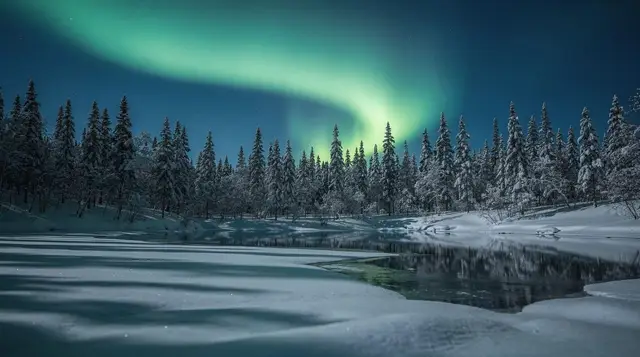
What does exist, and what is worth knowing about if you are driving this corridor after dark, is a small number of guided evening trips that use the Auttiköngäs area and the wider Ranua–Kemijärvi corridor as a base for aurora viewing rather than for the daytime walk.
The Auttiköngäs scenic night hike takes small groups out after dark to combine a short walk near the falls with watching the sky away from any town lighting, which suits travellers who would rather not navigate an unlit forest trail alone at night. For a longer daytime combination that pairs this area with the Korouoma canyon further along the same road, there is a guided hiking day trip covering both Korouoma and Auttiköngäs.
And if the aurora, rather than the waterfall, is the actual goal, Kemijärvi has its own dedicated aurora operators, including a small-group guided aurora hunt out of Kemijärvi that ranges across this same stretch of countryside chasing clear sky rather than sticking to one fixed spot.
None of these are required to see the falls in daylight — they are options for the after-dark version of the same corridor, and worth comparing against the general aurora hunting guide and free northern lights viewing spots before you decide whether a guided trip adds anything over driving yourself.
Practical logistics
Fuel up before leaving Rovaniemi or Ranua; there is no petrol station at the trailhead and none for a reasonable stretch either side of it. Mobile coverage thins out on the back roads, so download an offline map or confirm your route before setting off, and tell someone your plan if you are hiking alone outside peak season. Sturdy, waterproof footwear matters more here than technical hiking boots — the boardwalk sections are usually fine, but the ground off them can be wet even in summer, and any winter visit means proper grip.
There are no toilets or bins at the site: use facilities in Ranua or Kemijärvi beforehand, and carry out anything you bring in. Under Finland’s right of public access you can walk the area freely and pick berries in season, but you should not light fires outside a marked spot, cut live wood or disturb the riverbanks — the same rules that apply across Rovaniemi’s public land generally.
Auttiköngäs: questions worth asking before you go
Is there an entry fee for Auttiköngäs?
No. Auttiköngäs is an unstaffed natural site with free, unrestricted access under Finland’s right of public access. There is no ticket booth, no opening hours and nothing to pay for on site.
How long does the walk take?
Most visitors spend 30 to 45 minutes actually walking the main loop and bridge, and 1.5 to 3 hours total once you include the drive, a stop at the viewpoint and a packed lunch.
Can I visit Auttiköngäs in winter?
You can, but access is uncertain: the car park may not be ploughed, boardwalk sections can be snow-covered or icy, and the river is partly frozen. It suits travellers already equipped for winter conditions rather than a first-time winter outing on its own.
Is Auttiköngäs suitable for young children?
The main path and boardwalk are manageable for children who can walk 1 to 2 km comfortably, but the viewpoint and footbridge are not fenced to modern standards, so supervise children closely near the water and rocks.
Do I need a car to get there?
Effectively yes. There is no public bus service to the trailhead, so this stop only works for travellers with a rental car or a private driver.
Is Auttiköngäs the same as Korouoma canyon?
No. They are separate sites along a similar direction from Rovaniemi. Auttiköngäs is a short riverside falls walk; the Korouoma canyon is a longer, steeper gorge hike known for frozen waterfalls in winter. Some guided day trips combine both in one outing.
Can I book a guided tour specifically to Auttiköngäs?
Not as a stand-alone daytime ticketed tour, since the site itself is free and independent. What is bookable are evening aurora-focused trips that use the area, and combined hiking days that pair Auttiköngäs with Korouoma or other stops along the same road.
What should I bring?
Water, food (there is nowhere to buy either on site), sturdy footwear, insect repellent in summer, and layers appropriate to the season — see the three-layer packing guide for specifics.