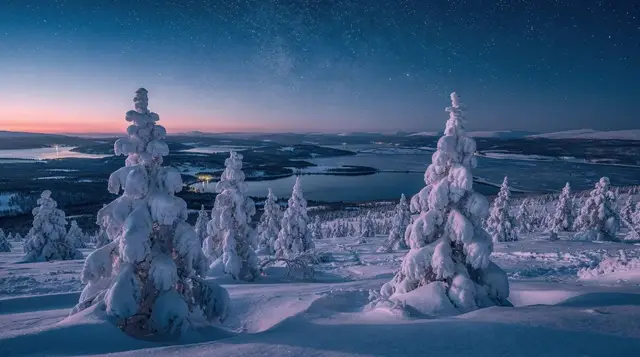
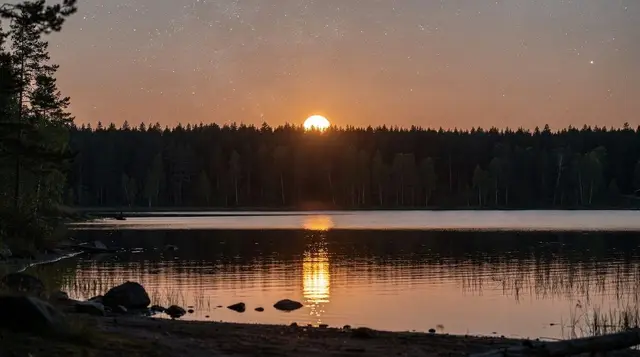
A small fell base, not a resort
Pallastunturi sits at the far end of Pallas-Yllästunturi National Park, roughly 195 km northwest of Rovaniemi and a further stretch beyond Ylläs and Levi. It is best understood as three things bolted together at the base of a fell range: a national park visitor centre, a compact family ski slope, and the trailhead for two of Finnish Lapland’s better-known hikes.
It is not a village. There’s no strip of restaurants, no lift queue, and nothing resembling the après-ski scene of Levi or the twin bases of Ylläs at Äkäslompolo and Ylläsjärvi. A handful of hotels, the visitor centre and the ski slope make up the entire settlement, ringed by open fell and birch forest.
That’s the point of coming here rather than staying at the larger resorts down the road. Pallastunturi trades scale for quiet: shorter lift lines because there are barely any lifts, a slope that a nervous beginner can manage without feeling watched, and fell trails where you’re more likely to meet a herd of reindeer than a crowd. If what you actually want is a big ski area, a wide choice of restaurants and organised evening activity, this isn’t it, and it’s worth being blunt about that before the drive.
Getting there from Rovaniemi
The drive from Rovaniemi runs north on road 79 through Kittilä, skirting Levi, then continues towards Muonio before turning off for the final stretch into the fells. Budget around 2h45 in normal winter driving conditions, longer if the road is snow-covered or if you stop, which most people do. There’s no direct rail option; the nearest useful station is Rovaniemi itself or, for onward connections, Kolari.
Public bus services running this far into the park are thin and seasonal, so renting a car is the practical way to get here — see the general notes on driving in Lapland for winter tyres, reindeer on the road and low-light driving, all of which apply on this route. Some visitors instead base themselves in Ylläs or Levi and treat Pallastunturi as a day trip, which cuts the return leg to roughly 45 minutes to an hour each way from either base — a far more realistic add-on than trying to reach it directly from Rovaniemi and back in one day.
There’s no meaningful public transport loop connecting Pallastunturi to Muonio or Kittilä for day-trippers without a car; if you’re relying on buses for the wider trip, this is one of the harder places on the itinerary to reach without your own wheels or a booked transfer.
The Pallastunturi Visitor Centre
The visitor centre is the obvious first stop and, for many people arriving without a hiking plan, the main reason to come at all. It’s the national park’s information point for this end of Pallas-Yllästunturi, with a small exhibition on the fells, the wildlife (elk, mountain hare, ptarmigan, and occasional wolverine sign in winter) and the geology of the range, plus trail maps and staff who know the current state of the paths — worth asking before setting out, since conditions above the tree line change fast. The exhibition space is free to enter; some optional materials and guided programmes are ticketed separately.
From the centre, a short marked path — well under a kilometre, an easy 15 to 20 minutes — climbs to Sammaltunturi, a low viewpoint that looks out over the fell range and, on a clear day, a genuinely long way across the surrounding wilderness. It’s an easy win for anyone who doesn’t want to commit to a full summit hike: no technical difficulty, minimal elevation gain, and a proper sense of the scale of the park without the multi-hour commitment. In winter, dress for wind here even if the forecast looks mild in the valley — the exposed viewpoint catches whatever weather is moving across the fells.
The ski area: small, and that’s the point
Pallastunturi’s ski slope is not a rival to Levi or Ylläs, and it makes no attempt to be. It’s a handful of lifts serving a short run of groomed pistes, aimed squarely at families, beginners and anyone who wants an hour or two on snow without the crowds. There’s no terrain park to speak of, no long black runs, and no queue management systems, because there’s rarely a queue. If your trip plan involves serious downhill mileage, do that at Levi or Ylläs and treat Pallastunturi as a change of pace, not a substitute.
| Pallastunturi | Ylläs | Levi | |
|---|---|---|---|
| Scale | Small, family-oriented slope | One of Finland’s largest ski areas, two village bases | Finland’s most-visited ski resort |
| Lifts | A handful | Dozens across two bases | Numerous, higher-capacity lifts |
| Atmosphere | Quiet, inside a national park | Two lively villages, wide dining choice | Busiest après-ski scene in Lapland |
| Cross-country skiing | Extensive marked trails from the visitor centre into the park | Extensive, linked network | Extensive |
| Best for | An unhurried half-day, beginners, families | A full ski holiday with variety | Full-scale resort holiday |
Where Pallastunturi does compete on its own terms is cross-country skiing. Marked trails run out from the visitor centre directly into the national park, tracing the base of the fells through birch and pine — see the general notes on cross-country skiing for technique and etiquette if you’re new to it. Because the trails start inside a national park rather than a resort, the scenery is consistently wild rather than resort-adjacent, which is the trade-off Pallastunturi is built around.
Hiking to Taivaskero
The main day hike from the visitor centre is the circular route to Taivaskero, the highest point in this part of the Pallas fell range at 807 m. The full loop runs roughly 3 to 4 km with a steady, occasionally steep climb onto open fell terrain above the tree line. Expect a few hours round trip at a comfortable pace, longer with stops for photographs, and treat it as a proper hike rather than a stroll: the top is exposed, wind picks up quickly, and the marked path can be hard to follow in low winter light or fresh snow.
Sturdy boots, layers and, outside midsummer, some form of traction are the minimum. The reward is a wide, uninterrupted view over the fell range and, on a good day, a long way into the national park beyond — see hiking trails around Rovaniemi and summer hiking in Lapland for what to expect on marked Lapland trails more generally, and Finland’s right to roam for what you can and can’t do off the marked path.
The Hetta-Pallas trail
Pallastunturi is also one end of the Hetta-Pallas trail, a roughly 55 to 60 km marked route across open fell country to Enontekiö-Hetta, usually walked over three to four days with wilderness huts and one fee-based hut along the way. It’s one of Finland’s classic long-distance treks and a serious undertaking: multiple days above the tree line, weather that can turn quickly, and no resupply options once you’ve set out.
This is not a walk to start without planning, proper gear and, ideally, some multi-day hiking experience already behind you. Most visitors reading this page are here for the day hike to Taivaskero or the short walk to Sammaltunturi, not the full trail — but if the Hetta-Pallas route is what brought you to Pallastunturi, the visitor centre is the place to check current hut status and trail conditions before you leave the car park.
The Hotel Pallas and staying overnight
A historic hotel building from 1938 sits close to the visitor centre and is one of the older purpose-built tourist hotels in Finnish Lapland, predating almost everything at Levi or Ylläs. Accommodation options at Pallastunturi itself are limited — a small cluster of hotel rooms and cabins rather than the wide range you’d find in Äkäslompolo or Levi — and they get booked up around school holidays and clear-sky forecasts in aurora season.
Dining is similarly limited to what the hotel and visitor centre café offer; there’s no village strip to wander for options. Many visitors instead base themselves in Ylläs, Kittilä or Levi, where the choice of beds and restaurants is far larger, and drive in for the day.
Northern lights at Pallastunturi
The same rules apply here as anywhere in this region: no clear sky, no aurora, regardless of how far you’ve driven. Pallastunturi’s advantage is genuinely dark surroundings with minimal light pollution once you’re away from the small cluster of buildings, and the Sammaltunturi viewpoint or the base of the ski slope both work as unobstructed vantage points if the forecast cooperates. If you’d rather have a guide manage the logistics — reading cloud cover, finding a gap in the weather, keeping a fire going while you wait — options based out of Ylläs cover this stretch of fell country too:
a photography-focused aurora tour out of Ylläs that’s aimed at people who want usable photos, not just a sighting, and a more relaxed campfire-based aurora watch from Levi for anyone who’d rather sit still with a hot drink and let the sky do the work.
Other ways to spend a day here
Snowmobiling is the other activity commonly booked around this fell range, usually departing from Ylläs or Kittilä rather than Pallastunturi itself, since neither the visitor centre nor the small ski base runs its own fleet.
A slower-paced snowmobile tour focused on the landscape suits anyone who wants to see more of the fell country than the marked hiking trails cover without committing to a summit climb, while a snowmobile safari up onto higher fell terrain covers ground that would otherwise take a full day on foot. If you’re travelling with children who’d rather meet dogs than climb a fell, a guided husky farm visit near Kittilä and Levi is a reasonable detour on the drive back towards Rovaniemi, and is covered in more detail alongside the welfare questions worth asking any kennel.
When to visit
Late February through April is the most reliable window: the ski slope is running, snow cover on the fells is at its most stable, and daylight hours are long enough for a full hike without a headtorch. December and January bring the shortest days and the least predictable weather for exposed summit walks.
Late August into September brings the ruska — the turning colours of the birch and fell vegetation — and is a genuinely good, quieter alternative for hiking Taivaskero before the snow arrives; see autumn ruska in Lapland for how the colour season plays out more broadly. Summer (June to August) suits the longer treks, including the approach to the Hetta-Pallas trail, but pack for midges near the lower forest sections.
Practical notes
Prices at Pallastunturi run lower than at Levi or Ylläs simply because there’s less on offer to spend money on: a day pass on the small slope, a coffee and meal at the hotel or visitor centre café, and fuel for the drive typically land in the 70-160 EUR per person range for a day trip, excluding any overnight stay. There’s no ATM or large supermarket on site, so arrive with cash or a working card and, if you’re planning a longer hike, food and water bought in Kittilä or Muonio on the way in.
Mobile signal thins out on the higher trail sections; tell someone your planned route if you’re heading beyond the short Sammaltunturi walk, and check hut and trail status at the visitor centre before setting out on anything longer. For planning a wider loop through this side of Lapland, the six-day Lapland road trip itinerary and the general guide to how many days you need around Rovaniemi both cover where a stop at Pallastunturi fits against Ylläs, Levi and the rest of the region.
Frequently asked questions about visiting Pallastunturi
Is Pallastunturi worth the drive from Rovaniemi?
If you want a fell walk, a quiet ski slope or the start of a proper trek, yes. If you want lift capacity, après-ski or a big choice of restaurants, Levi or Ylläs are the better use of a 2h45 drive.
How big is the Pallastunturi ski area?
Small and deliberately so. It’s a handful of lifts and a short run of groomed pistes aimed at families and beginners, not a destination for anyone chasing vertical drop or terrain variety.
Can I visit Pallastunturi without a car?
It’s difficult. Bus services from Rovaniemi to this specific fell are sparse and seasonal, and there’s no train link, so almost everyone arrives by rental car or an organised transfer from Levi or Ylläs.
What is the Pallastunturi Visitor Centre?
It’s the national park’s main information point for this end of Pallas-Yllästunturi, with exhibitions on the fells and their wildlife, trail maps and staff who know current snow and trail conditions. Entry to the exhibition area is free.
How hard is the walk to Taivaskero?
The circular route to Taivaskero’s summit from the visitor centre is around 3 to 4 km with a steady climb, manageable in a few hours for anyone with reasonable fitness and the right footwear, but it crosses open, exposed fell terrain.
What is the Hetta-Pallas trail?
A roughly 55 to 60 km marked trail across open fell country between Enontekiö-Hetta and Pallastunturi, usually walked over 3 to 4 days with wilderness huts and a fee hut along the way. It’s a serious multi-day trek, not a day hike.
Is Pallastunturi good for families?
The small ski slope and short, marked nature trails from the visitor centre suit families well. The longer summit and multi-day routes are for older children and adults with hiking experience.