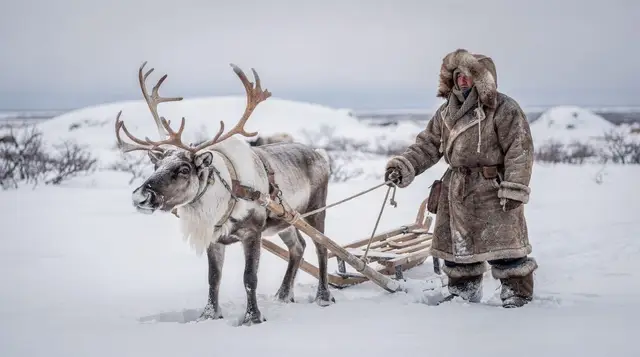
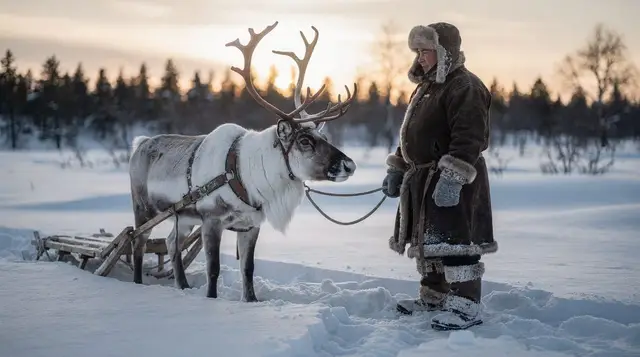
Reindeer herding: a real Sámi livelihood, not a show
Is reindeer herding a real Sámi tradition or a tourist show?
It is a genuine, legally regulated livelihood. Reindeer are privately owned and ear-marked by named herders, managed through paliskunta cooperatives, and gathered at seasonal round-ups using snowmobiles, quad bikes and increasingly drones. Not every herder is Sámi and not every Sámi person herds reindeer. The farm visits sold to tourists are a separate, commercial experience.
A cooperative system: what a paliskunta actually is
Most visitors meet reindeer at a farm gate, on a short sledge ride booked through a tour desk. That is a legitimate activity, covered in its own guide to reindeer sleigh rides, but it is not how reindeer are actually managed in Finland. Behind every free-ranging animal you see beside a Lapland road is a working livelihood, organised through a cooperative system called the paliskunta.
A paliskunta is a legally defined reindeer herding district. Finland’s official reindeer herding area, which covers roughly a third of the country’s land area and stretches well south of the Arctic Circle into parts of the Oulu region, is divided into around 54 of these districts.
Every owner of reindeer within a district’s boundaries must belong to its paliskunta, pay into its shared costs, and follow its decisions on grazing rotation, herd size ceilings and slaughter quotas. Each paliskunta elects a head, the poroisäntä, and holds an annual meeting where members set the rules for the coming year. This is closer to an agricultural cooperative than to a folk custom: budgets, elected officers, membership registers and government oversight all apply.
Crucially, paliskunta membership is not restricted to Sámi people across most of the herding area. Anyone who is a Finnish or EU citizen resident within a paliskunta’s district can, in principle, own reindeer and join it, and in the paliskunta districts south of the traditional Sámi homeland the great majority of members are ethnic Finns who have herded for generations without being Sámi themselves.
The exception sits in the far north: in the northernmost herding districts, broadly the area covering Utsjoki, Inari and Enontekiö, Finnish law reserves the right to own reindeer for Sámi people specifically, recognising reindeer husbandry there as a protected Indigenous livelihood rather than an open agricultural trade. Both things are true at once, and a fact sheet that only says “Sámi tradition” or only says “Finnish farming” is telling half the story.
Ear-marking: how a herder proves which reindeer is whose
With animals that roam freely across tens of kilometres of forest and fell, and that mix constantly with neighbouring owners’ herds, ownership cannot be tracked by fences. It is tracked by the ear.
Every reindeer calf is caught in its first summer, usually still following its mother, and given an ear mark: a specific combination of notches and cuts made in a set pattern on both ears. That pattern is registered to one named owner within the paliskunta and, in effect, functions as a signature that can be read at a distance with binoculars or up close by hand.
Marks are inherited within families and recorded in an official register, and a serious dispute over a mark, or an accusation of altering someone else’s mark, is treated as a real legal matter, not a minor disagreement. A herder can look across a mixed group of a few hundred animals gathered at a round-up and sort them by owner in minutes, purely from the ear pattern, which is the entire point of the system.
This is worth knowing before a farm visit, because most tourist reindeer wear a simple coloured collar rather than a traditional ear mark, precisely because they are a settled group kept for demonstration rather than part of an active free-ranging herd. If you want to understand what the mark on a working animal actually means, the fuller picture of Sámi identity and livelihoods sits in the guide to Sámi culture, and the reference collection at Siida in Inari displays real ear-mark registers alongside the tools used to read them.
The reindeer’s year: forest life and the seasonal round-up
For most of the year, herded reindeer are not handled at all. They are semi-domesticated: owned and marked, but left to range and feed themselves across open forest and fell, moving with the season in search of lichen, grass and, in summer, fresh shoots. A paliskunta’s grazing area is large by necessity, because reindeer need to move to find enough food, and a herder may not see a specific animal for months.
The calendar turns on a handful of fixed points. Calves are born in May and marked in summer, as described above. The main gathering, the round-up or erotus, happens in autumn, typically from October into November, when herders drive scattered groups toward large wooden or wire corrals, sometimes over several days on snowmobile or on foot with dogs. At the corral, animals are sorted by ear mark, counted against the paliskunta’s records, and separated: some are released back to the forest for another year, calves are marked if that was not already done, and a portion is selected for slaughter to supply the meat trade.
A second, smaller round-up can happen in winter if animals need supplementary feeding or further separation. Supplementary feeding itself has become more common in recent decades, because a specific winter hazard called ice-locking, where rain falls on snow and then refreezes into a hard shell, can seal off the lichen reindeer would normally dig through with their hooves, forcing herders to truck in hay and pellets to prevent starvation.
None of this matches the idea of an animal quietly living wild and untouched. It is a managed agricultural cycle with a fixed autumn peak, built around a genuinely free-ranging animal, which is a different thing from either a wild species or a fenced farm animal, and is worth holding in mind while driving the routes covered in driving in Lapland with reindeer and ice on the road, since the animals you meet at the roadside are working stock, not strays.
Snowmobiles, drones and GPS collars: a modern livelihood, not a frozen tradition
The clearest mistake a visitor can make is to picture reindeer herding as an activity that has not changed in a century. It has changed enormously, and continues to.
The snowmobile replaced skis and reindeer-drawn transport for most herding work decades ago and remains the standard way to locate, drive and check on a herd across snow-covered terrain far too large to cover on foot in a working day. Quad bikes and light trucks do the equivalent job in summer and autumn. Mobile phones coordinate round-ups between herders spread across a wide district.
More recently, drones have become a genuinely useful tool for spotting a herd’s location across open fell or forest canopy from the air, cutting down the hours once spent searching by snowmobile, and some paliskunta members now fit GPS collars to a portion of their animals to track general herd movement through the winter, particularly in years when ice-locking is a risk. None of this is exotic or unusual within the trade; it is standard working equipment, bought and maintained out of the same tight seasonal income as any other small agricultural business.
Skills that predate all of this, such as reading a herd’s movement by weather and terrain, or judging where lichen will still be reachable after a thaw-freeze cycle, remain central and are not replaced by the equipment. But presenting herding as a livelihood frozen in an earlier century, with the snowmobile and the drone edited out of the picture, misrepresents what it actually is: a contemporary rural business that uses whichever tools do the job, inside a legal framework that is itself under constant review as Finland balances herding against forestry, mining and renewable energy development on the same land.
Meat, hides and a supplementary tourism income
Reindeer husbandry is, first and foremost, a meat business. The animals selected at the autumn round-up are slaughtered under the same food safety regulation as any other livestock, and reindeer meat, most visibly as sautéed poronkäristys, is the backbone of the trade’s income, sold both within Finland and for export. Hides, antler and smaller quantities of handicraft material provide secondary income.
Tourism has become a real supplementary income for some paliskunta members and some individual herding families, but it sits alongside the meat trade rather than replacing it, and it is not evenly distributed: a family with land close to Rovaniemi, Levi or Inari, on a route tourists already drive, is in a very different position from one working a remote district further east. Where a genuine herding family does host visitors, it is usually a controlled, smaller-scale version of their normal work, such as a supervised feeding session or a short talk beside the corral, rather than the working round-up itself, which runs on the herd’s schedule and cannot be staged for a bus timetable.
A visit built around this kind of honest access, for example the Sodankylä reindeer herding experience or the Sámi reindeer herding family workshop near Inari, is worth more than a generic photo-stop precisely because it is framed around a working family’s actual routine rather than a script.
Real herding versus the farm visit sold to tourists
It helps to separate the two clearly, since brochures rarely do.
| Working paliskunta herding | Tourist reindeer farm | |
|---|---|---|
| Animals | Free-ranging most of the year, identified by ear mark | Small settled group, often collared, kept near the buildings |
| Purpose | Meat, hide and antler production, regulated by law | Visitor experience, income for the operator |
| Pace | Set by season and weather, not a timetable | Fixed slots to match a tour schedule |
| Who runs it | A registered paliskunta member, Sámi or not | May or may not be an active herder |
| What you see | Rarely open to visitors, no fixed viewing point | Feeding, short sledge rides, photos |
If the point of your visit is to understand herding itself rather than to take a ride, ask the operator directly whether they are an active paliskunta member and how the animals you will see fit into their working herd; a straightforward answer is a good sign. A short, supervised session such as reindeer feeding in Inari is honest about being exactly that: feeding a settled group, not filming a round-up.
For the sledge-ride side of things, including how the age limits and pace compare to a husky sled, the reindeer versus husky comparison and the reindeer farm driving licence explainer cover what is actually on offer, and it is worth knowing before you book that a farm’s own souvenir stand is exactly the kind of place where the advice on Sámi souvenirs to avoid becomes relevant.
Where the two stories genuinely meet, and where they do not
It is fair to say that reindeer herding is historically and culturally tied to Sámi life in the northernmost herding districts, where the right to own reindeer is legally reserved for Sámi people and where herding sits alongside other protected livelihoods discussed in the wider guide to Sámi culture. It is not fair to extend that link across the whole country, where a Finnish farming family near Sodankylä can have herded the same district for five generations without being Sámi, and where plenty of Sámi people in towns like Inari work as teachers, fishers, artists or in tourism itself rather than herding at all.
Reindeer herding is one Sámi livelihood, protected by name in the far north, practised more broadly by Finns and Sámi alike across the rest of the herding area, and increasingly squeezed by the same pressures facing rural livelihoods everywhere: predator losses, competing land use and a changing climate. None of that fits neatly onto a souvenir postcard, which is exactly why it is worth explaining properly rather than folding it into a generic “meet the reindeer” activity listing under things to do with reindeer and Sámi culture.
If wildlife and land use interest you beyond reindeer specifically, the broader picture of what shares this same forest, from elk to golden eagles, is covered in wildlife watching in Lapland, and the legal right that lets anyone walk, forage and camp on this same land without owning it is explained in the guide to everyman’s right.
For a longer, more personal look at where the tourist framing of Sámi life runs into its limits, the essay on the Sámi question tourists don’t ask is worth the extra ten minutes, and the regional overview of Finnish Lapland sets the herding area in its full geographic context.
Reindeer herding livelihood: frequently asked questions
What is a paliskunta?
A paliskunta is a reindeer herding cooperative, a legal district that manages grazing, round-ups and herd numbers within a fixed area. Finland’s reindeer herding area is divided into around 54 of them, each with an elected head, and every reindeer owner in that district must belong to it.
Are all reindeer herders in Finland Sámi?
No. The Finnish reindeer herding area covers roughly a third of the country, far beyond the traditionally Sámi regions, and most paliskunta members across that wider area are ethnic Finns. Only in the northernmost herding districts does Finnish law reserve reindeer ownership specifically for Sámi people.
Are all Sámi people reindeer herders?
No. Reindeer herding is one Sámi livelihood among several, alongside fishing, handicraft, and modern professions, and most Sámi people in Finland today do not herd reindeer for a living. Treating the two as interchangeable is a common visitor mistake.
How do herders know which reindeer belongs to whom?
Every calf is given a personal ear mark, a specific pattern of notches and cuts, before it leaves its mother. The pattern is registered to one owner within the paliskunta, and it is how ownership is identified from a distance in a mixed free-ranging herd.
Why do reindeer wander onto the road if they are owned?
Reindeer here are semi-domesticated, not fenced livestock. Owners let them range freely across forest and fell for most of the year and gather them for marking, separation and slaughter at set points in the calendar, which is why they turn up on roads at any time of day or night.
Do herders still work the traditional way, on skis with a lasso?
Some of that survives in specific tasks, but the everyday tools are a snowmobile, a quad bike or a truck, a mobile phone, and increasingly a drone or a GPS collar to locate a herd scattered across a large forest area. It is a working livelihood that has adopted modern equipment, not a fixed re-enactment.
Can visitors watch a genuine round-up?
Rarely, and only by arrangement, since a round-up is working time on a tight schedule, not a performance. What is sold to tourists is usually a farm visit with a smaller, settled group of reindeer kept closer to the buildings for feeding and short sledge rides.
Is reindeer herding under pressure?
Yes, from several directions at once: predator losses to wolverine, bear, lynx and eagle, competing land use from forestry, mining and wind power, warmer winters that turn snow into ice layers reindeer cannot dig through, and traffic collisions on Lapland’s roads.
Reindeer farms & sleigh rides on GetYourGuide
Verified deep-linked GetYourGuide tours. Book through these links and we earn a small commission at no cost to you.
GetYourGuide does not provide a product photo for this activity — the image shows the meeting point, photographed by us.