The Sami question tourists don't ask
I got it wrong for years before anyone corrected me. I’d say “Lapp” the way I’d say “Parisian” or “Roman” — a regional label, I assumed, nothing more. It took a very patient guide outside Inari to tell me, without much drama, that the word I kept using is one that many of the people it describes consider a slur.
That’s the whole of it, really. Say Sami, not “Lapp” or “Laplander.” Lapland is fine as the name of the region — it’s a place, and nobody objects to that. But the people who belong to that place, who herd reindeer there, who sit in their own parliament in Sajos, who speak Sami languages that predate the Finnish state by a long way, are Sami. Not Lapps. The word “Lapp” has a documented history of being used by outsiders to mean something closer to “backward” than “northern,” and it was rarely, if ever, a name the Sami chose for themselves. Once you know that, using it starts to feel careless rather than neutral.
I’m not writing this as someone who’s always got it right. I hadn’t, until fairly recently, and I doubt I’m alone. Most visitors arrive in Rovaniemi having absorbed “Lapland” and “Lapp” as a matching pair from old geography books, Christmas marketing and half-remembered cartoons, with no signal anywhere that one half of that pair is a problem. Nobody sets out to be careless about it. The information just isn’t handed to you at the border, and a lot of the commercial machinery around this town has no incentive to hand it to you either.
Where the discomfort actually lives
The place I felt it most sharply wasn’t a conversation. It was a shop window near Santa Claus Village, on one of the visits where I went looking for what the site actually is beyond the postmark and the photo booth. Alongside genuinely made Finnish handicraft, there were racks of what were sold, more or less, as “Lapp costumes” — bright trims, plastic-look “reindeer” hats, the sort of thing built to be worn for twenty minutes and a photograph. Nothing on the label said it was connected to any actual Sami maker or community, and nothing needed to, because the buyer wasn’t expected to ask.
The gákti — the real, traditional Sami dress — isn’t generic. Its colours, bands and cut identify the wearer’s family and region; it’s closer to a signature than to a costume. Seeing a flattened, decorative version of it sold as a tourist prop, a few kilometres from where families genuinely herd reindeer for a living, is the kind of thing that’s easy to walk past and hard to unsee once someone’s pointed it out to you.
I’ve since read enough to understand this is a long-running and genuine grievance among Sami people, not a fringe complaint invented for a travel blog. I don’t think the shopkeepers are cartoon villains — the demand exists because visitors want a souvenir that says “I was here, and it felt like the north.” I just don’t think that need has to be met this particular way, and once you’ve seen the difference it’s hard not to notice it everywhere afterwards.
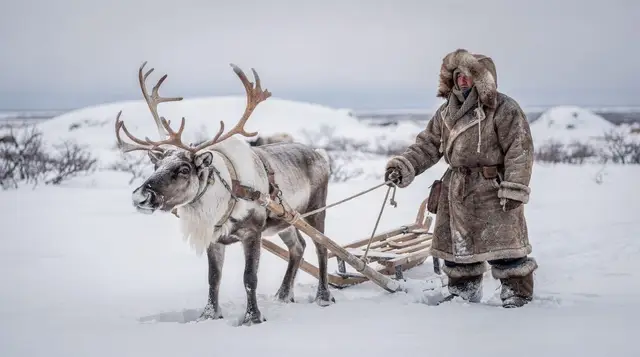
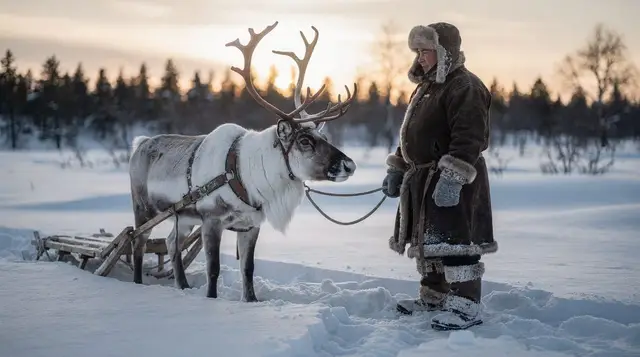
None of this means avoid reindeer experiences altogether, or treat every operator with suspicion. Reindeer herding is a real Sami livelihood, organised through herding cooperatives, not a folk memory kept alive for visitors. A short, honestly-run husky and reindeer sledding outing near Rovaniemi is not the same thing as a person in a rented gákti posing for tips. The difference is usually in who’s running it, whether reindeer herding is presented as work rather than performance, and whether anyone can tell you where the animals and the operation actually come from.
The place that does this properly
If you want the real version of this — not a corrective lecture, just the actual history and culture told by people with a stake in it — the reference point is the Siida museum in Inari, about 330 km north of Rovaniemi. I’m not going to turn this into a visiting guide; that’s not what this piece is for, and the museum deserves its own proper write-up rather than a paragraph tacked onto an apology. What I’ll say is that it exists, it was rebuilt with real Sami involvement rather than assembled for tourists from the outside, and it’s the place I wish I’d gone before I went anywhere near a souvenir rack.
It’s a long way to travel for one museum, so it makes far more sense folded into a longer trip north — maybe alongside Ivalo or Lake Inari — than as a special detour from Rovaniemi itself. If your itinerary doesn’t stretch that far this time, that’s fine. The minimum version of getting this right doesn’t require the drive: it’s just choosing your words correctly and being a little more sceptical of what’s sold to you as “authentic” in the meantime.
I bring this up on a trip that’s otherwise full of aurora chases and reindeer bells not to spoil the mood, and honestly not to make anyone feel bad — I’ve made the mistakes I’m describing, and nobody scolded me for it. It just seems worth saying plainly, the way I wish someone had said it to me on my first visit, before I’d spent a couple of years getting it wrong. You can still book a night out chasing the northern lights, still take the kids to see the reindeer, still enjoy Rovaniemi for exactly what it is.
If your route takes you as far as Levi, the fell summit tour that includes a Samiland stop is worth going into with the same question in mind: who’s actually presenting this, and is it their culture to present. Just get the one word right, and look a little harder at what’s behind the next “Lapp” souvenir before it goes in your bag. It costs nothing and it matters more than it looks like it should.
If you want to read further before you travel, the longer explainer on Sami culture, the note on what to avoid buying, and the piece on Sami reindeer herding as a livelihood go into all of this properly. This was just the version I needed someone to tell me first.
Reindeer farms & sleigh rides on GetYourGuide
Verified deep-linked GetYourGuide tours. Book through these links and we earn a small commission at no cost to you.
GetYourGuide does not provide a product photo for this activity — the image shows the meeting point, photographed by us.